
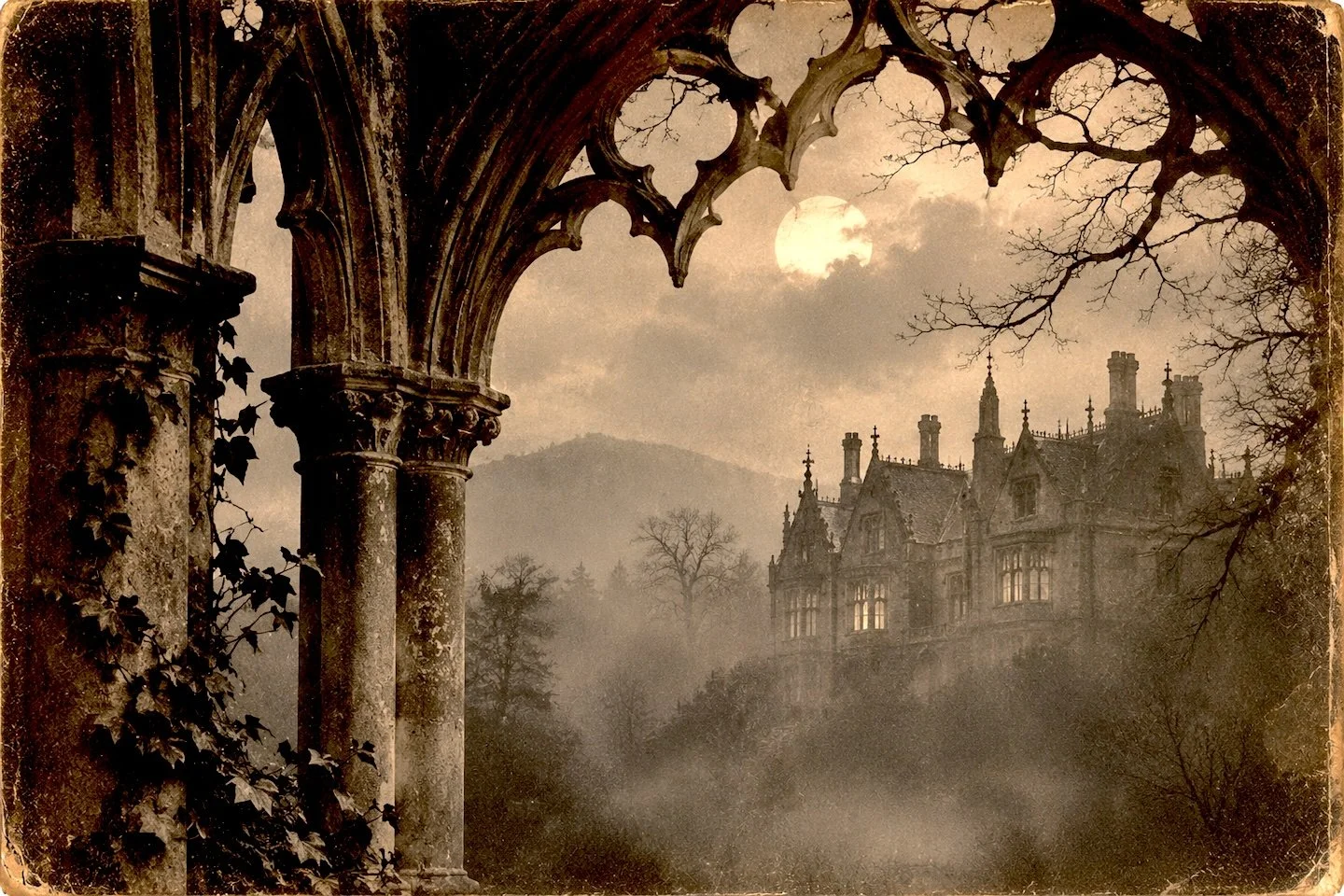
I often visit places that give me ideas and inspiration for my writing. Churches, castles museums and art galleries are especially fertile sources of inspiration. Earlier this week, whilst wandering around Bangor Cathedral, I found myself thinking about the Victorian fascination with the medieval world.
Incredibly, there has been a place of worship on the Bangor site since Deiniol founded a monastic cell in AD525. This is one of the oldest ecclesiastical sites in Great Britain.
Churches have been built, destroyed and rebuilt on this site ever since. The building we see today was largely developed in the nineteenth century. It incorporated features from the fourteenth century and it made me wonder about why the Victorians were so intent on constructing the future yet seemingly so preoccupied with the past.
What was it about the medieval world that appealed to their imagination, and what might that fascination tell us about the age itself?
Few periods in British history witnessed such profound change as the sixty-four years of Victoria’s reign. When she came to the throne in 1837, the railway network was still in its infancy. By the time of her death in 1901, Britain had been transformed by railways, steamships, the electric telegraph, the telephone and the emergence of electric lighting. Photography had given us the means to preserve moments in time, sound could be recorded and reproduced, and the first moving pictures had appeared.
Industrialisation transformed not only the physical landscape but also the structure of society. Towns became cities, rural populations migrated in search of employment, and an increasingly influential industrial and commercial middle class began to challenge the traditional centres of wealth and power.
Education became more widely accessible, literacy increased, organised labour gained influence, and successive parliamentary reforms extended political participation. Women began to challenge the social, educational and legal restrictions that had governed their lives.
Yet alongside this extraordinary progress existed poverty, exploitation, overcrowding and disease. Britain’s expanding empire generated enormous wealth and influence, but its professed ideals of civilisation and moral superiority frequently sat uneasily alongside the means by which that power was acquired and maintained.
Perhaps more unsettling than the physical and social transformation of the nineteenth century was the change in our understanding of ourselves.
Geological discoveries challenged traditional accounts of the age of the Earth, while the publication of Charles Darwin’s On the Origin of Species in 1859 called into question long-established beliefs about creation and humanity’s place within it.
Towards the latter part of the century, psychology began to emerge as a scientific discipline in its own right. The study of consciousness, memory, dreams, suggestion and unconscious mental processes raised uncomfortable questions about the extent to which we understood, or indeed controlled, our own behaviour.
The Victorians were acquiring an unprecedented understanding of the world around them whilst discovering how little they understood about the world within.
The attraction of the past
Against this background of extraordinary change, the Gothic Revival gathered momentum. Although its origins predated the Victorian period, it found particularly fertile ground during the nineteenth century.
Architects such as Augustus Pugin and George Gilbert Scott (who incidentally was involved in the redesign of Bangor Cathedral) looked towards the medieval world for inspiration. For Pugin, Gothic architecture was not simply an aesthetic preference but an expression of religious belief and moral values. Medieval craftsmanship, with its perceived integrity and spiritual purpose, offered an alternative to some of the consequences of industrialisation and mass production.
Perhaps the most striking example of this apparent contradiction is the Palace of Westminster. At the heart of a nation undergoing unprecedented industrial and technological advancement, the Victorians constructed a seat of government whose architectural language belonged to the medieval world.
I wonder whether part of the attraction lay in a desire for continuity, for something recognisable and enduring in a society where so much was changing. Of course, the medieval world to which the Victorians looked was often an idealised version of the past, shaped as much by their own aspirations as by historical reality.
We are perhaps no less inclined to romanticise the past when we find the present difficult to comprehend.
The darker imagination
The Gothic imagination was equally evident in Victorian literature, although here it often served a rather different purpose.
In Emily Brontë’s Wuthering Heights (1847), we encounter obsession, isolation, cruelty and the destructive consequences of human passion.
In Robert Louis Stevenson’s Strange Case of Dr Jekyll and Mr Hyde (1886), the respectable exterior of Victorian society conceals something altogether more disturbing.
Oscar Wilde explored similar territory in The Picture of Dorian Gray (1890), examining the relationship between outward appearance and moral corruption.
Then, in 1897, came Bram Stoker’s Dracula, a novel in which ancient superstition encounters the modern world of scientific investigation, medical knowledge, railways, typewriters and phonographs.
However, few writers observed the inequalities of life in Victorian England more perceptively than Charles Dickens. His own childhood experience of poverty, working in a blacking factory at the age of twelve whilst his father was imprisoned for debt, undoubtedly informed much of his subsequent writing.
In Oliver Twist (1837–39), he exposed the brutality of the workhouse system and the vulnerability of children born into poverty. In Nicholas Nickleby (1838–39), he drew attention to the exploitation and mistreatment of children, whilst in Bleak House (1852–53) he questioned the workings of a legal system seemingly indifferent to the human suffering it perpetuated.
Perhaps nowhere was his criticism of industrial society more explicit than in Hard Times (1854), in which he explored the consequences of a society increasingly concerned with economic efficiency, productivity and the accumulation of wealth, often at the expense of human dignity.
Running through much of Dickens's writing was a question that remains as relevant today as it was in the middle of the nineteenth century. Does material progress necessarily translate into social and moral progress?
What interests me about these works is the extent to which their darkness emerges from the very society that celebrated reason, respectability and progress.
The Gothic provided a means of exploring those aspects of human nature that were difficult to reconcile with the prevailing ideals of the age. Beneath the veneer of civilisation lay fears, desires and impulses that scientific advancement and social convention had done little to extinguish.
It is also curious that an age increasingly characterised by scientific enquiry witnessed a flourishing interest in spiritualism, séances, the occult and psychical research. The boundaries between science, religion and superstition were perhaps considerably less distinct than we might imagine from our twenty-first-century perspective.
The acquisition of knowledge did not necessarily bring certainty. In some respects, it created further uncertainty.
Writing within the Victorian world
In creating the character of Professor Owain Morgan, a late-Victorian Professor of Mental and Moral Science, I have become increasingly interested in these contradictions.
Owain inhabits a world in which the study of human behaviour is beginning to move beyond the traditional boundaries of philosophy and theology. He is interested in the relationship between reason, conscience and the forces that influence human conduct, yet he lives within a society in which religious belief continues to shape the lives and moral judgements of those around him.
His own loss of faith following the death of his wife and child adds another dimension to that relationship. The questions he encounters as a scholar are not entirely separate from those he has had to confront in his personal life.
I had not consciously set out to write Gothic fiction, but in developing his world I have found myself drawn to many of the preoccupations of the Victorian Gothic imagination. The influence of the past upon the present, the disparity between outward respectability and private conduct, the nature of belief, and our capacity to deceive ourselves all seem to find their way into my writing.
Living in North Wales perhaps makes some of these connections more apparent. Here, the remains of medieval castles, ancient burial chambers, churches and chapels exist alongside the industrial landscapes of the nineteenth century. Within a relatively small geographical area, we can encounter the physical evidence of several thousand years of human belief, endeavour and ambition.
The past is rarely far removed from the present.
The anxiety of progress
I find myself wondering whether some of the fascination that Victorian Gothic holds for us today lies in the parallels between that age and our own.
We, too, are experiencing extraordinary technological change. Artificial intelligence, advances in genetics and the increasingly pervasive influence of digital technology are challenging established ideas about work, creativity, identity and even what it means to be human.
Like the Victorians, we are acquiring new capabilities at a remarkable rate, whilst struggling to understand their wider social, psychological and moral consequences.
Victorian Gothic was, of course, far more than a response to the anxieties of progress, but I wonder whether some of its enduring appeal lies in its willingness to explore the uncertainties that accompanied that progress.
We tend to think of progress in terms of what humanity has learned and what it has become capable of achieving. Perhaps we should devote rather more thought to what it has yet to understand about itself.