
A University That Never Existed
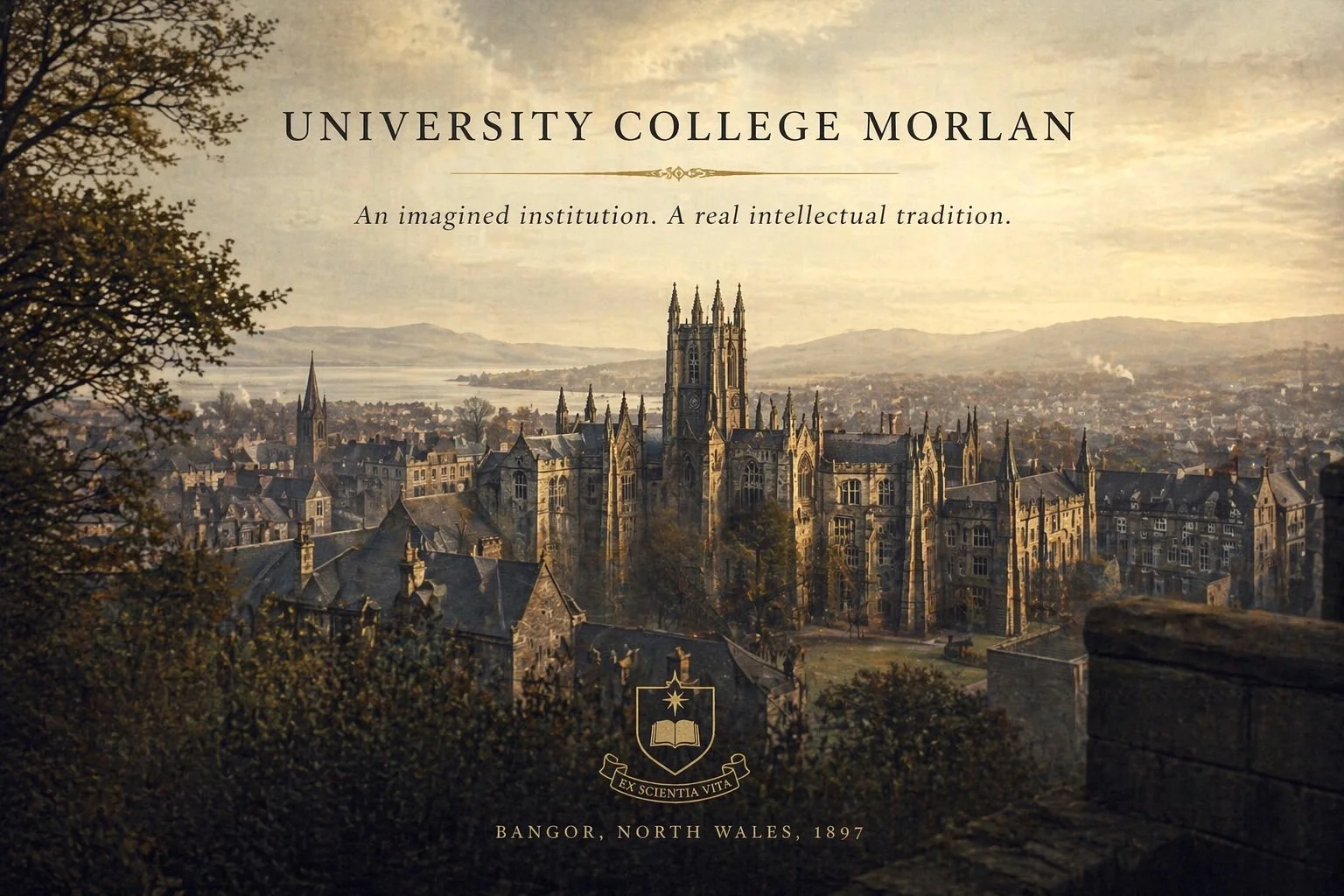
The intellectual home of Professor Owain Morgan
There is something slightly self-indulgent about writing the history of a place that never formally existed. It gives free rein to the imagination, and allows the creation of a world I might have wished to inhabit myself.
University College Morlan has no charter, no surviving records, no physical presence that can be visited or verified. And yet, in another sense, it feels entirely real.
That is not accidental.
I did not invent Morlan to escape history, but to work more closely within it. My aim was not to create something fantastical, but something plausible—something that might have stood alongside the institutions that did emerge in nineteenth-century Wales, shaped by the same intellectual, religious, and social currents.
In the later decades of the nineteenth century, higher education in Wales was beginning to take form in new ways. Colleges were being established, often with strong ties to religion, civic life, and the emerging idea of national identity. These institutions did not simply teach; they reflected the tensions of their time—between faith and reason, tradition and reform, authority and inquiry.
Morlan belongs to that moment.
It is not a reconstruction of any one institution, but a way of drawing together the influences of places I know into a single, coherent setting. The fact that I have sited it in Bangor, close to where I live, will no doubt invite comparison.
The late Victorian period was also a time in which ideas about the human mind were beginning to shift. Moral philosophy, theology, and the early study of psychology did not exist as separate disciplines in the way they do now. They overlapped, often uneasily, and it was within that overlap that questions of belief, habit, responsibility, and perception were explored.
It seemed to me that this intellectual world required a setting.
A real institution, bound by its own history and constraints, would always carry with it certain fixed meanings. By imagining Morlan, it became possible to bring these elements into focus without being confined by the exact record of any one place.
Fiction, in this sense, allows a different kind of truth to emerge.
It allows us to ask not only what happened, but what might have been thought, what tensions were felt, and how certain ways of seeing the world were formed.
Morlan exists in that space.
It is a place where ideas are not simply taught, but tested; where the structures of authority are present, but not always stable; where belief and habit shape conduct in ways that are not always visible, even to those who hold them.
From such a place, a mind like Owain Morgan’s becomes possible.
That, ultimately, is the purpose of Morlan:
not to describe an institution,
but to understand the conditions from which a way of thinking might emerge.
From the research behind The Casebook of Owain Morgan