
William Blake and the Inner World
In The Silence of the White Shadow, Blake’s work shapes the thinking of Owain Morgan. But the ideas behind it are rooted in something far older, and far less easily explained.
William Blake was not an incidental influence in The Silence of the White Shadow. His work helped shape the intellectual and emotional world of Owain Morgan.
That connection emerged during my research, particularly through reading Peter Ackroyd’s excellent biography of Blake. What I found there was not simply an artist or poet, but a way of thinking about the human mind that felt immediately relevant to the world I was creating.
Blake was, in many respects, ahead of his time; a visionary, engraver, painter, poet, and a thinker who resisted the limits of convention.
It was those qualities that first drew me to him and led me to see him as a powerful influence on my fictional Professor, Owain Morgan.
Blake was born in London in 1757, into a world that was beginning, quietly at first, to change.
The Industrial Revolution had not yet reached its full force, but its direction was already set. Systems were emerging, economic, social, and intellectual, that sought to organise, measure, and control. Reason was ascendant, order was prized, and progress increasingly defined in material terms.
Blake stood apart from all of this.
Not in the manner of a reformer or a political agitator, but as something more elusive, a man who seemed to inhabit a different layer of reality altogether.
He was, by trade, an engraver. This mattered more than is often acknowledged. Engraving is slow, exacting work. It requires patience, precision, and an eye for detail. Blake possessed all of these qualities.
But alongside them, he claimed something else.
He saw visions.
Not metaphorically, but literally: angels in trees, figures moving through space, a world alive with meaning that others could not perceive. Whether one takes these as spiritual experiences, imaginative expressions, or something in between is almost beside the point.
What matters is that Blake treated them as real.
Against ‘Single Vision’
Blake’s objection was not to reason itself, but to its dominance.
He believed that when reason becomes the only lens through which the world is viewed, something essential is lost. He described this narrowing as ‘single vision’, a flattening of experience into something manageable, but incomplete.
In its place, he proposed something far more difficult to grasp:
that truth is not singular, but layered
that contradiction is not a flaw, but a condition of being human
that imagination is not an escape from reality, but a means of perceiving it more fully
This is the foundation of The Marriage of Heaven and Hell.
The title itself is a provocation. Heaven and Hell are not reconciled in the sense of being made harmonious. They remain in tension, and that tension is necessary. Energy and restraint, impulse and structure, desire and control all exist because of one another.
Remove one, and the whole system collapses.
The Human Mind as a Landscape
What makes Blake feel so modern is his instinctive understanding that human behaviour cannot be reduced to simple categories.
Long before psychology gave us its language, Blake was exploring:
the fragmentation of identity
the conflict between opposing impulses
the way belief shapes perception
the danger of mistaking one’s own worldview for objective truth
His figures, whether in Songs of Innocence and of Experience or in his later, more mythological works, are rarely stable. They shift, fracture, expand, and collapse. They inhabit states of mind rather than fixed identities.
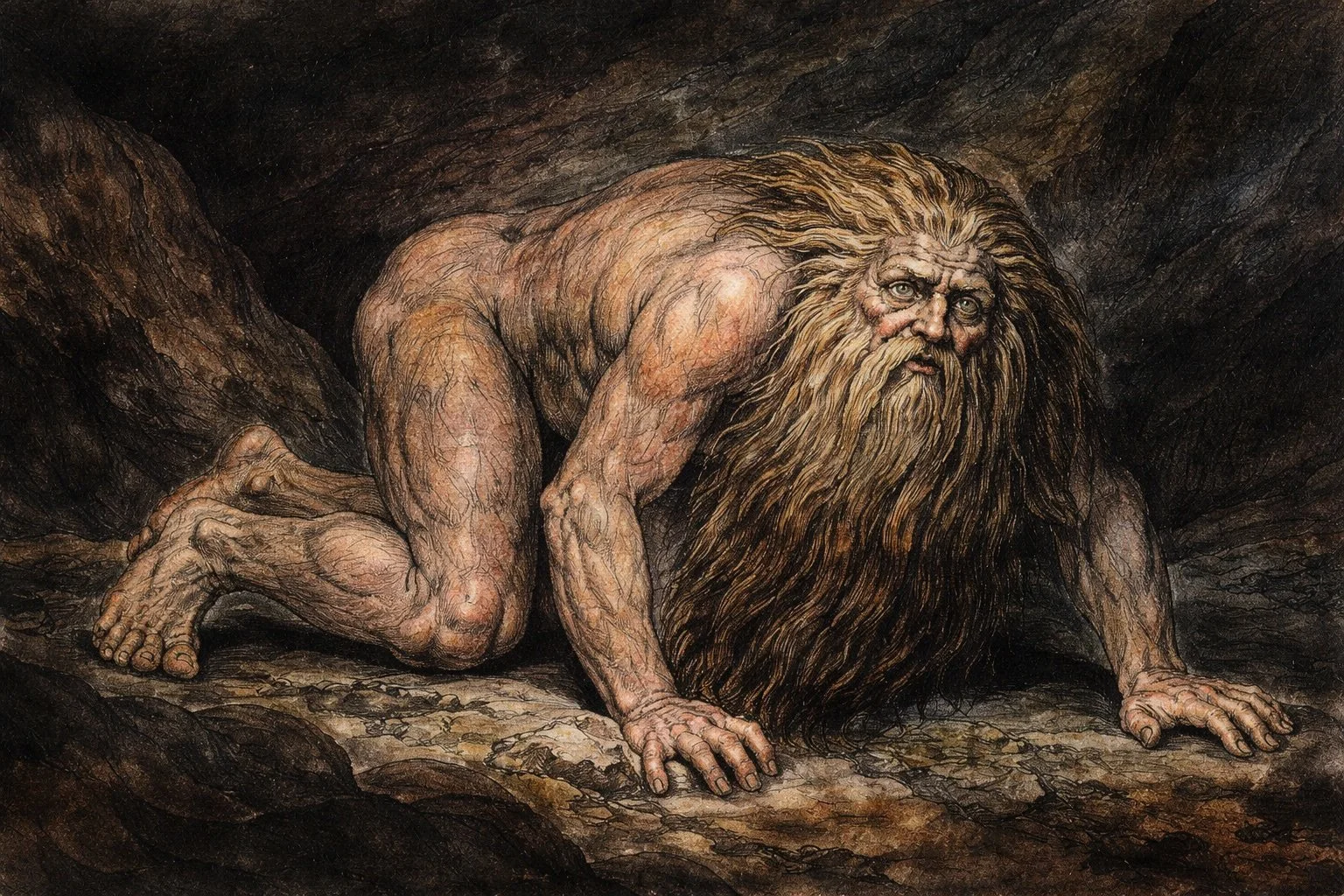
Nebuchadnezzar, the image that first drew my attention, is perhaps the clearest example of this.
Nebuchadnezzar was a king of ancient Babylon, whose story is told in the Book of Daniel. In that account, pride gives way to collapse. He loses not only his kingdom, but his sense of himself, and lives like an animal until his reason returns.
It is not simply a king brought low.
It is a mind unravelling.
There is something deeply unsettling about the image.
The body is still recognisably human, but the posture is not. The limbs are held in tension, the fingers splayed against the ground as though searching for a stability that is no longer there. The eyes are wide and alert, but not with clarity. They suggest a mind that remains active, but no longer anchored.
This is not sleep, nor rest, nor even madness in the theatrical sense.
It is something quieter, and perhaps more troubling.
A loss of orientation.
Blake does not show us the moment of downfall. He shows us what comes after, when the structures that once held a person in place have already given way.
There is no crown, no symbol of former power, no trace of the world that once defined this figure. Only the man remains, and even that is uncertain.
What we are looking at is not simply punishment.
It is exposure.
The stripping away of identity, until what remains is something more elemental, more instinctive, and far less easily understood.
In this sense, Nebuchadnezzar is not just a biblical image.
It is a psychological one.
It asks a question that Blake returns to again and again:
What becomes of a person when the framework through which they understand themselves begins to collapse?
Why Blake Endures
Like many thinkers and artists who break the mould, Blake was not widely celebrated in his lifetime.
He was, if anything, regarded as eccentric, even obscure. His methods were unusual, his ideas difficult, and his work often self-published in forms that resisted easy distribution.
And yet, over time, his influence has grown rather than diminished.
Why?
Because Blake speaks to something that remains unresolved.
We continue to live in a world that values clarity, measurement, and control. These things have brought undeniable progress. But they have not resolved the deeper question of what it means to be human.
We are still, as Blake understood, divided.
Capable of reason, yet driven by forces we do not fully comprehend. Seeking order, yet drawn towards chaos. Constructing identities that feel stable, even as they shift beneath us.
Blake does not offer solutions.
He offers recognition.
Blake and Owain Morgan
It becomes clear why William Blake held such significance for Owain Morgan.
A man trained in logic, philosophy, and emerging psychological thought, Owain operates in a world that increasingly seeks explanation through reason. Evidence, structure, and method are his tools.
And yet, his work repeatedly brings him into contact with something less easily contained.
Human behaviour resists neat explanation. Motives are rarely singular. People act from inner worlds that are coherent to them, even when they appear contradictory from the outside.
Blake understood this instinctively.
In The Silence of the White Shadow, Blake’s The Marriage of Heaven and Hell travelled with Owain to Edinburgh, where it became a quiet source of strength during his bereavement. In Blake’s union of vision and critique, he found something that spoke directly to his own tension, between reason and imagination, order and insight.
A Final Reflection
There is a temptation, when encountering a figure like William Blake, to try to resolve him, to decide whether he was visionary or irrational, prophetic or eccentric.
But perhaps that misses the point.
Blake’s enduring power lies precisely in his refusal to be reduced.
He reminds us that the human mind is not a tidy place, and that any attempt to make it so will always come at a cost.
It is this recognition that places him so firmly at the heart of Owain Morgan’s world.
For all his training in logic and method, Owain understands that reason alone is never enough. Beneath every action lies a more complex landscape of belief, contradiction, memory, and imagination.
Blake did not solve that complexity.
He saw it clearly.
And in doing so, he gave it form.