
René Descartes
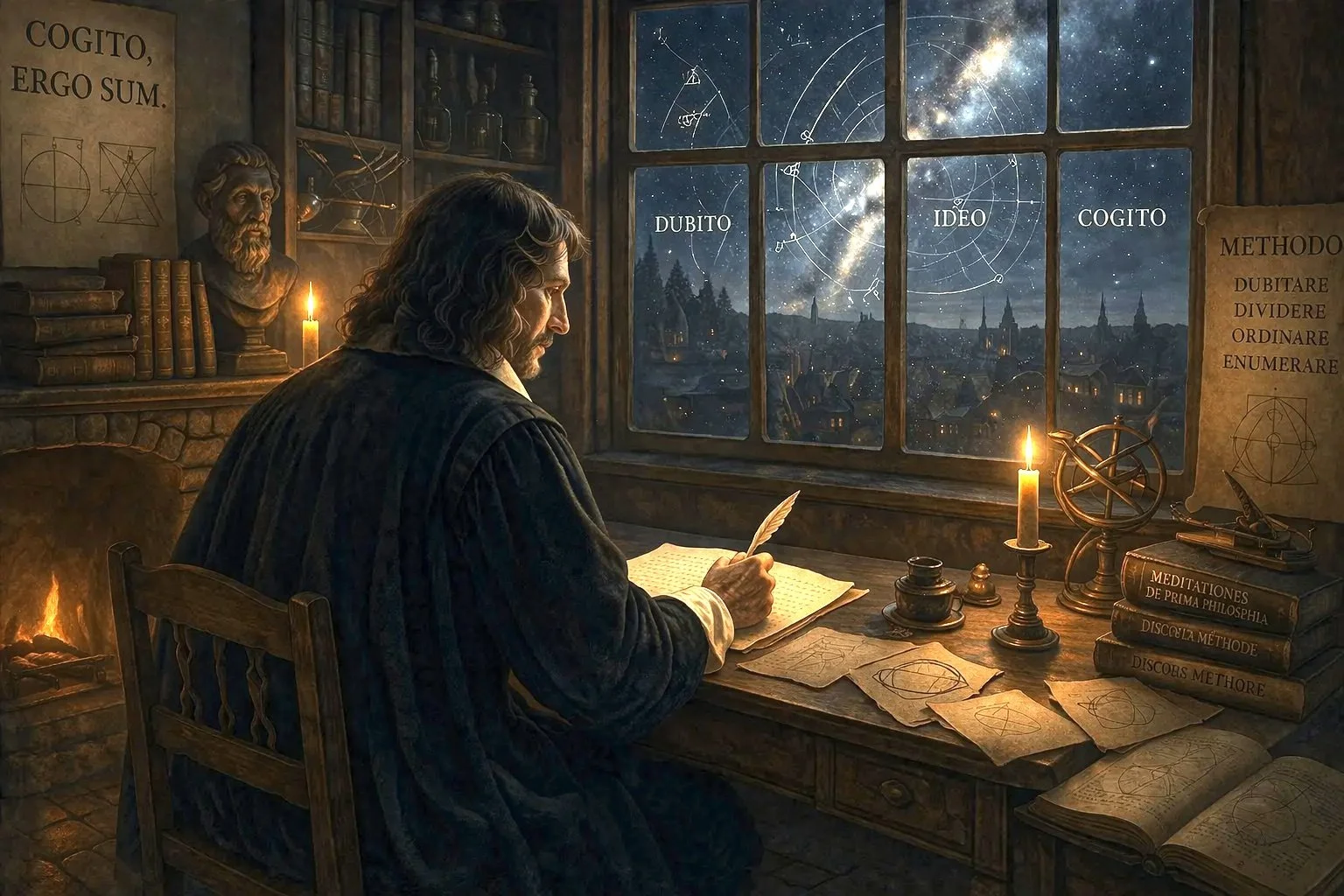
Doubt, Certainty, and the Search for Foundations
The Big Idea
What, if anything, can we know with certainty?
René Descartes approached this question with unusual resolve. Rather than accepting inherited beliefs, he chose to doubt everything that could possibly be doubted: the evidence of the senses, the reliability of memory, even the existence of the external world.
If knowledge were to stand, it would have to survive this test.
At the end of that process, one thing remained. However far doubt extended, the act of thinking itself could not be denied. If one is thinking, then there must be a thinker.
Cogito, ergo sum.
I think, therefore I am.
This was not a conclusion reached through observation, but a point of certainty discovered through reflection. It did not describe the world. It established the existence of the self as the foundation from which knowledge might proceed.
Descartes’ ambition was not modest. He sought a secure starting point from which the entire structure of knowledge could be rebuilt.
The Man and the Moment
René Descartes was born in 1596 in France and educated at the Jesuit college of La Flèche, where he received a rigorous training in philosophy, mathematics, and classical learning. The education was thorough, but it left him dissatisfied.
The world around him did not appear to reflect the certainty that philosophy claimed to possess. Europe was marked by religious conflict, political instability, and competing systems of thought, each asserting its own authority.
Descartes began to suspect that the problem lay not in the answers, but in the method.
He studied law, travelled widely, and served for a time as a soldier, but his real work took place in reflection. In 1619, during a period of intense thought, he experienced a series of vivid dreams which he later regarded as significant. Whether taken literally or not, they marked a turning point, strengthening his resolve to reform the foundations of knowledge.
Much of his life was spent in relative seclusion, particularly in the Netherlands, where he wrote and developed his ideas away from the immediate pressures of public life. His works would later attract the attention of the Church, and some were placed on the Index of Prohibited Books, an indication that his ideas had begun to travel.
In 1649, he accepted an invitation to Sweden to tutor Queen Christina. The climate, and the demands of early morning instruction, did not suit him. Within months, he fell ill and died.
Why It Mattered
Descartes’ significance lies in his method.
Rather than building upon inherited authority, he began with doubt and used reason as his primary tool. Knowledge was no longer something received, but something constructed, beginning with what could be known with certainty.
From the cogito, he developed a distinction between mind and body. The thinking self, res cogitans, was fundamentally different from the physical world, res extensa. This division would shape centuries of philosophical debate, raising questions about how thought and matter might interact.
His work also helped establish a new standard for inquiry. Clarity, precision, and method became central. In mathematics, his development of analytical geometry provided a way of describing space in numerical terms, linking algebra and geometry in a manner that would prove foundational for science.
More broadly, he shifted authority away from tradition and toward reason. Truth was no longer guaranteed by its source. It had to be demonstrated.
In Owain Morgan’s Method
Descartes’ influence on Owain Morgan lies in the disciplined use of doubt.
Owain does not accept statements at face value, nor does he assume that what appears certain has been properly examined. Like Descartes, he begins by questioning what may be taken for granted, testing the reliability of what is presented before drawing conclusions.
This does not lead him to reject evidence, but to scrutinise it.
A witness may speak confidently. An account may appear coherent. Yet coherence is not certainty. What seems clear may rest on untested assumptions, incomplete perception, or prior belief.
Owain separates what can be directly established from what is inferred, and remains alert to the possibility that the mind may impose order where none has yet been proven.
In this sense, doubt becomes not an obstacle, but a tool.
The Present Question
If certainty requires such careful construction, then belief must be approached with restraint.
What appears obvious may not have been examined. What feels certain may rest on assumptions that have never been tested. The difficulty lies not in forming beliefs, but in recognising how easily they take shape.
Descartes reminds us that understanding requires more than acceptance.
It requires method.
To question what is given, to distinguish between what is known and what is assumed, and to proceed with a degree of intellectual discipline that resists the comfort of immediate certainty.
The Legacy
Descartes’ influence extends across philosophy, science, and the study of the mind.
His method helped shape the development of modern science, where systematic doubt and careful reasoning remain essential. His distinction between mind and body continues to inform debates in psychology and philosophy, even where it is challenged.
More broadly, he contributed to a shift in intellectual authority. Knowledge became something to be established through inquiry rather than accepted through tradition.
Yet his legacy is not without tension. In seeking certainty within the self, he also raised enduring questions about the relationship between the individual mind and the external world, questions that remain unresolved.
Key Works
Discourse on Method (1637). A clear account of his approach to reasoning and inquiry.
Meditations on First Philosophy (1641). A deeper exploration of doubt, certainty, and the nature of the self.
Principles of Philosophy (1644). An attempt to unify scientific and philosophical understanding.
The Essence
‘Cogito, ergo sum.’
From this single point of certainty, Descartes sought to rebuild knowledge itself, not on assumption, but on foundations that could withstand doubt.