Landscape, history and the human thread.
Many of my ideas begin with a walk. Others emerge from history, books, photography and forgotten stories. This notebook gathers them together in one place.
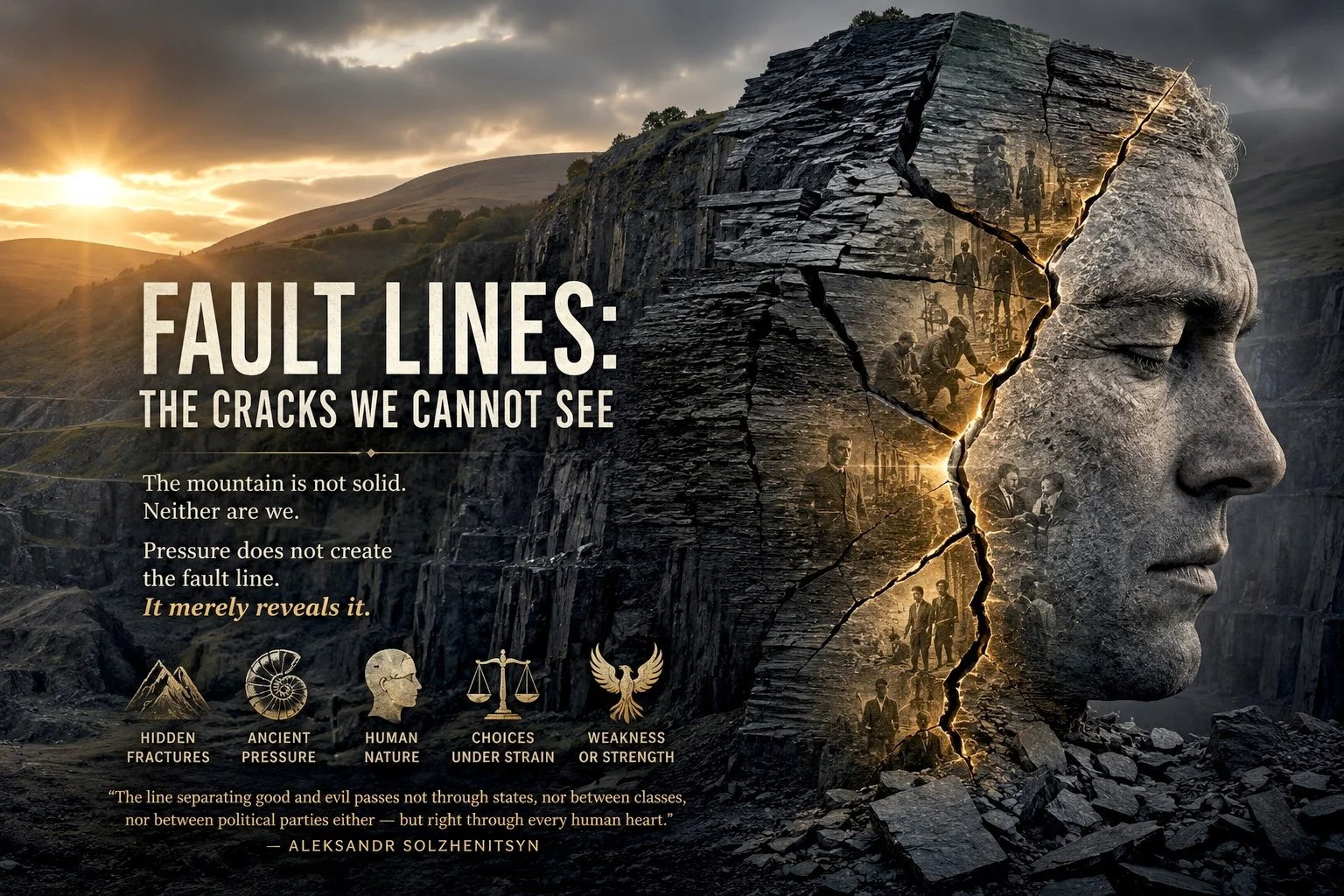
Fault Lines
The hidden pressures, fears, and ambitions that reveal the fault lines within human character.
The cracks we cannot see
I live in North Wales, once the global slate capital. It was said that this region roofed the world. Vast fortunes were built here. Communities flourished. Lives were lost. For generations, men carved mountains apart in pursuit of a material that helped shape the modern world.
Today, many of those quarries stand silent.
When I walk among the remains of these places, where nature is slowly reclaiming what industry left behind, it is easy to believe the mountain has always been as it is.
The rock face appears solid, immense, almost permanent. Layer upon layer of slate stretches away into the distance, shaped by forces so vast and ancient that they are difficult to comprehend. Yet every quarryman knows something that the casual observer does not.
The mountain is not solid.
Hidden within the rock are fractures. Most remain invisible. They may lie dormant for years, unnoticed by anyone passing by. Then pressure arrives. A blast is set, a section is cut away, or the weight above shifts ever so slightly. Suddenly the hidden weakness reveals itself.
The rock breaks.
Human beings are not so different.
We tend to think of character as something fixed. We describe people as honest, trustworthy, loyal, courageous, generous, or kind, as though these qualities were carved permanently into stone. Yet history, psychology, and everyday experience suggest something rather different.
Much of who we are remains untested.
A person may live for decades without ever encountering the circumstances that expose their deepest weaknesses. Another may spend a lifetime believing themselves incapable of a particular action, only to discover under pressure that they are not quite the person they imagined themselves to be.
This is not necessarily because people are deceitful. Often, they simply do not know themselves as well as they believe.
Pressure has a curious way of revealing what lies beneath the surface.
Fear can do it.
So can shame, greed, loss, humiliation, the threat of failure, fear of exposure, or the possibility of losing status, wealth, reputation, or belonging.
History offers countless examples. Respected politicians have ruined careers to conceal relatively minor mistakes. Successful business leaders have risked fortunes in desperate attempts to preserve the appearance of success. Religious leaders, academics, military officers, and public figures have all been known to compromise deeply held principles when faced with pressures they felt unable to endure.
When these stories emerge, we often ask a simple question.
‘What were they thinking?’
It is a natural response.
Yet it may be the wrong question.
A better one might be:
‘What pressure were they under?’
Throughout history, philosophers, psychologists, writers, and statesmen have wrestled with the question of why people act as they do under pressure.
Shakespeare filled his plays with characters undone by ambition, jealousy, pride, and fear. Macbeth does not begin as a murderer. He becomes one, step by step, under the pressure of temptation and self-deception.
The psychologist Carl Jung argued that much of our behaviour is driven by forces hidden beneath conscious awareness. Until we confront those hidden aspects of ourselves, he suggested, they continue to shape our actions from the shadows.
Writing after his experiences of the Soviet labour camps in The Gulag Archipelago, Aleksandr Solzhenitsyn offered perhaps the most sobering observation of all:
‘The line separating good and evil passes not through states, nor between classes, nor between political parties either — but right through every human heart.’
This is not to suggest that all people are equally virtuous, nor that serious wrongdoing can be explained away by circumstance. Rather, it is to recognise that human behaviour is seldom as simple as we would like it to be.
Different centuries. Different experiences. Yet all point towards a similar conclusion: human beings are rarely as simple as they appear.
This does not excuse wrongdoing. Nor does it remove personal responsibility. But it does acknowledge something important about human behaviour.
Most people do not wake up one morning and decide to become dishonest, cruel, or destructive.
The process is usually more gradual.
A compromise here.
A rationalisation there.
A decision justified as temporary.
An action taken to avoid embarrassment.
A truth left unspoken.
A warning ignored.
What begins as self-preservation can slowly become self-deception.
Psychologists have long understood that people possess a remarkable ability to explain their own behaviour in ways that preserve a positive self-image. We tell ourselves stories about who we are. Most of the time those stories serve us well. They provide coherence and meaning.
The problem arises when reality begins to challenge them.
Consider the person whose identity is built around success. What happens when failure becomes unavoidable?
Or the scholar whose reputation rests upon a particular theory. What happens when evidence emerges that threatens everything they have spent years defending?
Or the business owner facing financial ruin after decades of achievement?
In such moments, the threat is often deeper than it first appears.
It is not simply money, status, or reputation that is at stake.
It is identity itself.
The question becomes not merely, ‘What will happen to me?’
But rather:
‘Who will I be if this is taken away?’
Under sufficient pressure, people can behave in ways that would once have seemed impossible to them.
The fault line was always there.
The pressure simply revealed it.
Perhaps this is why history remains so endlessly fascinating. It is not merely a record of events. It is a record of human beings under pressure.
Wars, revolutions, industrial disputes, financial collapses, political crises, and social upheavals all place extraordinary strain upon individuals and communities. Some people rise to the occasion with remarkable courage.
Others fracture.
Most of us are capable of both.
The uncomfortable truth is that we rarely know which version of ourselves will emerge until the moment arrives.
This is not a pessimistic view of human nature. Quite the opposite.
For every story of corruption, there is another of resilience.
For every act of cowardice, there is an act of quiet courage.
Pressure does not merely expose weakness. it reveals strength as well.
The irony is that slate itself owes its existence to pressure.
What began as layers of mud on the floor of an ancient sea was transformed over millions of years by heat and compression into one of the most durable materials known to man.
Not all pressure destroys.
Some pressure creates strength.
The same forces that drive one person towards selfishness may inspire another towards sacrifice.
The same crisis that causes one individual to retreat into fear may compel another to step forward.
The fault lines run in different directions.
Perhaps that is why understanding human behaviour requires a degree of humility.
It is easy to judge from a distance.
It is more difficult to acknowledge that, under different circumstances, we might have acted similarly ourselves.
The quarry offers a useful reminder.
What appears solid on the surface may conceal hidden fractures beneath.
Yet those fractures are part of the rock itself. They do not define the whole mountain. They merely reveal something about its structure.
Human beings are much the same.
Most of us carry strengths we have yet to discover and weaknesses we have yet to confront.
The challenge is not to pretend those weaknesses do not exist.
It is to understand them before pressure arrives.
Because sooner or later, for individuals, communities, and societies alike, it always does.
Perhaps that is why these questions continue to fascinate me. Not only in history and psychology, but in fiction as well.
They sit at the heart of much of my writing.
The loss of academic credibility and reputation formed a central theme in my first Owain Morgan novel, The Silence of the White Shadow. Those same questions continue to shape the novel I am currently working on.
Fault Lines explores an unexplained death in a North Wales slate community.
What causes an ordinary person to cross a line they once believed they never would?
The pressure does not create the fault line.
It merely reveals it.
Field Notes and photographs are occasionally shared on Instagram @iamjohnrees