
What Owain Taught Me
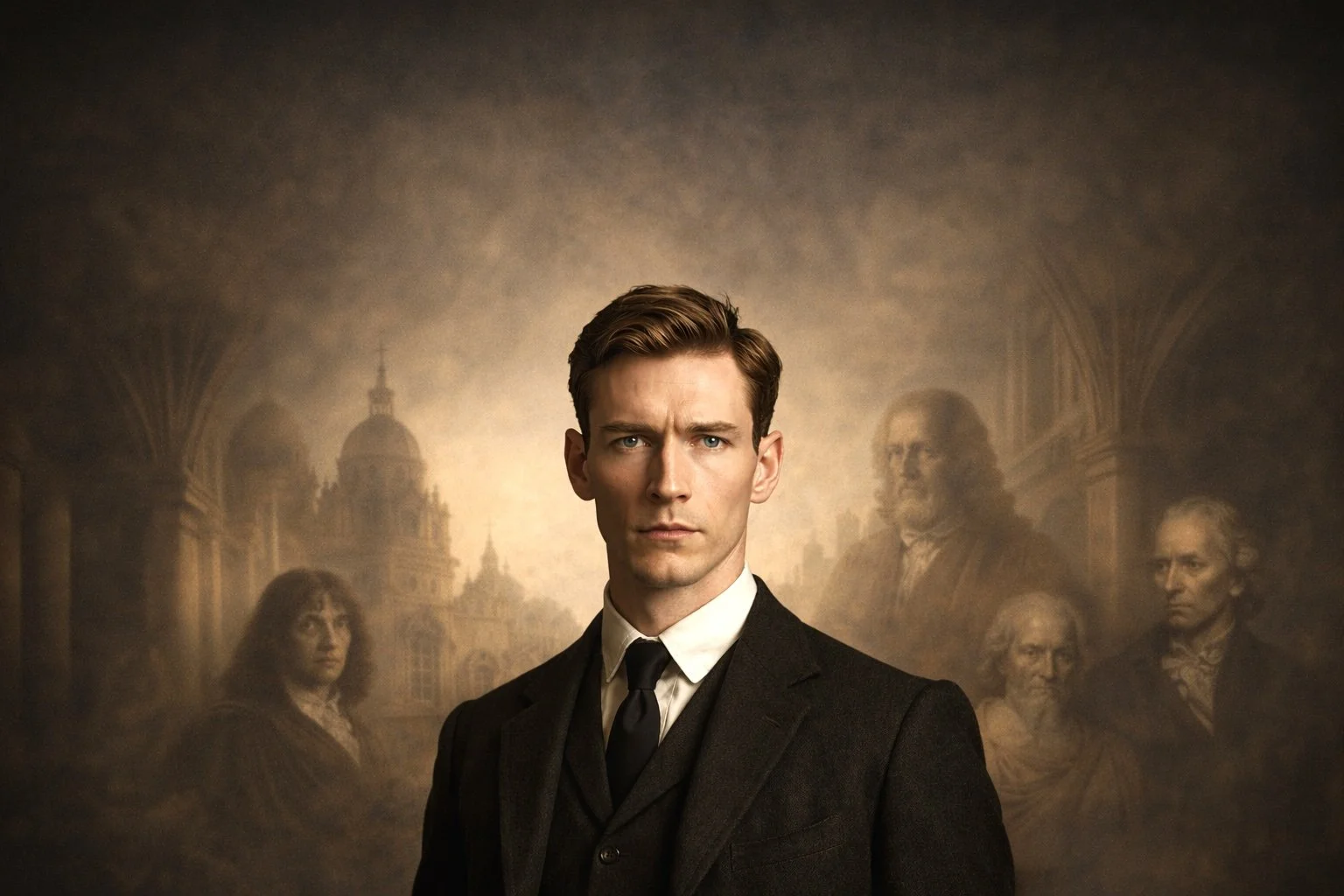
When I started writing historical novels a few years ago, I circled far too many ideas. Some became notebooks, others outlines, but none possessed the coherence I was looking for. I was searching not simply for a novel, but for a world I wanted to inhabit, and one I hoped readers would want to inhabit with me.
One afternoon, while sitting in the library at University College Bangor in North Wales, a different idea began to take shape. Outside, students crossed the quadrangle as they had done for generations. Inside, I found myself wondering what kind of academic might once have occupied an office overlooking the same city.
The ideas I wanted him to explore, however, did not quite fit the history or structure of the real institution.
So I created another.
I called it University College Morlan.
Drawing inspiration from universities such as Oxford, Cambridge and Durham, I built a fictional college with its own traditions, history and academic life. It acquired colleges, common rooms, lecture theatres, rivalries, customs and personalities until it became as familiar to me as many real places I have visited.
Within that world I created Professor Ieustin Owain Morgan, Chair of Mental and Moral Science.
At first, I thought I was simply creating the central character for a series of historical mysteries.
I wasn’t.
Or rather, I wasn’t only doing that.
Like many writers, I began researching in order to make my fictional world more convincing. But something unexpected happened. My research gradually ceased to feel like research at all. It became a conversation.
I also live in North Wales, where mountains, rivers and coastlines are never far away. Walking has long been part of my life, as has photography. Both have taught me the value of slowing down and paying attention.
It wasn’t long before those landscapes became part of Owain’s world too.
I began to imagine him walking the paths above Capel Curig, climbing Moel Siabod, standing beneath the walls of Dolwyddelan Castle, or pausing beside the sea at Rhoscolyn on Anglesey. Those places didn’t simply provide settings. They shaped his way of seeing.
The Welsh landscape is never simply a backdrop in the novels. It is where questions emerge, where ideas settle, and where difficult conversations continue long after the people involved have gone home.
In time, I realised that I wasn’t only discovering how Owain solved mysteries.
I was discovering how he observed the world.
Only then did I realise that understanding a character isn’t simply about knowing what they do. It’s about understanding why they notice what others overlook.
As the stories developed, I found myself reading ever more deeply into nineteenth-century philosophy and psychology. Not because the novels demanded it, but because Owain himself would do exactly that.
If he was to understand people, he needed more than intelligence.
He needed a way of thinking.
As I write, I often find myself asking a simple question:
‘What would Owain do?’
‘How would he think about this situation?’
The answer is rarely obvious, nor is it something I can invent on the spot. It almost always sends me back to the books—not because I’m looking for a plot, but because I’m trying to understand the mind from which that plot must emerge.
How would he reason through a moral dilemma?
What would he notice that others overlooked?
Would he judge a person’s actions first, or would he first try to understand the forces that had shaped them?
The deeper I travelled into questions of habit, conscience, language, self-deception and character, the more I realised these weren’t simply pieces of background research.
They were the architecture of Owain’s mind.
And because they were the architecture of his mind, they became the architecture of the novels themselves.
I found myself returning to thinkers whose names are less familiar today than they once were: William James, Alexander Bain, Henry Sidgwick, Schopenhauer and William Benjamin Carpenter. Alongside them stood older voices—Aristotle, Hume and Kant—still asking questions that refuse to disappear.
Different answers.
The same enduring question.
Again and again, I found myself returning to it.
Why do human beings act as they do?
That question gradually became the centre of Owain’s world.
One sentence, in particular, kept returning as I wrote.
‘Men do not act without reason. They act from reasons they do not always understand.’
It isn’t intended as an excuse for human behaviour. It is an invitation to understand it before judging it.
From that point onwards, every mystery became less a puzzle to be solved than an attempt to understand the hidden motives, loyalties, fears and habits that lie beneath outward actions.
Somewhere along the way, I realised something else.
If I kept asking myself how Owain would think, sooner or later I had to ask another question.
What would he write?
Not another mystery.
Not another investigation.
But the book that lay behind them both.
The lectures he would deliver.
The essays he would publish.
The reflections to which he would return throughout his life.
That book became The Morgan Papers.
Presented as a collection of lectures, essays, notes and reflections from University College Morlan, it explores questions of character, conscience, will, responsibility and moral judgement—not as abstract philosophy, but as the foundations from which human conduct emerges.
Owain Morgan and University College Morlan are rooted in the intellectual, religious and social world of late nineteenth-century Wales, where philosophy, psychology and science were reshaping our understanding of the human mind.
Looking back now, I don’t think I invented Owain Morgan at all.
I think I discovered him.
The more completely I understood how he thought, the less freedom I seemed to have as his author.
I stopped asking,
‘What should happen next?’
Instead, I found myself asking,
‘What would Owain do?’
And once I could answer that question honestly, The Morgan Papers no longer felt like a book I had decided to write.
It felt like the book Owain had been waiting to write all along.
Readers first meet Professor Morgan in my historical mystery The Silence of the White Shadow.
That novel marked the beginning of a series exploring not only the mysteries he investigates, but the ideas that shape the way he investigates them. The Morgan Papers sits alongside those stories. It is not another case, but the intellectual world from which the cases emerge.
Yet perhaps the most unexpected consequence of creating Owain Morgan has been a personal one.
When I first imagined him, I thought I was inventing a character.
Over time, I realised he had become something else.
A way of asking better questions.
A reminder to look beneath appearances, to resist easy judgements, and to remember that understanding almost always begins with curiosity rather than certainty.
In that sense, Owain has taught me as much as I have taught him.
He has reminded me that every story, every historical event and every human life is driven by the same enduring question:
Why do human beings act as they do?
I suspect I’ll spend the rest of my writing life exploring that question.
Owain Morgan simply happens to be the companion with whom I’ve chosen to explore it.