
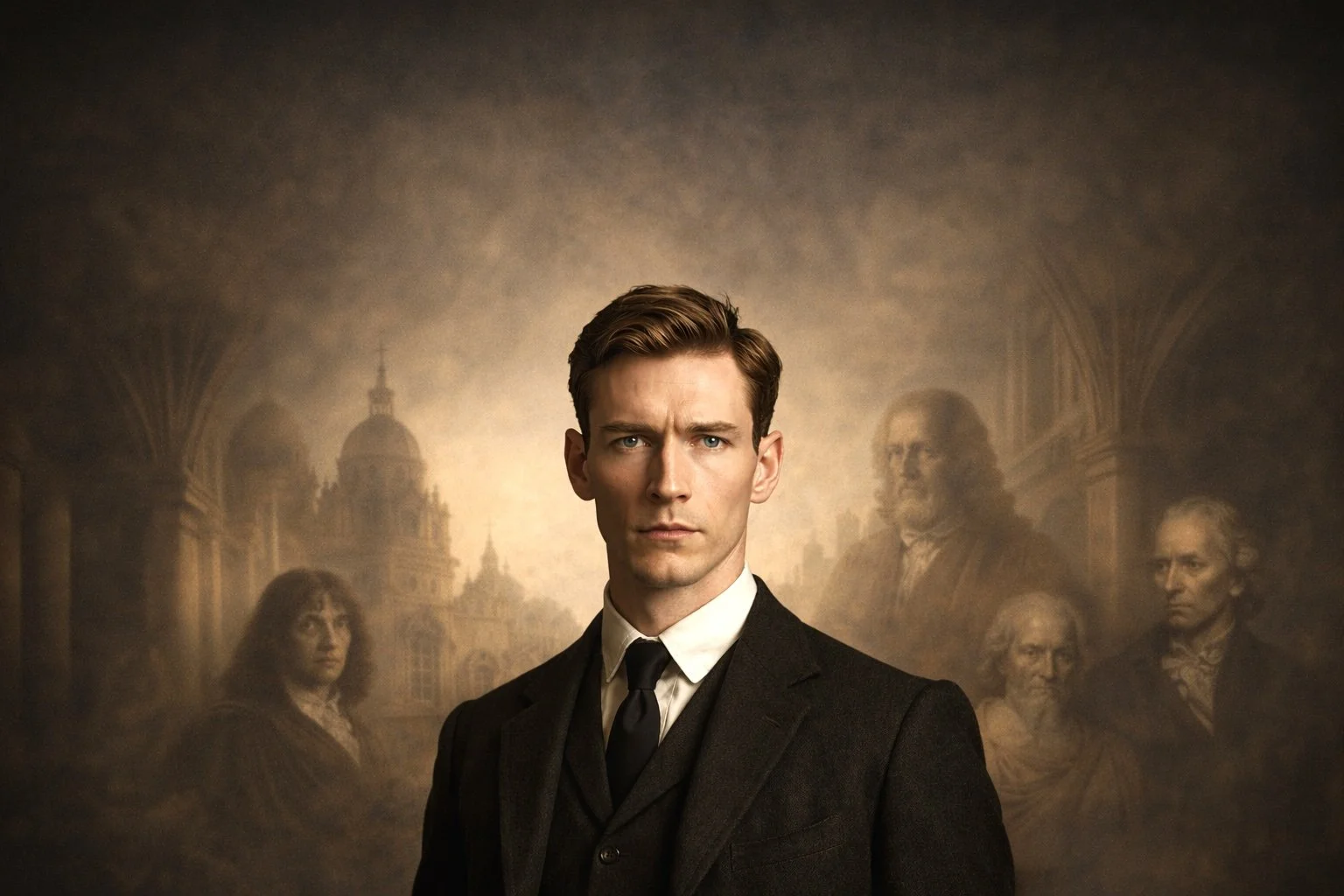
Owain Morgan’s Intellectual Influences
The stories I write — particularly those involving Owain Morgan — do not stand alone. They emerge from a long tradition of thought that stretches across centuries.
In the late nineteenth century, what we now call psychology was only beginning to take shape and had not yet broken away from philosophy. Questions of mind, behaviour, morality, and perception formed a single enquiry.
Owain inhabits that world.
He is not simply an investigator, nor solely an academic, but a student of human nature. His methods are shaped by thinkers who returned, again and again, to the same enduring questions:
How do we know what is true?
Why do we believe what we believe?
What drives human action under pressure?
The answers to these questions do not reside in any single system. They take shape through tension, dialogue, and disagreement, forming a body of thought that endures precisely because it is contested.
Some ideas provide foundations, others challenge what we think we know, and some remain unresolved. Together, they form the intellectual ground from which Owain’s thinking develops.
His work does not begin with evidence alone, but with the human mind itself. Evidence may tell us what happened; Owain wants to understand what changed within a person before the act itself occurred.
This is where that exploration begins.
Among those voices:
Blake — saw imagination not as escape, but as truth.
James — understood the mind as a stream, shaped by habit.
Sidgwick — wrestled with the difficulty of knowing what is right.