
Confucius
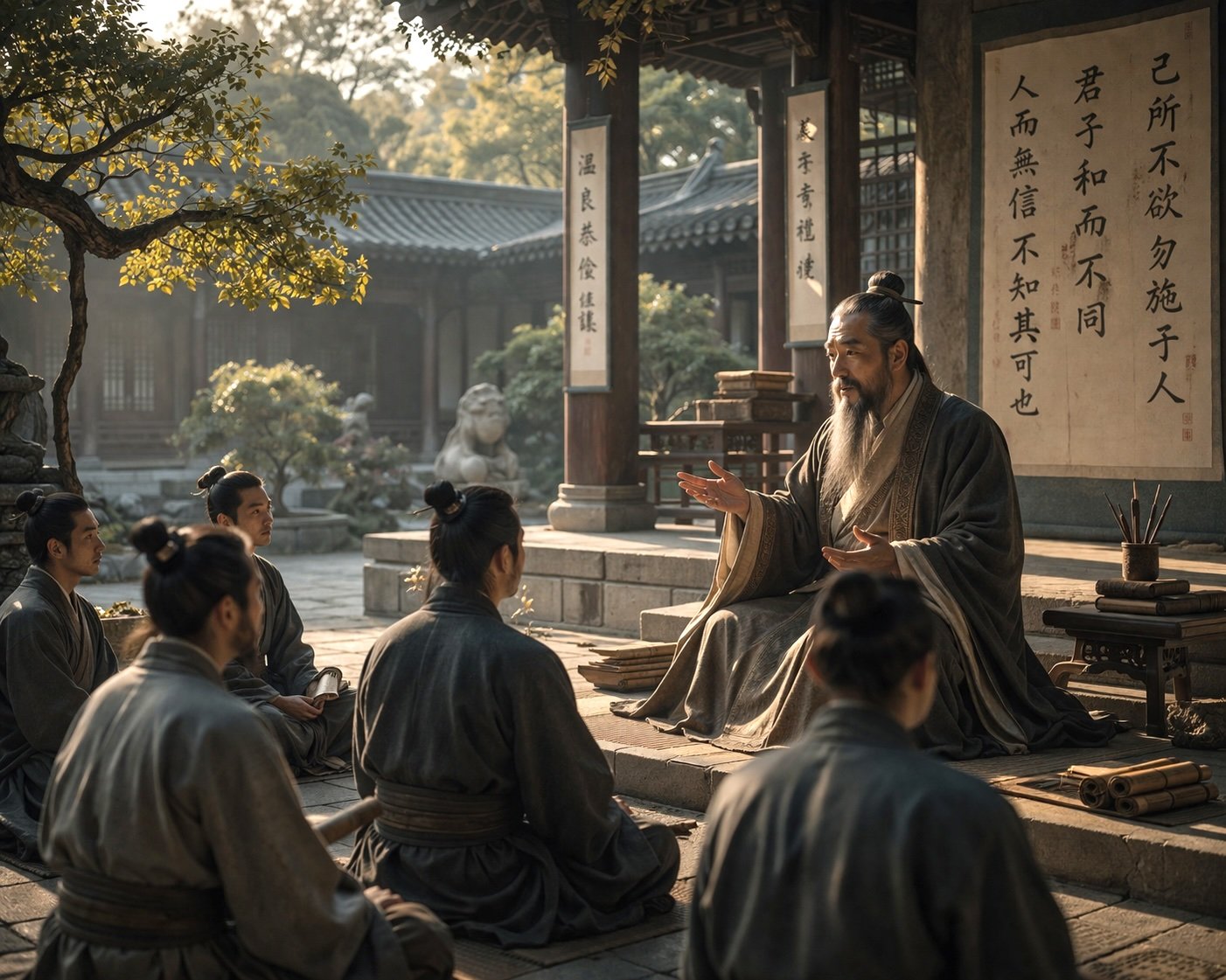
Most of us want a better world. Confucius thought that was the wrong place to begin. He believed order starts close to home — in how we speak, act, and treat one another. Civilisation, in his view, is built in the small things.
The Big Idea
Everyone wants a better world, but most of us hope someone else will sort it out.
Confucius had a better idea. He said order starts close to home — in how we speak, act, and treat one another.
Harmony isn’t imposed from above; it’s built between us, in the small daily courtesies that keep chaos at bay.
The gods can rest — provided we can manage basic decency for five minutes.
The Man and the Moment
Confucius was born in 551 BCE in the state of Lu, in what’s now Shandong province, China. The world around him was falling apart: kingdoms fighting, families feuding, morality optional. (The pattern feels familiar - have we learned nothing in a few thousand years?) Into this stepped a man who genuinely thought the answer was better manners. You have to admire the optimism.
He wasn’t wealthy, but he was ferociously clever. He studied music, poetry and ritual until he could probably conduct a wedding and a funeral at the same time. He became a teacher, then a government official, then a teacher again after the officials stopped taking his calls.
Eventually he packed a few students into a wagon and hit the road, travelling from court to court like a travelling school of ethics. He offered rulers the secret to good government: honesty, humility and a functioning moral compass. Most preferred war. His advice was filed under “things we’ll get to eventually.”
But he kept going. He was convinced that goodness could be taught, that decency was contagious, and that the right ceremony could make even the worst people behave like humans for a few minutes. You might say he was the world’s first behavioural psychologist, albeit with better robes.
Why It Mattered
Confucius wasn’t interested in the afterlife. He was too busy worrying about the neighbours. “You do not yet understand life,” he said, “so how could you understand death?” For him, morality was an everyday practice: how you greet someone, how you speak, how you handle disagreement without throwing a teapot.
He believed virtue could be cultivated one habit at a time: dignity in the self, respect in the home, fairness in the state, peace in the world. It was philosophy as a tidy-up operation.
Ritual, to him, wasn’t empty formality but emotional training — the choreography of decency. Every bow, gesture and thank-you was a small act of self-restraint. Good manners, he thought, were the gymnasium of the soul.
We’ve largely forgotten this. Today, we treat politeness as a luxury brand — optional, performative, and usually reserved for reserved for carefully worded emails. Confucius would have seen it differently. Courtesy wasn’t superficial; it was civilisation’s nervous system.
He also insisted that learning and thinking go together. “To study without thinking is labour in vain,” he warned, “but to think without studying is dangerous.” In modern terms: beware of people who say they’ve “done their own research.”
The Legacy
Over time, Confucianism became the moral operating system of East Asia. His teachings shaped emperors, bureaucrats, teachers, parents — anyone with an opinion on how to behave. For two thousand years, China ran on his ideas: education as virtue, government as moral example, harmony as public service announcement.
His sayings, collected in The Analects, became the ancient equivalent of a bestseller. Every official exam quoted him. Entire dynasties rose and fell to the sound of his aphorisms. Even rebellion, when it came, often claimed to be “the true Confucian way.” It was the ultimate brand loyalty.
Critics said his system made people polite but passive, courteous but conformist. Maybe so. But it also produced centuries of stability, literacy and a cultural obsession with not making a scene — which, frankly, feels underrated in the age of Twitter, X or whatever it’s called today.
He gave Asia its distinctive faith in education, family and collective responsibility. The West built cathedrals; the East built classrooms. He made goodness not something you believed in, but something you practiced.
In Our Time
If Confucius were alive today, he’d probably be running a leadership seminar on “The Way of the Gentleman,” complete with mindfulness exercises. He’d tell executives that good management starts with listening, and good listening starts with shutting up.
He’d look at modern politics and shake his head in despair. The Confucian ideal of modesty hasn’t aged well. Today’s public figures measure integrity in decibels. He’d probably say, “The superior man is modest in speech but exceeds in action,” and be drowned out by applause from the very people he was criticising.
He’d be baffled by social media. To him, the internet would look like a Confucian nightmare: constant noise, minimal humility, and no respect for elders unless they’re influencers. The comment section alone would have convinced him that civilisation is on the brink of destruction.
And yet, he’d see the potential too. He’d love the idea of global conversation, but he’d insist on better manners. Imagine a Confucian version of modern social media — no insults, no shouting, and a gentle reminder before you post: “Are you sure this is benevolent?”
He’d have been equally unimpressed by artificial intelligence. Machines can mimic thought, but they can’t model virtue. They can predict what you’ll buy, but not what you should value. “To know what is right and not to do it,” he’d remind us, “is the worst kind of cowardice.”
He’d probably think our “authenticity culture” — saying whatever we feel, whenever we feel it — is just ego in fancy dress. For Confucius, authenticity meant being genuinely kind, not brutally honest.
And if you told him that “cancel culture” was a sign of moral progress, he’d raise an eyebrow and suggest that shouting people into silence isn’t the same as teaching them virtue.
He might still offer hope. He believed that society could always be repaired, one relationship at a time. “The strength of a nation,” he said, “derives from the integrity of the home.” Not GDP. Not technology. Just people being decent to each other. It still sounds like a good idea.
Key Texts
The Analects (compiled c. 5th–4th century BCE) – A collection of conversations and sayings, gathered by his students. Half philosophy, half life advice. Still brilliant on respect, kindness, and not shouting on public transport.
The Great Learning (c. 4th century BCE) – A short guide on how self-cultivation leads to good government. Self-help for rulers, not that many seem to have read it.
The Doctrine of the Mean( c. 4th century BCE) – A call for balance and moderation in all things. Basically, Confucius warning against overreacting long before Twitter.
The Book of Rites (older origins, edited by followers) – How to behave properly, from family rituals to public etiquette. Imagine Emily Post meets ancient China.
The Essence
“Real knowledge is to know the extent of one’s ignorance.” — Confucius
Wisdom, he might say, isn’t knowing everything. It’s knowing when to stop talking.
Follow the thread:
Read Aristotle, Hobbes, Machiavelli, and others who shaped how we think.