
Friedrich Nietzsche
Truth, Morality, and the Courage to Stand Alone
The Big Idea
What if the truths we live by are not eternal, but inherited?
Friedrich Nietzsche argued that much of what we call morality is not discovered, but constructed. It emerges over time, shaped by culture, power, religion, and fear. What passes as truth is often what has been repeated, preserved, and protected.
His most unsettling claim was simple.
The foundations of belief are not as secure as we imagine.
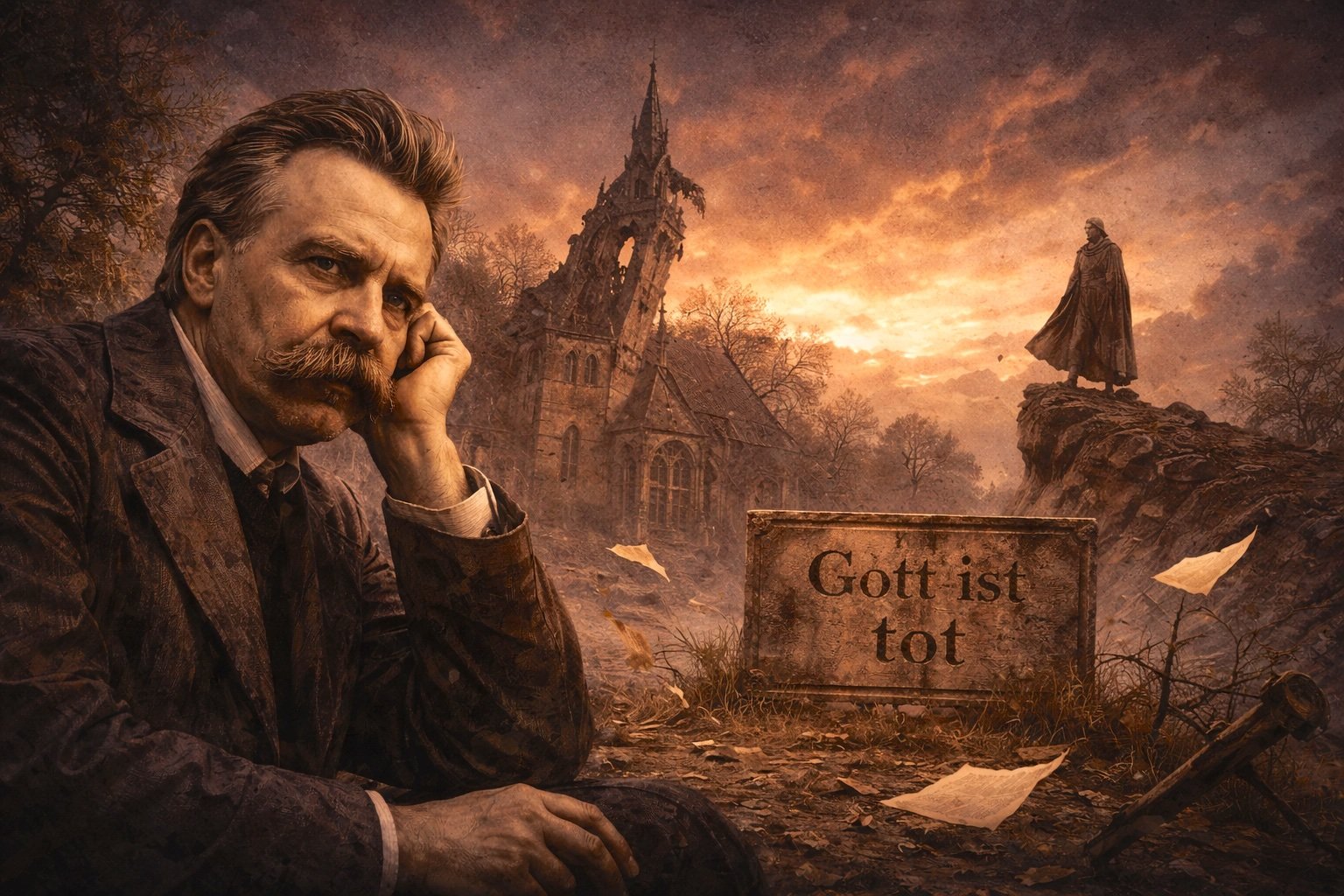
In The Gay Science, he famously declared that ‘God is dead’, not as a triumph, but as a diagnosis. The structures that had once given meaning and certainty to human life were losing their authority. What had once been unquestioned now had to be justified.
With that loss came a deeper problem.
If inherited beliefs no longer hold, how is meaning to be sustained? What replaces the frameworks that once guided judgement, duty, and truth?
Nietzsche does not offer comfort. He offers confrontation.
The Man and the Moment
Nietzsche was born in 1844 in Röcken, in Prussia, the son of a Lutheran pastor. His early life was shaped by faith, discipline, and scholarship, a moral inheritance he would later examine with relentless intensity.
He showed early brilliance and was appointed professor of classical philology at Basel at the age of twenty-four. Yet his academic life proved brief. Ill health forced his resignation, and much of his remaining life was spent in solitude, moving between modest lodgings in Switzerland and Italy.
It was in this isolation that his most significant work was written.
Nietzsche did not write in the manner of a system-builder. His work is fragmentary, often aphoristic, sometimes deliberately contradictory. He was not constructing a single doctrine, but dismantling the assumptions that made doctrines appear stable.
His later years were marked by collapse. In 1889, he suffered a mental breakdown and spent the remainder of his life in silence, his work only gradually gaining recognition after his death.
There is something fitting in this.
A thinker who questioned certainty so deeply was not easily accommodated by his own time.
Why It Mattered
Nietzsche’s importance lies in his re-examination of morality and motive.
He argued that values are not fixed truths, but expressions of human need and power. What a society calls ‘good’ often reflects what it wishes to preserve. What it calls ‘evil’ may simply be what threatens its structure.
This is not merely a philosophical claim.
It is a psychological one.
Nietzsche suggested that beneath moral language lie deeper forces — resentment, fear, pride, the desire for control, the need for recognition. People do not always act from the reasons they give. Often, they construct reasons after the fact, to make their actions appear justified.
He was particularly attentive to what he called ressentiment — a form of moralised resentment in which weakness presents itself as virtue. In such cases, moral systems can emerge not from strength, but from reaction.
This does not mean morality is meaningless.
It means it must be examined.
Nietzsche shifts the question.
Not what is good?
But who calls it good, and why?
In doing so, he anticipates a central insight of modern psychology.
That human beings are often less transparent to themselves than they imagine.
The Legacy
Nietzsche’s influence is wide-ranging and often misunderstood.
He reshaped philosophy by directing attention toward the origins of belief rather than its surface claims. His work influenced existentialism, psychology, and modern critiques of culture and power.
He did not provide a system to replace what he dismantled.
Instead, he created a space in which inherited certainty could no longer be taken for granted.
This has made him both influential and difficult.
His work can be read as liberating or destabilising, depending on what one seeks from it. Yet at its core lies a consistent demand.
To examine belief without relying upon it.
To confront the possibility that meaning is not given, but must be faced, and perhaps formed.
In Owain Morgan’s Method
Nietzsche sharpens Owain Morgan’s understanding of motive.
Owain recognises that what individuals say they believe is not always what governs their actions. Beneath stated principles lie deeper structures — fear of loss, desire for control, resistance to change, the need to preserve identity.
He listens carefully to moral language.
When a man speaks of duty, Owain considers what that duty protects. When he speaks of principle, Owain asks what may be threatened if that principle were set aside.
In moments of tension, these underlying motives often become visible.
A justification arrives too quickly. A certainty is defended too forcefully. A principle is invoked where explanation would suffice. These are not proofs, but signals.
Nietzsche helps Owain recognise that explanation and motive are not always aligned — that what is said may conceal as much as it reveals.
The Present Question
If the beliefs we inherit are shaped by history, culture, and circumstance, how should we approach them?
To accept them without question is to risk illusion.
To reject them entirely is to risk emptiness.
Between these lies a more difficult path.
To examine belief without discarding it too quickly. To recognise its origins without assuming its authority.
Nietzsche does not resolve this tension.
He insists that it be faced.
Key Works
The Gay Science (1882). Introduces the collapse of inherited belief and the challenge that follows.
Thus Spoke Zarathustra (1883–85). A philosophical exploration of transformation, meaning, and self-overcoming.
Beyond Good and Evil (1886). A critique of traditional morality and philosophical assumptions.
On the Genealogy of Morality (1887). A detailed examination of the origins of moral values.
The Essence
‘He who has a why to live can bear almost any how.’
Nietzsche reminds us that meaning is not guaranteed.
It must be examined, tested, and, if necessary, created.
Follow the thread:
These ideas do not stand alone. They form part of a wider conversation that shapes Owain Morgan’s understanding of the world.