
George Henry Lewes
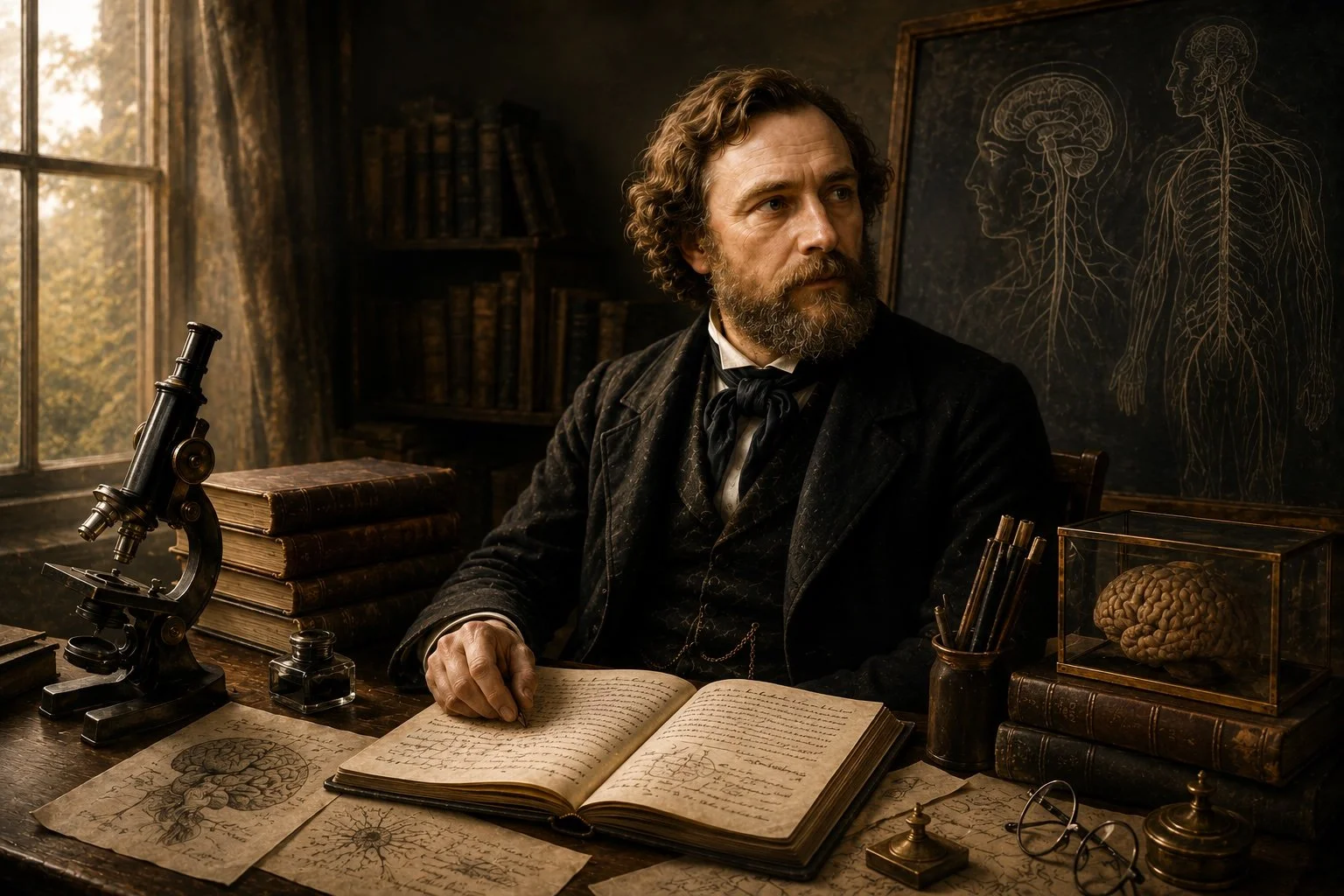
Behaviour, Observation, and the Mind in Action
The Big Idea
What people do often reveals more than what they say.
George Henry Lewes believed that the mind could not be understood through abstract theory alone. It had to be observed in movement, behaviour, reaction, hesitation, and habit. Thought was not something sealed away from the world, but something constantly expressing itself through action.
This shifted the study of the mind in a new direction. Rather than asking only what human beings ought to think, Lewes became interested in how they actually behave, not idealised reason, but lived psychology.
He argued that mental life leaves traces. A pause before an answer, a contradiction introduced without awareness, a movement that does not quite align with the words being spoken. These are not empty details. They form part of the structure of thought itself.
In this sense, behaviour becomes evidence. Not proof in isolation, but a visible expression of processes that are otherwise hidden.
Lewes understood something that would later become central to psychology: the mind is not separate from action. It reveals itself through it.
The Man and the Moment
George Henry Lewes was born in London in 1817 and lived a life that moved across disciplines with unusual freedom. He wrote criticism, philosophy, science, psychology, and literary essays, while also studying physiology and becoming deeply interested in the relationship between mind and body.
He is perhaps remembered as much for his partnership with George Eliot as for his own work. Their relationship, unconventional by Victorian standards, scandalised parts of society but became one of the great intellectual collaborations of the nineteenth century.
Lewes belonged to a world in transition. Old certainties were weakening, science was expanding rapidly, and questions about consciousness and behaviour were beginning to move away from theology and towards observation.
This was the intellectual space he entered.
His major philosophical work, Problems of Life and Mind (1873–79), attempted to bring together philosophy, physiology, and psychology into a more unified understanding of human behaviour. Across its three series, Lewes explored consciousness, sensation, identity, and the relationship between subjective experience and biological process.
He distrusted rigid systems and abstract metaphysics, preferring careful observation, gradual refinement, and close attention to how people actually think and act.
That preference would prove influential.
Why It Mattered
Lewes helped shift attention away from abstract speculation towards observable behaviour. He believed that thought could not be separated from lived experience, because mental life expressed itself physically, verbally, and emotionally. To study the mind therefore required attention not only to ideas, but to conduct.
This had important consequences.
First, it challenged the sharp division between mind and body that had shaped much earlier philosophy. Thoughts were not detached entities floating beyond experience, but connected to sensation, memory, reaction, and feeling.
Second, Lewes resisted the growing tendency to reduce human consciousness to mechanism alone. While deeply interested in physiology and empirical observation, he argued that inner experience could not be understood purely from the outside. Thought possessed what he called a subjective aspect, something felt as well as observed.
This balance mattered.
Lewes made it possible to approach psychology scientifically without stripping human beings of meaning, feeling, or inwardness. In doing so, he helped create a bridge between philosophy, physiology, and the emerging study of consciousness itself.
He also recognised that people often reveal themselves indirectly, through inconsistencies, omissions, emphasis, or emotional shifts. What matters is not only what is said, but how it is said, when it is avoided, and what accompanies it.
In this, Lewes anticipates much of modern behavioural psychology. He understood that human beings are not always transparent to themselves, and that observation often reveals what explanation conceals.
The Legacy
Lewes occupies an unusual place in intellectual history.
He is rarely treated as a central philosopher, yet many of his instincts proved remarkably durable. His insistence that psychology should be grounded in observation helped prepare the way for later behavioural and cognitive approaches, while his attention to subjective experience anticipated later debates about consciousness and perception.
His influence also extended through literature.
Through George Eliot and the intellectual world they shared, Lewes helped shape a form of psychological realism that treated inner life with unusual seriousness and subtlety.
More broadly, he helped move psychology closer to lived experience. Not as abstract theory alone, but as something visible in behaviour, language, memory, and human interaction.
This movement away from pure speculation and towards careful observation would become one of the defining shifts of modern thought.
In Owain Morgan’s Method
Lewes sharpens Owain Morgan’s attention to behaviour.
Owain understands that people reveal themselves continuously, often without intending to do so. A hesitation, a shift in tone, an answer that arrives too quickly, or a silence held slightly too long may all carry meaning.
He does not treat these things as dramatic revelations.
They are traces. Small outward signs of inward movement.
Where others focus only on statements, Owain observes conduct. How a person enters a room. How they respond under pressure. Whether emotion and language align.
Lewes helps him recognise that behaviour itself forms part of the evidence. Not because it provides certainty, but because it reveals patterns that explanation alone may conceal.
At the same time, Lewes offers Owain an alternative to purely mechanical explanations of human behaviour. Observation matters, but so does inward life. Meaning cannot be reduced entirely to process.
In Lewes, Owain finds neither creed nor system, but a way of holding thought and feeling within the same frame.
The Present Question
How much of ourselves do we reveal without realising it?
Modern life encourages constant explanation. Opinions, statements, declarations, carefully managed identities.
Yet behaviour still speaks in quieter ways.
A reaction. A pause. A contradiction between language and conduct.
Lewes reminds us that understanding another person requires more than listening to what they claim about themselves.
It requires attention to what their behaviour continues to disclose.
Key Works
Problems of Life and Mind (1873–79). Lewes’s major attempt to unite philosophy, psychology, and physiology.
The Physiology of Common Life (1859). A study of the relationship between bodily processes and mental experience.
Biographical History of Philosophy (1845–46). An accessible account of major philosophical thinkers and traditions.
The Essence
‘Insight is often found not in what is declared, but in what is revealed indirectly.’
Lewes reminds us that the mind is never entirely hidden.
It leaves traces in behaviour, tone, hesitation, and habit. To observe carefully is not merely to gather information, but to witness thought becoming visible.