
Baruch Spinoza
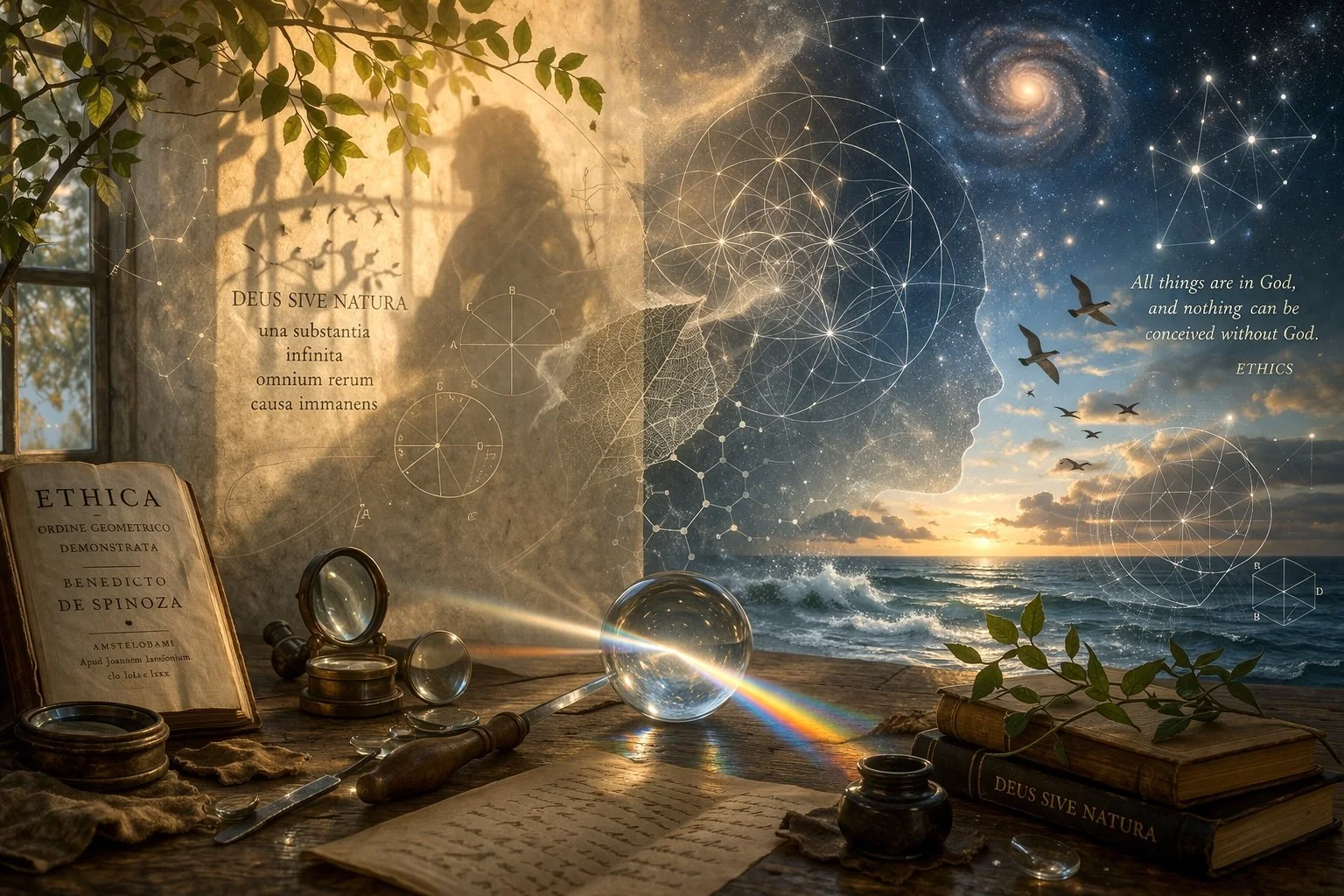
God is not above the world. God is the world.
The Big Idea
God isn’t somewhere else.
He is not a figure standing apart from the world, watching over it. That image, Spinoza thought, had caused more confusion than comfort.
For Spinoza, God and nature were one and the same thing. Two names for a single reality.
People, he believed, wasted their lives begging heaven for answers when the divine was already all around them, in every leaf, cloud, and thought. God was not a supervisor pulling strings from above, but the very structure of existence itself.
This was not atheism. It was something far more unsettling.
Spinoza rejected the idea of a supernatural ruler handing out rewards and punishments and offered instead a universe that runs on reason, necessity, and beauty all at once. To understand nature, he said, is to understand God.
Which, come to think of it, makes science a kind of prayer.
The Man and the Moment
Baruch, or Benedictus, Spinoza was born in 1632 in Amsterdam, the son of Portuguese Jews who had fled the Inquisition. Amsterdam in the seventeenth century was one of the few places where people could think freely, or at least appear to. The air smelled of ink, fish, and possibility.
Ships arrived from every corner of the known world, carrying sugar, silk, and ideas. Printers argued with preachers, merchants debated theology over coffee, and philosophy was quietly becoming Europe’s most dangerous hobby.
Into this bustling marketplace of minds came Spinoza, quiet, curious, and unflappable. The sort of young man who, when told ‘Because God says so’, would calmly ask to see the minutes from that meeting.
He wanted reasons, not rituals. Understanding, not authority.
By his twenties, he was asking questions his community could not tolerate. What if God wasn’t a person at all? What if ‘divine will’ was simply another way of describing the order of nature? What if prayer didn’t change the universe, but changed you?
In 1656, the rabbis of Amsterdam issued a herem, an excommunication so severe that his name was to be cursed ‘by day and by night’. No one was to speak to him, read him, or come near him.
For a man devoted to unity, it was the cruellest separation imaginable.
Spinoza did not protest or plead. He bowed his head, gathered his books, and left quietly.
He earned a modest living grinding lenses for microscopes and telescopes, an oddly perfect occupation for a man obsessed with clarity. The glass dust slowly ruined his lungs, and he died of tuberculosis at forty-five.
In that short life, he produced one of the most remarkable systems of thought ever written. It was as if he had decided that if peace could not be found in community, it would have to be built in logic.
Why It Mattered
Spinoza’s vision was both dazzlingly simple and terrifyingly radical.
He saw the universe as a single, infinite, self-sustaining whole. Everything that exists, stars, people, sadness, and yes, even the most ordinary things, are part of that one substance.
He called it Deus sive Natura. God, or Nature.
Not God and nature. Not two realms, one holy and one profane. One continuous reality.
To Spinoza, the laws of the universe were not divine commands. They were God. To understand them was the highest form of reverence.
This horrified the religious authorities of the day. No miracles. No divine moods. No heavenly interventions. Where did that leave prayer, worship, or sin?
Spinoza’s answer was calm and devastating. Right where they belong. Inside us.
As Albert Einstein would later say, ‘I believe in Spinoza’s God, who reveals himself in the orderly harmony of what exists.’ That is quite an endorsement.
His masterpiece, The Ethics, attempted to explain the entire universe using the method of geometry. Definitions. Axioms. Propositions. Corollaries. A Euclidean manual for the soul.
It is not exactly bedtime reading, but the ambition is breathtaking. Spinoza tried to deduce peace from reason, as if serenity itself could be proved with enough patience.
His ethics followed naturally from his physics. If everything is part of the same divine substance, then to harm another is to harm yourself. Evil is not a cosmic force but a misunderstanding. We suffer because we imagine ourselves as isolated fragments rather than expressions of a whole.
Freedom, for Spinoza, was not about breaking rules. It was about understanding necessity. The more clearly you see why things happen as they do, including your own impulses, the freer you become.
You stop being angry at the rain for falling.
And then there was love, his most quietly radical idea. Not romantic or sentimental love, but what he called the intellectual love of God. To understand reality fully is to love it, not because it is perfect, but because it could not be otherwise.
That is not resignation. It is reconciliation.
The Legacy
Spinoza was exiled in life and canonised by posterity.
The Enlightenment grew up in his shadow. Locke borrowed his tolerance, Hume his naturalism, and Einstein his awe. Modern humanism owes him a debt for the idea that morality can arise from understanding rather than decree.
His books were banned across Europe, which is usually a sign that something important has been said. They were read in secret by the same people who condemned them in public.
Quietly, his thought seeped into the bloodstream of Western philosophy, a slow antidote to superstition and fear. He gave people permission to think of God without terror, and to see science not as heresy but as reverence.
He lived alone, ground lenses, ruined his lungs, and still found beauty in the structure of reality.
It is hard not to admire that kind of courage, or that kind of calm.
In Our Time
If Spinoza were alive today, he would probably live quietly in a small flat, quietly going about his work and ignoring social media. He would make tea, watch the light move across the wall, and mutter something about divine geometry.
He would find modern life noisy and unnecessarily fragmented, obsessed with division, with drawing lines between science and faith, mind and body, fact and feeling. He would remind us that unity is not an aspiration. It is the way things already are.
Ask him if he believed in God, and he would likely smile, point at the nearest tree, and say, ‘You’re looking at it.’
Then he would return to his lenses.
He would be intrigued by artificial intelligence, another expression of nature trying to understand itself. ‘Even your machines,’ he might say, ‘are part of the same substance.’ Then, with gentle irony, he would ask whether we understand our own nature well enough to be replicating it.
Somewhere between the dust motes and the light, he would probably find peace.
Key Works
The Ethics (written 1660s, published 1677). His masterpiece, published posthumously because being accused of heresy was bad for business. Written in the geometric style of Euclid and breathtaking in its ambition.
Tractatus Theologico-Politicus (1670). The book that really upset everyone. A fierce defence of freedom of thought, arguing that religion should guide conscience, not control it.
Treatise on the Emendation of the Intellect (unfinished). A guide to thinking clearly and avoiding confusion. Unfinished, but already enough to make most of us nervous.
The Essence
‘All things are in God, and nothing can be conceived without God.’ — Ethics
Or, in modern terms, everything is connected.
Strip away the theology, the Latin, and the conditions of his time, and what remains is a man calmly saying: slow down, look around, and notice how beautifully everything fits.
Follow the thread:
Read Aristotle, Hobbes, Machiavelli, and others who shaped how we think.