
Art as Witness
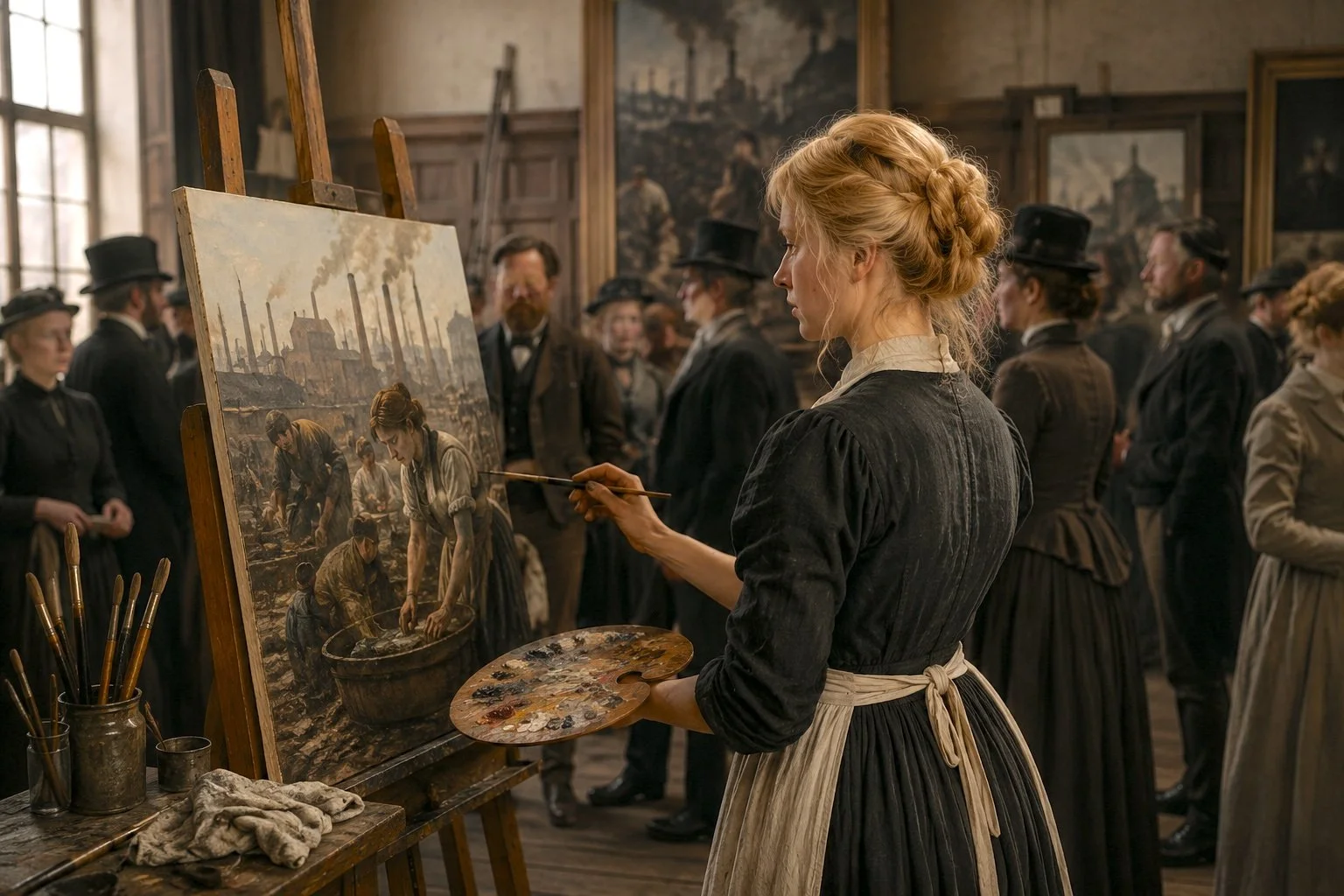
Seeing what is there, and refusing to look away
Unseen Souls was my first novel. It follows the life of Eliza Turner, a young woman shaped by the harsh industrial world of Dowlais in South Wales, whose talent for art gradually carries her into very different circles in late Victorian London.
The novel was grounded in extensive historical research into industrial Wales, Victorian London, labour, poverty, and the social realities of nineteenth-century life. Much of what Eliza witnesses — from the ironworks and coke yards of Dowlais to the hidden labour of laundries and domestic service — draws upon the lived conditions of the period.
As her work begins to attract attention, so too does the world she chooses to draw and paint. Through labourers, laundresses, ironworkers, and the overlooked poor, Eliza becomes associated with a growing movement for social reform, not through speeches or politics, but through the act of making difficult realities visible.
That idea sits at the centre of the novel.
Not art as decoration, nor art as escape, but art as witness.
There are many ways to describe the nineteenth century. An age of industry, expansion, reform, and contradiction.
It is also an age that learned, slowly and unevenly, how to confront aspects of itself that had long remained at the edges of public attention.
Reports were written. Statistics gathered. Parliamentary inquiries conducted. The language of reform took shape through documents, debates, and legislation. These mattered. They changed lives, sometimes profoundly.
But they did not always bring human experience fully into view.
There is a difference between knowing that something exists and feeling its reality.
Art occupies that space.
Not as sentiment, and not as ornament, but as a form of attention. A way of holding the world still long enough for its human weight to be acknowledged. Where reports describe conditions, art can render them immediate. Where numbers suggest scale, it can reveal cost.
At its best, this kind of work resists easy sentimentality.
To witness is not to soften suffering, but to present it without disguise.
By the later nineteenth century, a number of artists had begun turning their attention towards lives that had previously remained at the edges of serious art. Frank Holl painted exhaustion, grief, and urban poverty with an intensity that resisted sentimentality. Luke Fildes’s Applicants for Admission to a Casual Ward confronted viewers with the reality of homelessness and desperation in Victorian Britain. Hubert von Herkomer brought working-class labour and hardship into galleries more accustomed to wealth, mythology, and portraiture.
These works did not solve the conditions they depicted.
But they made avoidance more difficult.
In the industrial towns of Britain, much of life unfolded beyond the direct experience of those who governed or benefited from it. Labour was exhausting, repetitive, and often dangerous. Illness spread quickly through overcrowded streets. Entire households depended upon forms of work that remained largely unseen, particularly the labour of women.
These realities were not hidden because they were unknown. They were hidden because they were rarely confronted directly.
Art has the capacity to change that. Not by argument, but by presence.
A figure bent over a wash tub. Hands marked by labour. A room filled with steam and heat. A face that does not ask for pity, but does not conceal exhaustion either. Such images do not need to explain themselves. Their force lies in the simple fact that they insist upon recognition.
To encounter them is to acknowledge a reality that might otherwise remain comfortably distant.
This principle sits behind Eliza Turner’s work in Unseen Souls. Her paintings do not attempt to elevate suffering into something beautiful, nor reduce it to moral instruction. They insist, quietly but firmly, that it be recognised.
Her exhibition This Industrial Life brings into view the physical toll of labour: bodies shaped by work, endurance carried in posture and expression.
Her later series, The Price of White, turns towards those whose labour remains largely invisible: laundresses working in heat and isolation, sustaining the appearance of cleanliness for others at considerable cost to themselves.
In both, the act is the same.
To take what is overlooked and place it deliberately at the centre of attention.
Art cannot resolve injustice. It does not legislate, and it does not enforce. Its influence is quieter than that.
But it can alter what people are willing to see.
And once suffering has been rendered human rather than distant, once exhaustion has been given a face and a presence, indifference becomes more difficult to sustain.
That is where the power of witness begins.
Not in spectacle or sentiment, but in the simple refusal to look away.
From the research behind Unseen Souls