
Motive and Self-Deception
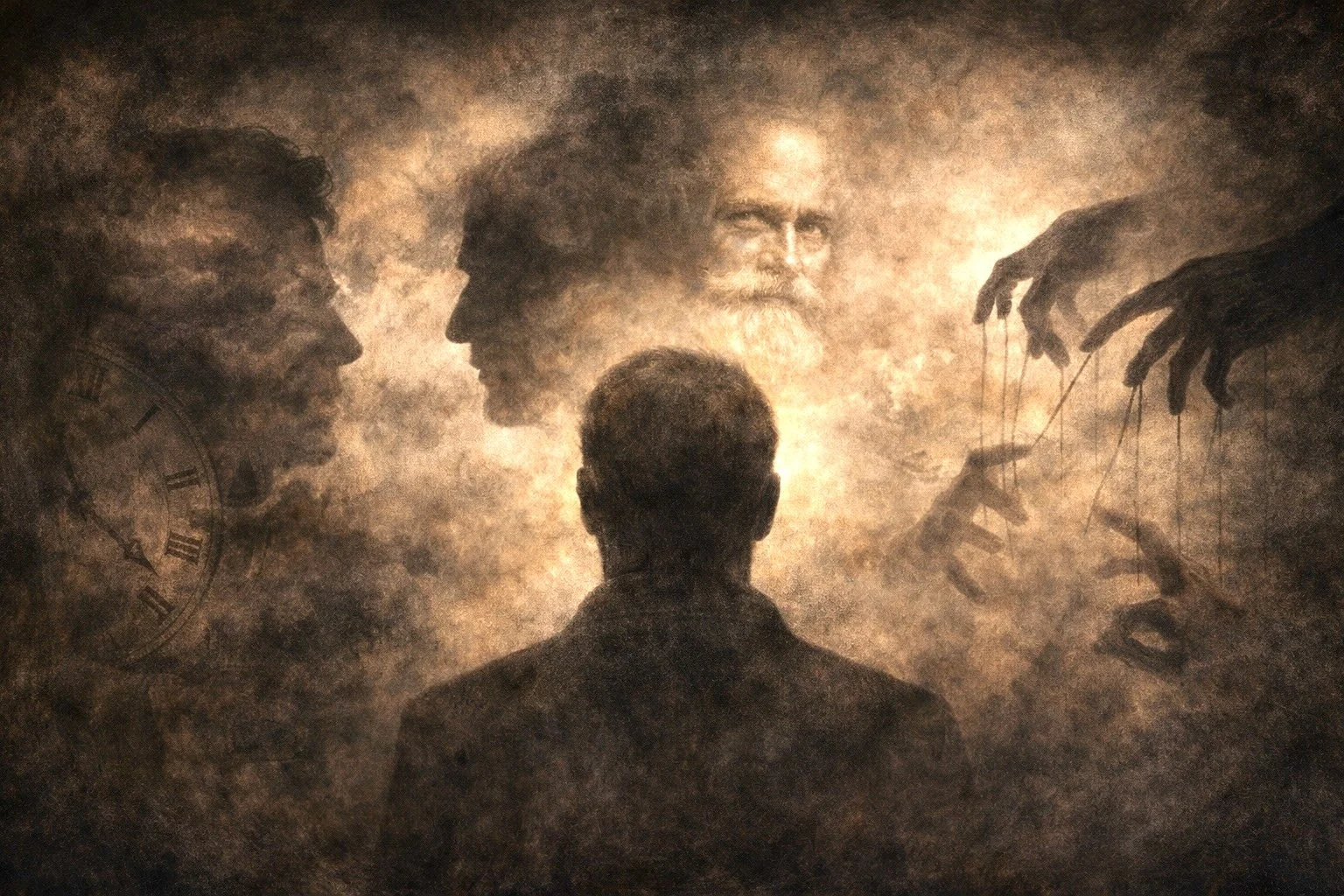
The lesser-known influences behind Owain Morgan
In developing the character of Owain Morgan, I wanted his intellect to emerge from the intellectual world of his time, rather than to feel imposed upon it.
He is not an invention placed into history, but a figure shaped by it.
An academic educated at Oxford and later in Edinburgh, he would naturally have encountered many of the ideas that were beginning to reshape the study of the human mind in the late nineteenth century. He would have read widely, not as a specialist confined to a single discipline, but as a thinker moving across philosophy, psychology, and moral inquiry.
What interested me was not simply what he might have read, but what he would have done with it.
Ideas, after all, are rarely absorbed unchanged. They are tested, adapted, and, over time, made personal. In that sense, Owain’s method is not borrowed. It is formed.
He draws on well-known figures such as William James, but also on thinkers who are less frequently read today, yet whose influence runs quietly beneath much of modern thought.
It is at that point, where historical ideas are internalised and reshaped, that the fictional and the factual begin to meet.
What connects these influences is a shared concern with what lies beneath outward behaviour. Not simply what is said, but the motive from which it arises.
Beneath the Surface
One of the most important of these influences is Henry Sidgwick (1838–1900).
Writing in the late nineteenth century, Sidgwick was concerned with the problem of moral reasoning. How we justify our actions to ourselves, and how easily that process can become distorted.
He was particularly interested in self-deception. Not the deliberate lie, but the quieter process by which we come to believe our own explanations. We shape our account of events in a way that allows us to feel justified in what we have already, often unconsciously, decided to do.
This insight sits close to Owain’s way of thinking. For him, the explanation offered is rarely the starting point. It is something that follows.
The Evidence of Behaviour
George Henry Lewes (1817–1878) approached the mind from a different direction.
Rather than focusing on abstract reasoning, he argued that mental life could be understood through observation. Not by asking what a person claims to think, but by attending to what they do.
In this sense, hesitation, omission, and pause are not empty moments. They are actions. Small, often unnoticed, but revealing. Traces of a thought process that has not fully resolved itself, or that is being quietly redirected.
Owain’s attention to silence owes much to this way of seeing.
Habit and the Shape of Action
Alexander Bain (1818–1903) extended this line of thought further.
He was interested in habit and repetition. The idea that patterns of behaviour reveal more about a person than any single statement.
What we do repeatedly acquires a kind of consistency that is difficult to disguise. Not because it is consciously chosen each time, but because it reflects something more deeply established. A tendency, a disposition, a way of responding to the world.
For Owain, this becomes an important principle. A single statement may be constructed. A pattern, sustained over time, is harder to control.
Contradiction and Truth
F. H. Bradley (1846–1924) approached the problem from yet another angle.
His concern was with contradiction. The points at which a system of thought begins to break down under its own weight.
For Bradley, contradiction revealed the limits of what we take to be reality.
Owain does not follow him into his broader metaphysical conclusions. But he recognises something important in the observation itself. When an account contains contradiction, it is rarely accidental. It marks a point of strain. A place where what is being said can no longer fully accommodate what is known, felt, or remembered. In that moment, something closer to the truth begins to surface.
The Psychology of Motive
Taken together, these ideas begin to form a coherent approach.
For Owain, understanding a person is not a matter of collecting statements. It is a matter of tracing the movement by which thought becomes action.
Memory, emotion, conscience, habit, and circumstance all play a part. What results is rarely simple, and rarely fully conscious. But it is not arbitrary because people act for reasons. They are simply not always aware of what those reasons are.
What This Means
In the world of the novels, this way of thinking shapes how Owain approaches both his academic work and his occasional involvement in investigation.
He is less interested in what can be demonstrated immediately, and more in what can be understood over time. Not the surface of an action, but the structure beneath it. Because it is there, in the tension between what is said and what is meant, that the deeper truth most often lies.
From the research behind The Silence of the White Shadow.