
Service and Silence
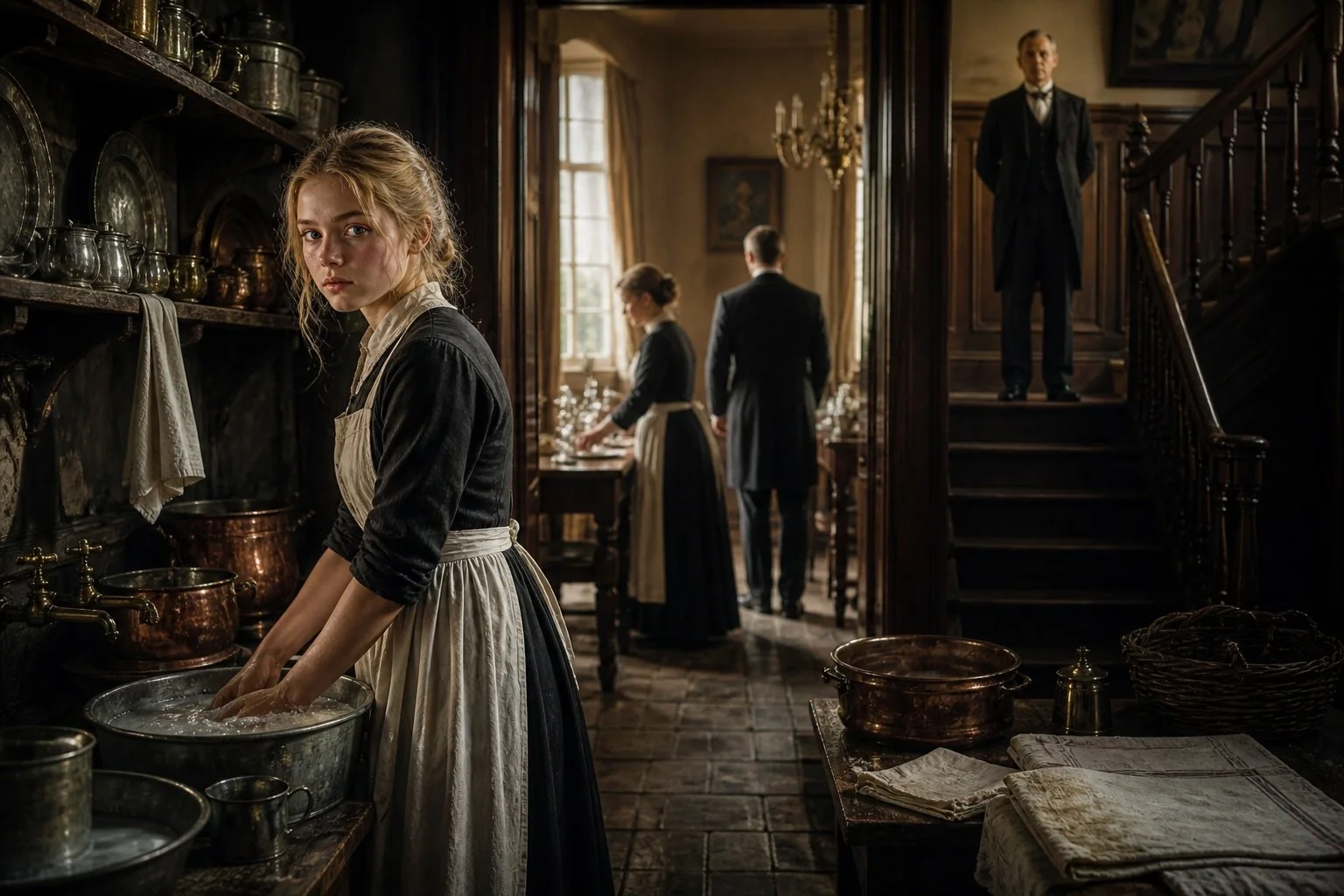
The hidden life of domestic servants in Victorian Britain
Unseen Souls traces the life of Eliza Turner as she moves from the ironworks of nineteenth-century Dowlais in South Wales to the households of London, where she enters service as a scullery maid. That world, so often glimpsed only at its edges, is central to her story.
By the late 1870s, it has been estimated that around 1.5 million people were employed in domestic service. The 1881 Census of England and Wales would later record it as the single largest occupation for women in the country.
At a time when Britain’s population stood at roughly thirty million, this meant that around one in twenty people worked in service. In some areas — particularly London, where Eliza’s journey takes her — the concentration was even more pronounced. A middle-class household might employ three to ten servants. In wealthier homes, such as that of the Ravensworth family, the number could be significantly higher.
They were everywhere, and yet rarely seen.
The household was not simply a place of work. It was a system. A structure defined by hierarchy, routine, and expectation. At the top stood the family. Beneath them, a carefully ordered chain of servants: butler, valet, footman, housekeeper, cook, parlourmaid, housemaid and scullery maid. Each role carried its own duties, its own place in the order, and its own limits. Movement within that structure was possible, but never easy.
Domestic service sat at the intersection of several realities. For many women, it was one of the few forms of stable employment available. Outside factories, laundries, or informal work, the alternatives were limited and often less secure. At the same time, the expansion of towns and cities, and the growth of the middle classes, reshaped expectations of household life. Respectability increasingly came to be measured, in part, by the presence of at least one servant.
The structure of service.
Most servants lived within the households that employed them. For young women leaving industrial towns or rural communities, this offered both accommodation and a form of economic security, however constrained. It was, at once, an opportunity and a confinement.
For those at the bottom, the work was relentless. Long hours. Early starts. Physical labour that left little room for rest.
The day began before the house itself had properly stirred. In the darkness or half-light of early morning, the scullery maid would rise to light the kitchen fires, coaxing heat into cold iron ranges, fetching water, and beginning the quiet work of cleaning what remained from the night before. By the time the rest of the household awoke, much of the labour that sustained it was already underway.
As the kitchen came to life, the rhythm of the day took hold. Pots clattered, water boiled, footsteps moved quickly across stone floors. Breakfast for the family above and the servants below had to be prepared and cleared in careful sequence. There was little time to pause. Even meals, when they came, were taken quickly, and often without rest.
Above stairs, rooms were opened, fires tended, and clothing laid out. Below, the work continued without interruption. Each movement followed the last. Each task gave way to another.
By mid-morning, the house had settled into its outward calm. But beneath that calm, the labour did not ease. Surfaces were cleaned, utensils scrubbed, preparations made for the next meal. The demands of the household shaped the pace of the day entirely. If guests were expected, the pressure intensified. More food. More preparation. More precision.
Roles in the household
Not all labour in the household was unskilled, nor was it without authority. At the centre of the kitchen stood the cook, a figure whose role combined experience, judgement, and control.
Her day was shaped not only by work, but by responsibility. She planned the meals, directed the kitchen staff, and ensured that everything leaving her domain met the standards expected above stairs. Dishes were not simply prepared, but managed — timed, tasted, adjusted. Feedback from the dining room, relayed through the servants who moved between the two worlds, was noted carefully. The success of the household’s daily rhythm depended, in no small part, upon her.
At the top of the structure stood the butler, a figure who embodied both authority and restraint. He moved between the worlds above and below stairs, ensuring that each functioned without friction.
His role was not defined by visible labour, but by coordination. Meals were served at the right moment, rooms prepared without error, guests received with the correct formality. Nothing was left to chance. The smoothness of the household depended upon his oversight. To the family, he was a quiet assurance that all was in order. To the staff below, he was both guide and judge, maintaining standards that could not be allowed to slip.
Alongside him stood the housekeeper, whose authority extended across the domestic life of the house itself. Where the butler ensured the smooth running of service, the housekeeper maintained the standards upon which that service depended.
Her work was constant and exacting. Rooms were inspected, fires checked, surfaces examined for the smallest trace of neglect. The appearance of order could not be left to chance. It had to be maintained, quietly and without interruption. She oversaw the housemaids and junior staff, correcting mistakes and reinforcing the habits expected of them. Cleanliness, precision, and discipline were not ideals, but requirements.
Much of this work took place out of sight, but its absence would have been immediately visible.
Evening brought no real relief. Dinner, often the most formal part of the day, required the greatest coordination. While the family dined above, courses were prepared, served, cleared, and replaced in swift succession. Below stairs, the work was at its most intense.
Only late at night did the pace begin to slow. Fires were checked. Doors secured. Lamps extinguished. The final traces of the day were cleared away.
For those who worked in the scullery, the labour often ended where it had begun — with cleaning. Pots, pans, floors, and surfaces brought back to order, ready for the next day to begin again.
It was a life measured not in hours, but in tasks.
Expectations
To be a good servant was, in many ways, to disappear.
Silence formed part of that discipline. Not only the absence of speech, but the suppression of opinion, feeling, even identity. Servants were expected to move quietly, to anticipate needs without being asked, and to remain unobtrusive at all times. The household depended upon them, but did not acknowledge them as equals within it.
It was a life lived in proximity, but not in belonging.
And yet, for many, service offered something that could not be found elsewhere. Regular meals. A roof over their head and a form of stability in a world where such things were far from guaranteed. For young women leaving industrial towns or rural poverty, it could represent both escape and constraint at once.
That tension shaped lives.
In fiction, the servant often appears at the edge of the scene — opening doors, carrying trays, moving quietly through rooms where others speak and decide. But behind that figure lies a far more complex reality. One defined not only by labour, but by observation.
Servants saw everything.
They witnessed the private lives of those they served: the fractures beneath respectability, the small hypocrisies, the unspoken tensions. They understood, often more clearly than their employers, how fragile the appearance of order could be.
But what they saw rarely found voice.
In Unseen Souls, Eliza Turner begins within this world. Not as an observer from a distance, but as someone shaped by its demands. The discipline of silence, the awareness of hierarchy, the habit of watching — these do not leave her. They become part of how she understands people, and, ultimately, how she represents them.
Because silence does not erase experience.
It stores it.
And in time, for some, it finds another way to speak.
From the research behind Unseen Souls