
The Sound of the Furnace
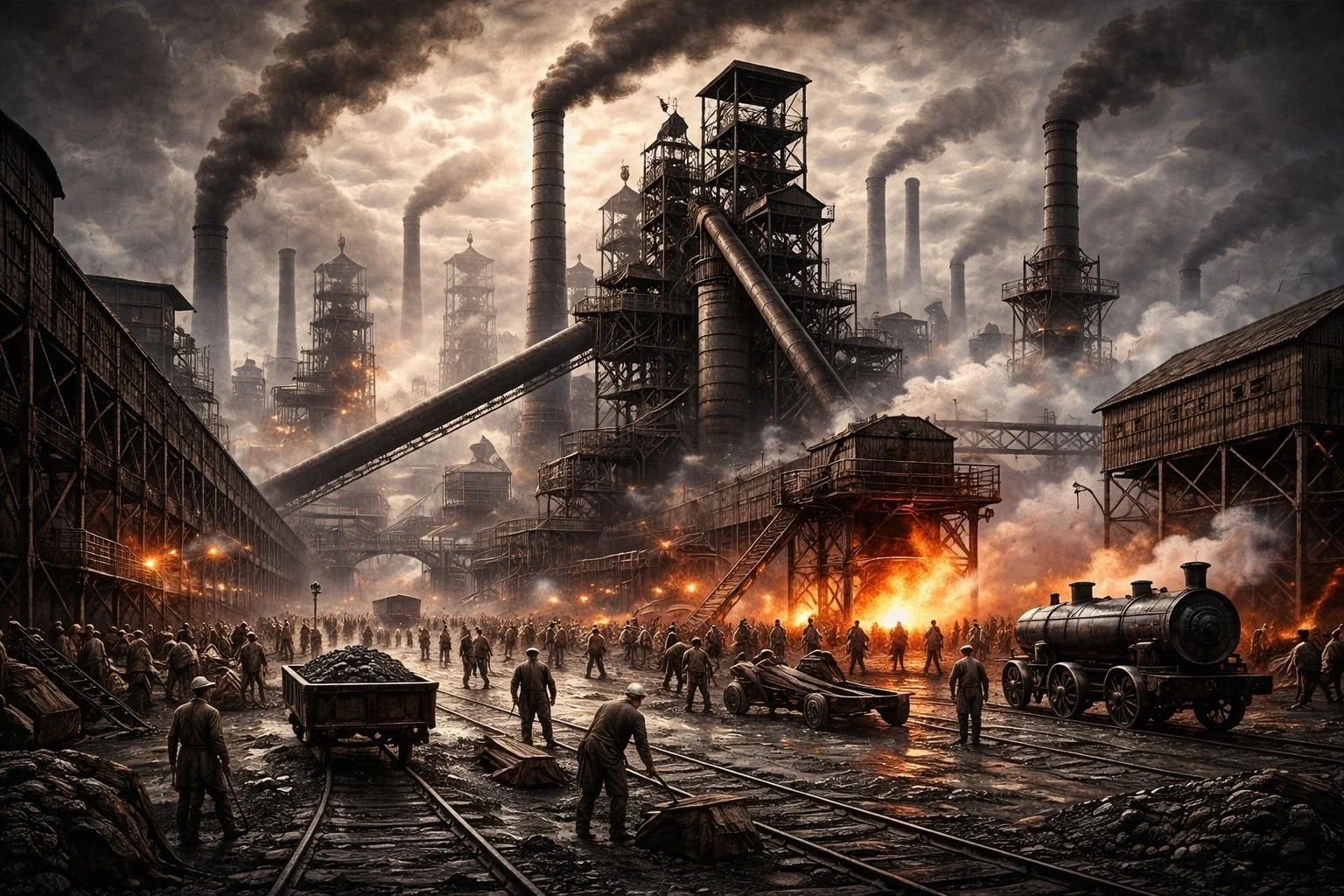
A working day in Dowlais
Unseen Souls is rooted in places I know, and in lives that are not recorded in any formal history
Dowlais, in particular, is not simply a setting. My grandmother was born there, and I visited as a child in the early 1960s, when the world it had once been had already begun to fade. By then, much had changed, but the presence of the ironworks still shaped the place. My great uncle had worked there, and stories of that life remained.
My father and grandfather were both coal miners. I grew up with a close understanding of what that kind of work demanded. It was hard, physical labour that left its mark, even on the strongest men.
In writing the novel, I have tried to remain as close as possible to accepted historical reality. But I have been less interested in events than in experience. Not simply what happened, but what it felt like to live and work in a place where labour shaped the rhythm of every day.
This note is an attempt to draw closer to that experience.
The working day at the Dowlais Ironworks in the mid-nineteenth century began before the light.
In Dowlais, the rhythm of life was not set by the rising of the sun, but by the demands of the ironworks. The first sound most people heard was not birdsong, but the distant bell or whistle calling men to their shift.
Work did not wait for comfort.
Men rose in darkness, often after only a few hours’ sleep, and made their way through narrow streets already marked by soot and ash. The air carried the smell of smoke long before they reached the furnaces themselves.
It was a world in motion before the day had properly begun.
Heat and Labour
Inside the works, the conditions were relentless.
Furnaces burned at temperatures that few could endure for long without consequence. The heat was constant, pressing in from all sides. Clothing offered little protection. Sweat mixed with soot and settled into the skin.
The work demanded strength, but more than that, it demanded endurance.
Iron had to be moved, shaped, and controlled at speed. There was little margin for error. A moment’s inattention could lead to injury, or worse.
And yet the work continued, hour after hour.
The Body at Work
Labour of this kind left its mark.
Hands hardened. Lungs strained against the dust and fumes. Backs bent under the weight of repeated effort. Injuries were common, and recovery was rarely complete.
There was no expectation of ease.
The body was part of the process, as much as the machinery. It was used, worn, and, when necessary, replaced.
Time and Survival
Time in the ironworks was measured differently.
A shift was not simply a number of hours, but a test of endurance. Meals were brief and functional. Bread, perhaps, or something carried from home. There was little space for rest.
Outside the works, life was organised around recovery.
Families adapted to the rhythm of labour. Women managed households under difficult conditions, often taking on additional work to supplement the family income. Children grew up quickly, drawn into the same cycle as soon as they were able.
Work shaped everything.
What Was Endured
It is easy, looking back, to reduce this world to statistics.
Production figures. Output. Expansion.
But those numbers tell only part of the story.
What mattered, day to day, was the experience of those who lived within it. The heat, the noise, the fatigue. The constant awareness that survival depended on continuing, regardless of discomfort or risk.
There was resilience here, but it was not romantic.
It was necessary.
A World Remembered
The Dowlais of Unseen Souls grows out of this reality.
It is not an exact reconstruction, but an attempt to remain faithful to the conditions that shaped the lives of those who worked there. The aim is not simply to describe the setting, but to convey something of what it felt like to inhabit it.
That world is not entirely distant to me.
I grew up in a mining village in South Wales, in a community where work was central to daily life. Many of those around me followed the same path into industrial labour. I worked in those environments myself, in coal yards and on production lines, where the demands of physical work were constant and unrelenting.
Those experiences inform the way I understand places like Dowlais.
What Remains
The furnaces of Dowlais no longer exist. They lie buried beneath car parks and supermarkets, their presence marked more by memory than by anything that can be seen.
And yet the past has not disappeared entirely.
It survives in fragments. In the old stables of the ironworks. In the Memorial Library and the Guest Reading Room, built as acts of paternal care and quiet control. In the lodge that once marked the entrance to Dowlais House. In the chapels that still stand, where communities gathered for solace, education, and a sense of belonging.
Even the streets retain something of their former shape. Rows of housing, altered but still recognisable, where generations lived within the orbit of the works.
These are not grand monuments. They are traces.
But taken together, they are enough to suggest what this place once was, and what it meant to those who lived here.
To write about such a place is not simply to describe it.
It is to recognise the people who endured it, and to acknowledge the reality of the world they helped to build.Not as abstractions, but as lived environments shaped by effort, necessity, and endurance.
From the research behind Unseen Souls