
The Weight of a Word
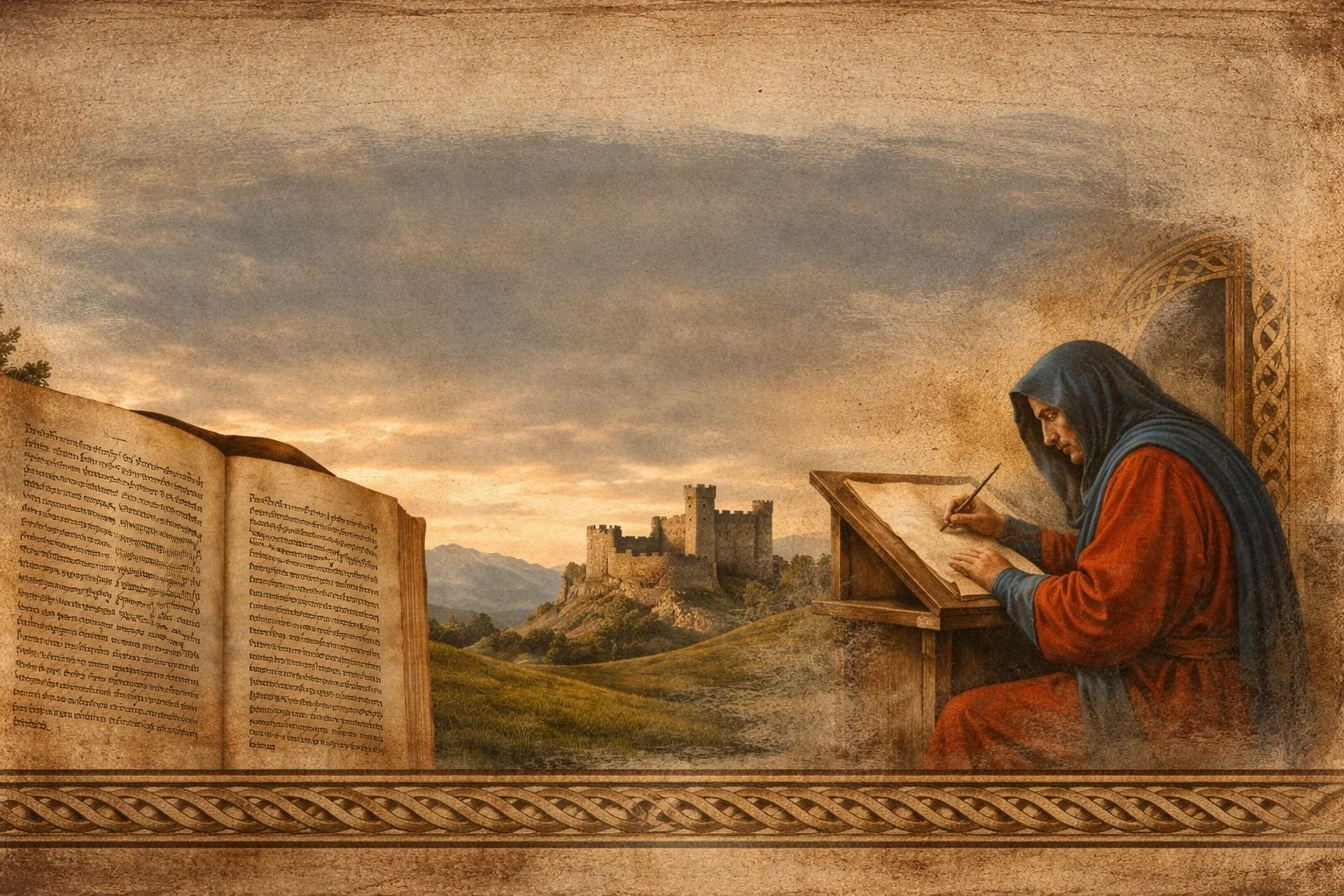
Middle Welsh, Latin, and the fragile art of translation in the world behind the story
Language is rarely as stable as we imagine it to be. That simple idea sits at the heart of my first Owain Morgan novel, The Silence of the White Shadow.
This piece draws on the real history that made that idea plausible.
In the medieval Welsh manuscripts that survive from the twelfth and thirteenth centuries, meaning is often uncertain. It shifts with the hand of the scribe, the habits of the writer, and the expectations of the reader. A single word can carry more than one sense. A single phrase can tilt a passage in one direction or another.
This is the world of Middle Welsh, Cymraeg Canol, the language of the law codes attributed to Hywel Dda and of the prose later gathered under the name of the Mabinogion, a collection of medieval Welsh tales drawn from much earlier oral tradition, preserved in manuscripts of the thirteenth and fourteenth centuries.
Hywel Dda, or Hywel ap Cadell, ruled much of Wales in the early tenth century, from around 920 until his death in 950. He is remembered not only as a king, but as a lawgiver. The legal traditions associated with his name, though compiled and written down in later centuries, reflect an attempt to order society through custom, judgement, and a shared understanding of justice.
These laws survive in Middle Welsh manuscripts, copied and recopied by generations of scribes. They do not present a single fixed text, but a living tradition, shaped by time, region, and interpretation. These texts don’t exist in a single original form. They were copied and changed over time, so what we read today reflects many different hands and moments, rather than just one.
It is within that shifting inheritance that the language must be understood.
Middle Welsh was the main form of the language used between the twelfth and fifteenth centuries. More survives from this period than from any earlier stage of Welsh, and it developed directly from Old Welsh.
It is recognisably Welsh, but not the Welsh spoken today. Its spelling is inconsistent, its grammar less settled, and its vocabulary often dependent on context in ways that resist easy translation. In some manuscripts, even the smallest variation, an added consonant or a shifted ending, can alter the force of a sentence.
It is, in other words, a language in which certainty is hard won.
And that uncertainty matters.
Because in the world of my novel, it is within one such ambiguity that everything begins to unravel.
Victorian Certainty
By the nineteenth century, scholars had begun the serious work of editing and translating medieval Welsh texts. Their efforts were often remarkable. They were painstaking, detailed, and in many ways foundational.
But they were also limited.
They worked with incomplete dictionaries and inconsistent grammars. More importantly, they often approached Welsh material through the intellectual frameworks they already knew, shaped by Latin, classical tradition, and a broader Anglocentric understanding of history.
Where Welsh and Latin appeared side by side, there was a tendency to assume that the Welsh reflected the Latin. It was expected to confirm rather than challenge it.
Middle Welsh does not always allow for that kind of certainty.
Its spelling varies from manuscript to manuscript. Words shift in meaning depending on context, date, or the habits of a particular scribe. Mutations, the subtle changes to the beginnings of words, can alter not just grammar but emphasis and legal force. Bilingual texts, far from offering clarity, often demand interpretation rather than simple translation.
It is a language that resists being forced into neat alignment.
Rutherford’s Discovery
In the novel, it is within this instability that Dr Meirion Rutherford finds his way through.
He notices a small grammatical construction in the Dolwyddelan Codex, something his mentor Professor Arthur Cavendish had passed over. Not because he lacked the ability to see it, but because he had learned, over time, not to look for it.
Cavendish assumed the primacy of Latin. When the two languages appeared together, he expected the Welsh to follow.
Rutherford did not.
Reading the Welsh on its own terms, and with a closer familiarity with medieval law texts, he recognised that a key passage did not mirror the Latin at all. It modified it, quietly but decisively.
The phrase was:
a gwnaethpwyt gyttyn
(roughly pronounced “ah gwneth-poo-it guth-in”)
Usually rendered simply as ‘and it was agreed’.
But in Middle Welsh legal contexts, it carries a more specific weight. It refers to a mutual compact, an agreement between parties standing in parity, rather than an act of submission or grant.
It is a small distinction.
But it changes everything.
Two Readings, Two Histories
From that single phrase, two entirely different interpretations emerge.
Rutherford reads:
‘And a compact was made between them, in equal standing, with neither service nor subordination.’
Cavendish reads:
‘And a grant was made unto him, binding him to service and rightful obedience.’
The difference is not merely linguistic.
In one version, the Welsh acknowledge English supremacy.
In the other, they enter into a negotiated relationship, one that implies parity rather than fealty.
A single verb unsettles an entire historical framework.
There are real precedents for this kind of divergence. The Treaty of Waitangi, signed in 1840, survives in both English and Māori versions. Yet the two do not say quite the same thing. Where the English text speaks of sovereignty, the Māori suggests something closer to governance. The difference is slight in wording, but profound in consequence, and it continues to shape interpretation to this day.
Even within older traditions, the same pattern appears. In the translation of biblical texts, a single Greek word, metanoia, originally meaning a change of mind or inner transformation, came to be rendered as repentance. The shift is subtle, but it alters the entire emphasis of the idea, from inward reflection to moral correction.
Meaning, once fixed in translation, begins to move.
What Could Not Be Seen
The error, then, is not simply linguistic. It is ideological.
For years, Cavendish’s scholarship has rested on a particular understanding of history, one in which hierarchy is assumed, and in which Welsh sources are expected to confirm English authority rather than complicate it.
He does not misread the text out of carelessness.
He misreads it because he cannot easily see beyond the structure of thought he has spent a lifetime building.
Rutherford approaches the text differently, with less certainty perhaps, but with greater openness to what it might contain.
That difference becomes the fault line between them.
Where Language and Life Meet
In the end, this is not only a question of translation.
It is a question of what we allow ourselves to see.
A small grammatical construction becomes the point at which:
a reputation begins to fracture
a body of work is quietly threatened
a man is forced to confront the possibility that he has misunderstood the very thing he set out to explain
Middle Welsh, in this sense, is more than a linguistic medium.
It is the place where meaning shifts, where certainty falters, and where the past resists being made too simple.
And in that moment, when a single word begins to carry more weight than it should, the tragedy of Dolwyddelan begins.
From the research behind The Silence of the White Shadow.