
Aristotle
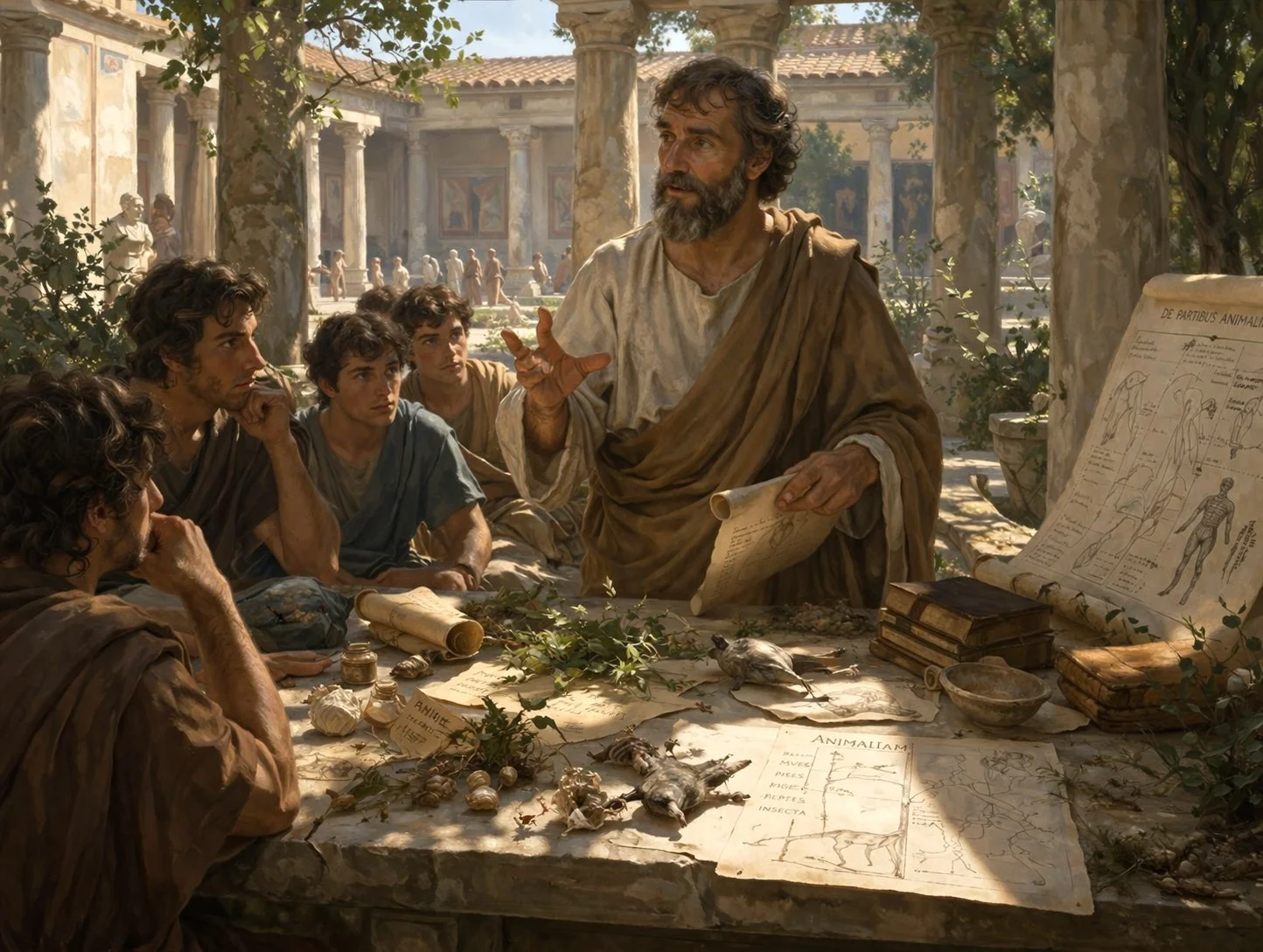
Observation, Purpose, and the Shape of Understanding
The Big Idea
Knowledge begins with attention.
Aristotle believed that understanding does not come from abstract speculation alone, but from careful observation of the world as it is. Where Plato looked beyond appearances to enduring Forms, Aristotle turned his attention to the things themselves, asking how they function, how they change, and what they are for.
He held that the world is intelligible because it has structure. That structure is not hidden in a separate realm, but revealed through experience, provided we take the time to observe it properly.
In this sense, knowledge is built gradually. It begins with perception, develops through comparison, and matures into understanding. The task of the thinker is not to escape the world, but to examine it closely enough to see how it works.
The Man and the Moment
Aristotle was born in 384 BCE in Stagira, in northern Greece. His father was a physician to the Macedonian court, and from an early age Aristotle was exposed to the idea that knowledge should be both precise and useful.
At seventeen, he travelled to Athens to study at Plato’s Academy, where he remained for nearly twenty years. The relationship was one of deep respect, but also of growing difference. Plato sought truth beyond the world of appearances; Aristotle sought it within the world itself.
After Plato’s death, Aristotle left Athens and spent several years travelling, studying, and teaching. During this period he became tutor to the young Alexander of Macedon, later known as Alexander the Great, an arrangement that paired philosophical reflection with political ambition in a way that history would remember.
When Aristotle returned to Athens, he founded his own school, the Lyceum. Teaching often took place while walking, and his followers became known as the Peripatetics. Philosophy, for Aristotle, was not a static activity. It moved, observed, and responded.
Why It Mattered
Aristotle’s lasting contribution lies in his method.
He approached knowledge systematically, asking a series of questions about any object or idea. What is it made of? What form does it take? What brought it into being? And what is its purpose?
These became his four causes:
1. Material – what something is made of
2. Formal – its structure or pattern
3. Efficient – what brings it into being
4. Final – its purpose
The final cause, purpose, sits at the centre of his thinking. Aristotle believed that things are best understood in terms of what they are directed towards. An acorn is understood by the oak it may become. A tool is understood by what it is designed to do.
This idea extends to human life.
Aristotle described the goal of human existence as eudaimonia, often translated as happiness, though the meaning is closer to flourishing. It is not a passing feeling, but a way of living well, developing one’s capacities, acting with virtue, and becoming what one is capable of being.
Virtue, in this account, is not innate. It is formed through habit. We become just by acting justly, courageous by acting with courage. Character is shaped through repetition.
He also argued that virtue lies between extremes. Courage, for example, exists between cowardice and recklessness; generosity between excess and deficiency. This principle, known as the doctrine of the mean, reflects his broader commitment to balance and proportion.
In Owain Morgan’s Method
Aristotle’s influence on Owain Morgan is evident in his attention to behaviour and purpose.
Owain observes not only what people say, but what they do, and how they tend to act over time. He recognises that character is not revealed in a single moment, but through actions that show a consistent direction.
But he also asks what those actions are directed towards.
Behaviour is rarely without purpose. Even when unspoken, it aims at something — preservation, advantage, avoidance, or control.
To understand an action, one must consider not only how it occurs, but what it seeks to achieve.
In this, observation becomes a disciplined practice.
Understanding is built not from assumption, but from attention.
The Present Question
If knowledge begins with observation, then the question is not simply what we see, but how carefully we attend to it.
It is possible to look without noticing, to encounter the world without examining it. Patterns may be present, but remain unrecognised if attention is shallow or distracted.
Understanding requires patience.
It requires the willingness to observe, to compare, and to resist the temptation to move too quickly from perception to conclusion. What appears obvious may not yet be understood, and what is familiar may not have been examined.
The discipline Aristotle describes is therefore not abstract. It is a way of engaging with the world that demands care, consistency, and restraint.
The Legacy
Aristotle’s influence extends across philosophy, science, and education.
For centuries, his works formed the foundation of intellectual life in both the Islamic world and medieval Europe. His methods shaped the development of logic, natural science, and ethical inquiry, and his questions continued to guide thinkers long after his conclusions had been challenged.
Even when later figures overturned aspects of his work, they did so by engaging with it directly. His influence lies not only in what he concluded, but in how he approached the task of understanding.
Key Works
The Nicomachean Ethics (c. 340 BCE). A study of virtue and the nature of a flourishing life.
Politics (c. 330 BCE). An exploration of society and the organisation of the state.
Poetics (c. 335 BCE). The first work of literary criticism, analysing tragedy with surgical precision.
Metaphysics (compiled c. 340–320 BCE) – A dense and ambitious inquiry into being itself.
On the Soul (De Anima) (c. 350 BCE) – Early psychology, asking what it means for something to be alive.
The Essence
We understand the world not by escaping it, but by attending to it.
Knowledge grows through observation, reflection, and the gradual recognition of pattern, and what we become is shaped by what we repeatedly do.