
Plato
Seeing Beyond Appearances
The Big Idea
We do not simply see the world. We interpret it.
Plato believed that what we encounter each day — objects, people, opinions — are not reality itself, but imperfect representations of something more stable beneath them. He called these underlying realities Forms: not physical things, but enduring ideas such as justice, beauty, and truth.
A just action is never perfect justice, only an approximation. A beautiful object fades, but the idea of beauty does not. What we perceive is always partial, shaped by circumstance and perspective.
For Plato, the visible world is convincing, but not ultimate. It resembles a copy rather than an original, something that reflects truth without fully containing it.
The task of philosophy, then, is not to accumulate opinions, but to learn how to distinguish appearance from reality.
The Man and the Moment
Plato was born around 427 BCE into an aristocratic Athenian family during a period of cultural achievement and political instability. Athens was intellectually vibrant, but increasingly uncertain, and the tension between power and principle was never far from view.
As a young man, Plato became a student of Socrates, whose method of questioning challenged assumptions and exposed the fragility of unexamined belief. Philosophy, in this form, was not abstract speculation but a way of living with intellectual honesty.
That belief was tested when Socrates was executed in 399 BCE.
For Plato, the event marked a decisive break. A society that prided itself on reason had silenced one of its most rigorous thinkers. Democracy, it seemed, could turn against truth when truth became inconvenient.
He left Athens and travelled, encountering different cultures, systems of thought, and forms of political power. These experiences reinforced his concern that human judgment, left to itself, was unreliable.
When he returned, he founded the Academy, an institution devoted to disciplined inquiry. His aim was not simply to produce clever thinkers, but to cultivate individuals capable of recognising truth and ordering their lives accordingly.
Why It Mattered
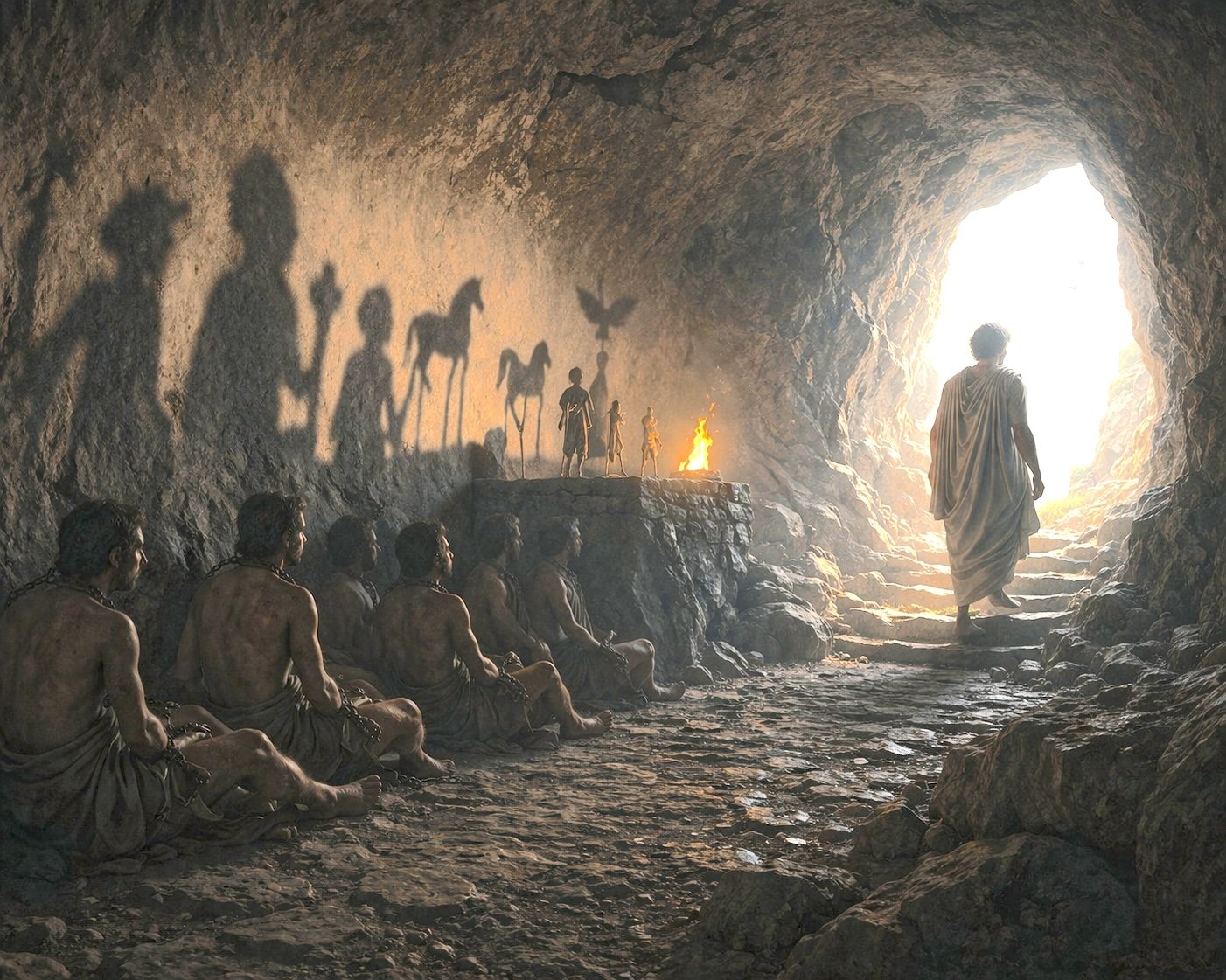
Plato illustrates this difficulty through his Allegory of the Cave, one of the most enduring images in philosophy.
He asks us to imagine people chained inside a cave, facing a wall. Behind them burns a fire, and between the fire and the prisoners, objects are carried back and forth, casting shadows onto the surface before them. The prisoners see only these shadows, and, having known nothing else, take them for reality.
They name them, argue about them, and build their understanding of the world around them. The most admired among them are those best able to predict which shadow will appear next.
When one prisoner is freed, he turns and sees the fire for the first time, and begins to understand that what he had taken to be reality was only a projection. He stumbles out into daylight, disoriented and uncertain, but gradually comes to see the world as it is.
If he returns to the cave to explain what he has seen, he is not welcomed. The others insist that the shadows are all that matter. Some would rather silence him than accept that they have been mistaken.
Plato’s point is precise. The danger is not ignorance, but familiarity.
The cave is not confined to any particular time. Wherever appearances are taken for reality, and wherever repetition hardens into belief, the same pattern emerges. What is encountered often enough begins to feel true, and what is familiar becomes difficult to question.
To move beyond this requires more than information. It requires attention, a willingness to pause, to question what is presented, and to consider that what appears clear may not yet be fully understood.
Plato understood that this movement is not easy. Those who turn away from the shadows often appear uncertain, because they resist the comfort of immediate certainty. For that reason, they are rarely the most admired voices.
Education, for Plato, is not the accumulation of knowledge, but the turning of the mind toward what endures beyond appearance.
In Owain Morgan’s Method
Plato’s influence on Owain Morgan lies in a shared suspicion of appearances.
Owain does not assume that what is presented reflects the underlying reality of a situation. He listens carefully, recognising that statements are often shaped by perception rather than fact.
A coherent account may still be incomplete, limited by understanding, memory, or the desire to present events in a particular way.
What appears straightforward may, on closer examination, prove to be only a surface.
Owain therefore treats appearances as a starting point, not a conclusion.
Clarity emerges gradually, often through the careful reconsideration of what first seemed obvious.
The Present Question
If perception is shaped by familiarity, then understanding requires effort.
What we encounter repeatedly begins to feel true, not because it has been fully examined, but because it has become known. The mind settles into patterns of recognition, and those patterns can obscure as much as they reveal.
To move beyond this requires more than information. It requires attention, a willingness to pause, to question what is presented, and to consider that what appears clear may not yet be fully understood.
This movement is rarely comfortable. It introduces uncertainty where certainty once stood.
Yet without it, understanding cannot deepen.
The Legacy
Plato’s influence extends across philosophy, politics, and education.
His theory of Forms shaped centuries of metaphysical thought, while his method of dialogue influenced how philosophical inquiry itself is conducted. His ideas were preserved, developed, and contested by later thinkers, forming a central strand of Western intellectual history.
Even where his conclusions have been challenged, his questions remain.
What is truth? How do we recognise it? And what is the relationship between knowledge and power?
These questions continue to define philosophical inquiry.
Key Works
The Apology (c. 399 BCE) – Plato’s account of Socrates’ trial. Clear, defiant, and painfully relevant.
The Republic (c. 380 BCE) – A vision of justice, truth, and power that still unsettles political theory.
The Symposium (c. 385–370 BCE) – A philosophical dinner party exploring love and meaning.
The Phaedo (c. 385 BCE) – Socrates’ final hours and a meditation on death and the soul.
The Essence
We do not simply see.
We interpret.
And what we take to be reality may, at times, be only its reflection.