

Landscape, history and the human thread.
Many of my ideas begin with a walk. Others emerge from history, books, photography and forgotten stories. This notebook gathers them together in one place.
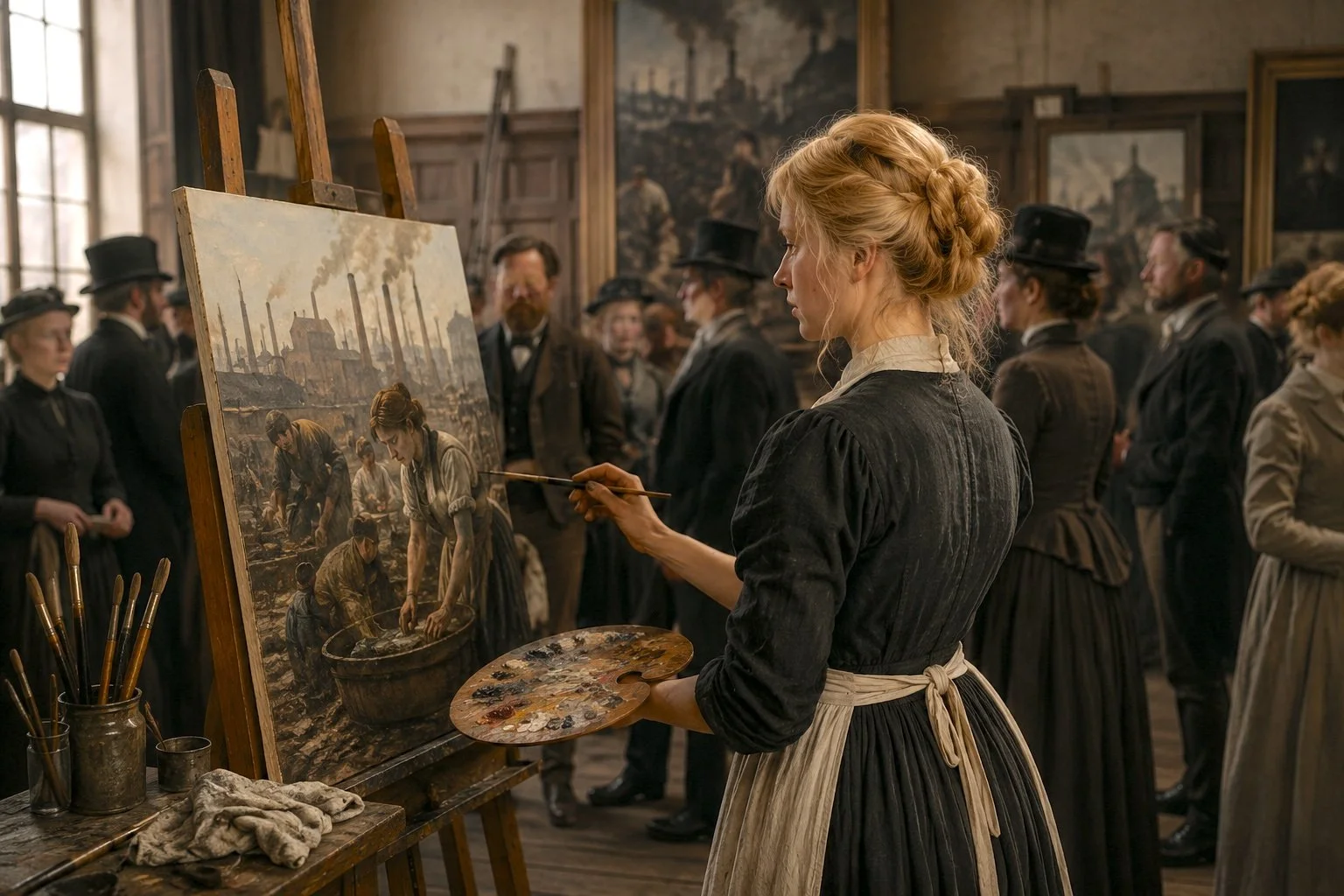
Art as Witness
How art, attention, and witness helped expose the hidden realities of industrial Britain.
Seeing what is there, and refusing to look away
Unseen Souls was my first novel. It follows the life of Eliza Turner, a young woman shaped by the harsh industrial world of Dowlais in South Wales, whose talent for art gradually carries her into very different circles in late Victorian London.
The novel was grounded in extensive historical research into industrial Wales, Victorian London, labour, poverty, and the social realities of nineteenth-century life. Much of what Eliza witnesses — from the ironworks and coke yards of Dowlais to the hidden labour of laundries and domestic service — draws upon the lived conditions of the period.
As her work begins to attract attention, so too does the world she chooses to draw and paint. Through labourers, laundresses, ironworkers, and the overlooked poor, Eliza becomes associated with a growing movement for social reform, not through speeches or politics, but through the act of making difficult realities visible.
That idea sits at the centre of the novel.
Not art as decoration, nor art as escape, but art as witness.
There are many ways to describe the nineteenth century. An age of industry, expansion, reform, and contradiction.
It is also an age that learned, slowly and unevenly, how to confront aspects of itself that had long remained at the edges of public attention.
Reports were written. Statistics gathered. Parliamentary inquiries conducted. The language of reform took shape through documents, debates, and legislation. These mattered. They changed lives, sometimes profoundly.
But they did not always bring human experience fully into view.
There is a difference between knowing that something exists and feeling its reality.
Art occupies that space.
Not as sentiment, and not as ornament, but as a form of attention. A way of holding the world still long enough for its human weight to be acknowledged. Where reports describe conditions, art can render them immediate. Where numbers suggest scale, it can reveal cost.
At its best, this kind of work resists easy sentimentality.
To witness is not to soften suffering, but to present it without disguise.
By the later nineteenth century, a number of artists had begun turning their attention towards lives that had previously remained at the edges of serious art. Frank Holl painted exhaustion, grief, and urban poverty with an intensity that resisted sentimentality. Luke Fildes’s Applicants for Admission to a Casual Ward confronted viewers with the reality of homelessness and desperation in Victorian Britain. Hubert von Herkomer brought working-class labour and hardship into galleries more accustomed to wealth, mythology, and portraiture.
These works did not solve the conditions they depicted.
But they made avoidance more difficult.
In the industrial towns of Britain, much of life unfolded beyond the direct experience of those who governed or benefited from it. Labour was exhausting, repetitive, and often dangerous. Illness spread quickly through overcrowded streets. Entire households depended upon forms of work that remained largely unseen, particularly the labour of women.
These realities were not hidden because they were unknown. They were hidden because they were rarely confronted directly.
Art has the capacity to change that. Not by argument, but by presence.
A figure bent over a wash tub. Hands marked by labour. A room filled with steam and heat. A face that does not ask for pity, but does not conceal exhaustion either. Such images do not need to explain themselves. Their force lies in the simple fact that they insist upon recognition.
To encounter them is to acknowledge a reality that might otherwise remain comfortably distant.
This principle sits behind Eliza Turner’s work in Unseen Souls. Her paintings do not attempt to elevate suffering into something beautiful, nor reduce it to moral instruction. They insist, quietly but firmly, that it be recognised.
Her exhibition This Industrial Life brings into view the physical toll of labour: bodies shaped by work, endurance carried in posture and expression.
Her later series, The Price of White, turns towards those whose labour remains largely invisible: laundresses working in heat and isolation, sustaining the appearance of cleanliness for others at considerable cost to themselves.
In both, the act is the same.
To take what is overlooked and place it deliberately at the centre of attention.
Art cannot resolve injustice. It does not legislate, and it does not enforce. Its influence is quieter than that.
But it can alter what people are willing to see.
And once suffering has been rendered human rather than distant, once exhaustion has been given a face and a presence, indifference becomes more difficult to sustain.
That is where the power of witness begins.
Not in spectacle or sentiment, but in the simple refusal to look away.
From the research behind Unseen Souls
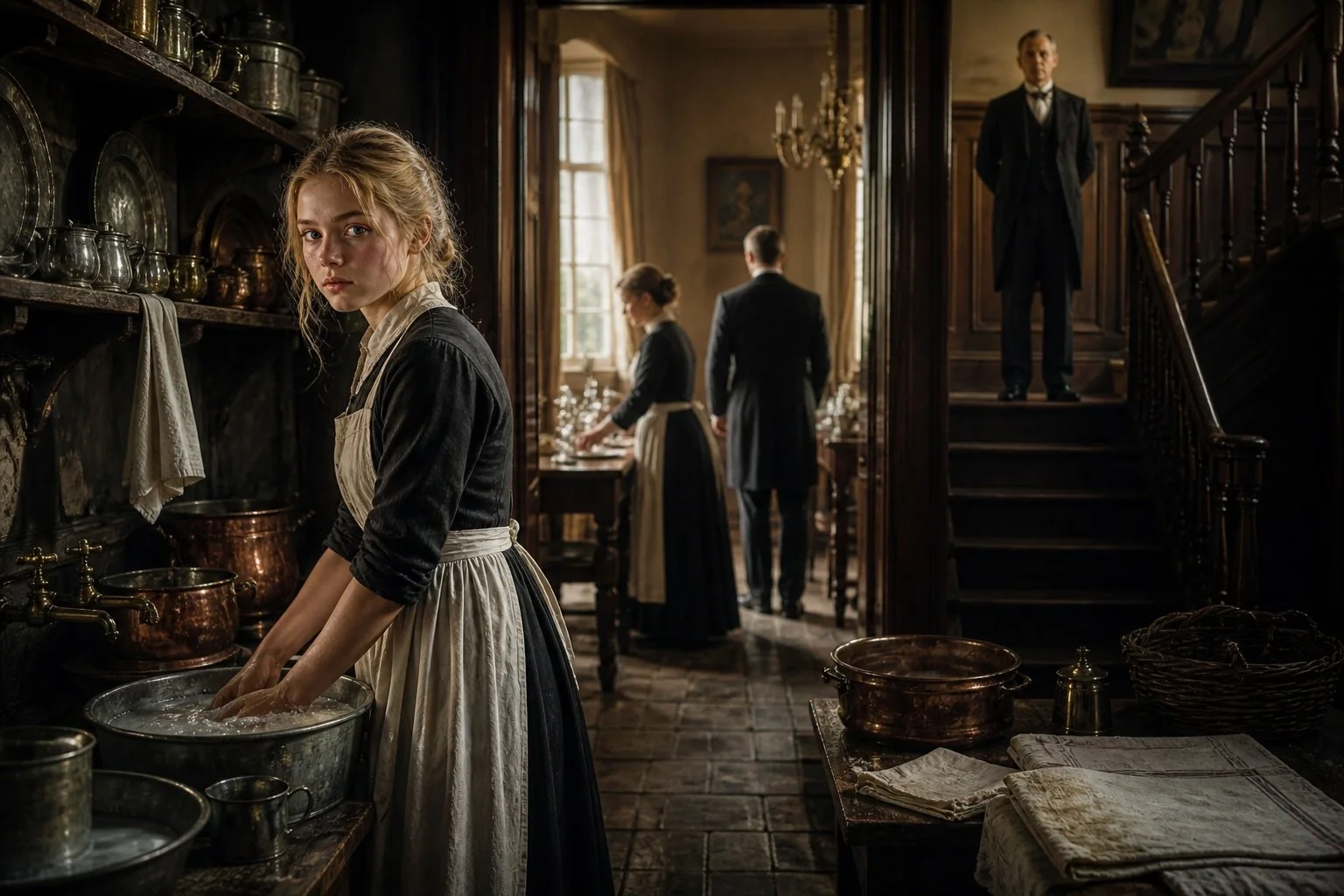
Service and Silence
Exploring the life of servants in late nineteenth century London through Eliza Turner in Unseen Souls.
The hidden life of domestic servants in Victorian Britain
Unseen Souls traces the life of Eliza Turner as she moves from the ironworks of nineteenth-century Dowlais in South Wales to the households of London, where she enters service as a scullery maid. That world, so often glimpsed only at its edges, is central to her story.
By the late 1870s, it has been estimated that around 1.5 million people were employed in domestic service. The 1881 Census of England and Wales would later record it as the single largest occupation for women in the country.
At a time when Britain’s population stood at roughly thirty million, this meant that around one in twenty people worked in service. In some areas — particularly London, where Eliza’s journey takes her — the concentration was even more pronounced. A middle-class household might employ three to ten servants. In wealthier homes, such as that of the Ravensworth family, the number could be significantly higher.
They were everywhere, and yet rarely seen.
The household was not simply a place of work. It was a system. A structure defined by hierarchy, routine, and expectation. At the top stood the family. Beneath them, a carefully ordered chain of servants: butler, valet, footman, housekeeper, cook, parlourmaid, housemaid and scullery maid. Each role carried its own duties, its own place in the order, and its own limits. Movement within that structure was possible, but never easy.
Domestic service sat at the intersection of several realities. For many women, it was one of the few forms of stable employment available. Outside factories, laundries, or informal work, the alternatives were limited and often less secure. At the same time, the expansion of towns and cities, and the growth of the middle classes, reshaped expectations of household life. Respectability increasingly came to be measured, in part, by the presence of at least one servant.
The structure of service.
Most servants lived within the households that employed them. For young women leaving industrial towns or rural communities, this offered both accommodation and a form of economic security, however constrained. It was, at once, an opportunity and a confinement.
For those at the bottom, the work was relentless. Long hours. Early starts. Physical labour that left little room for rest.
The day began before the house itself had properly stirred. In the darkness or half-light of early morning, the scullery maid would rise to light the kitchen fires, coaxing heat into cold iron ranges, fetching water, and beginning the quiet work of cleaning what remained from the night before. By the time the rest of the household awoke, much of the labour that sustained it was already underway.
As the kitchen came to life, the rhythm of the day took hold. Pots clattered, water boiled, footsteps moved quickly across stone floors. Breakfast for the family above and the servants below had to be prepared and cleared in careful sequence. There was little time to pause. Even meals, when they came, were taken quickly, and often without rest.
Above stairs, rooms were opened, fires tended, and clothing laid out. Below, the work continued without interruption. Each movement followed the last. Each task gave way to another.
By mid-morning, the house had settled into its outward calm. But beneath that calm, the labour did not ease. Surfaces were cleaned, utensils scrubbed, preparations made for the next meal. The demands of the household shaped the pace of the day entirely. If guests were expected, the pressure intensified. More food. More preparation. More precision.
Roles in the household
Not all labour in the household was unskilled, nor was it without authority. At the centre of the kitchen stood the cook, a figure whose role combined experience, judgement, and control.
Her day was shaped not only by work, but by responsibility. She planned the meals, directed the kitchen staff, and ensured that everything leaving her domain met the standards expected above stairs. Dishes were not simply prepared, but managed — timed, tasted, adjusted. Feedback from the dining room, relayed through the servants who moved between the two worlds, was noted carefully. The success of the household’s daily rhythm depended, in no small part, upon her.
At the top of the structure stood the butler, a figure who embodied both authority and restraint. He moved between the worlds above and below stairs, ensuring that each functioned without friction.
His role was not defined by visible labour, but by coordination. Meals were served at the right moment, rooms prepared without error, guests received with the correct formality. Nothing was left to chance. The smoothness of the household depended upon his oversight. To the family, he was a quiet assurance that all was in order. To the staff below, he was both guide and judge, maintaining standards that could not be allowed to slip.
Alongside him stood the housekeeper, whose authority extended across the domestic life of the house itself. Where the butler ensured the smooth running of service, the housekeeper maintained the standards upon which that service depended.
Her work was constant and exacting. Rooms were inspected, fires checked, surfaces examined for the smallest trace of neglect. The appearance of order could not be left to chance. It had to be maintained, quietly and without interruption. She oversaw the housemaids and junior staff, correcting mistakes and reinforcing the habits expected of them. Cleanliness, precision, and discipline were not ideals, but requirements.
Much of this work took place out of sight, but its absence would have been immediately visible.
Evening brought no real relief. Dinner, often the most formal part of the day, required the greatest coordination. While the family dined above, courses were prepared, served, cleared, and replaced in swift succession. Below stairs, the work was at its most intense.
Only late at night did the pace begin to slow. Fires were checked. Doors secured. Lamps extinguished. The final traces of the day were cleared away.
For those who worked in the scullery, the labour often ended where it had begun — with cleaning. Pots, pans, floors, and surfaces brought back to order, ready for the next day to begin again.
It was a life measured not in hours, but in tasks.
Expectations
To be a good servant was, in many ways, to disappear.
Silence formed part of that discipline. Not only the absence of speech, but the suppression of opinion, feeling, even identity. Servants were expected to move quietly, to anticipate needs without being asked, and to remain unobtrusive at all times. The household depended upon them, but did not acknowledge them as equals within it.
It was a life lived in proximity, but not in belonging.
And yet, for many, service offered something that could not be found elsewhere. Regular meals. A roof over their head and a form of stability in a world where such things were far from guaranteed. For young women leaving industrial towns or rural poverty, it could represent both escape and constraint at once.
That tension shaped lives.
In fiction, the servant often appears at the edge of the scene — opening doors, carrying trays, moving quietly through rooms where others speak and decide. But behind that figure lies a far more complex reality. One defined not only by labour, but by observation.
Servants saw everything.
They witnessed the private lives of those they served: the fractures beneath respectability, the small hypocrisies, the unspoken tensions. They understood, often more clearly than their employers, how fragile the appearance of order could be.
But what they saw rarely found voice.
In Unseen Souls, Eliza Turner begins within this world. Not as an observer from a distance, but as someone shaped by its demands. The discipline of silence, the awareness of hierarchy, the habit of watching — these do not leave her. They become part of how she understands people, and, ultimately, how she represents them.
Because silence does not erase experience.
It stores it.
And in time, for some, it finds another way to speak.
From the research behind Unseen Souls
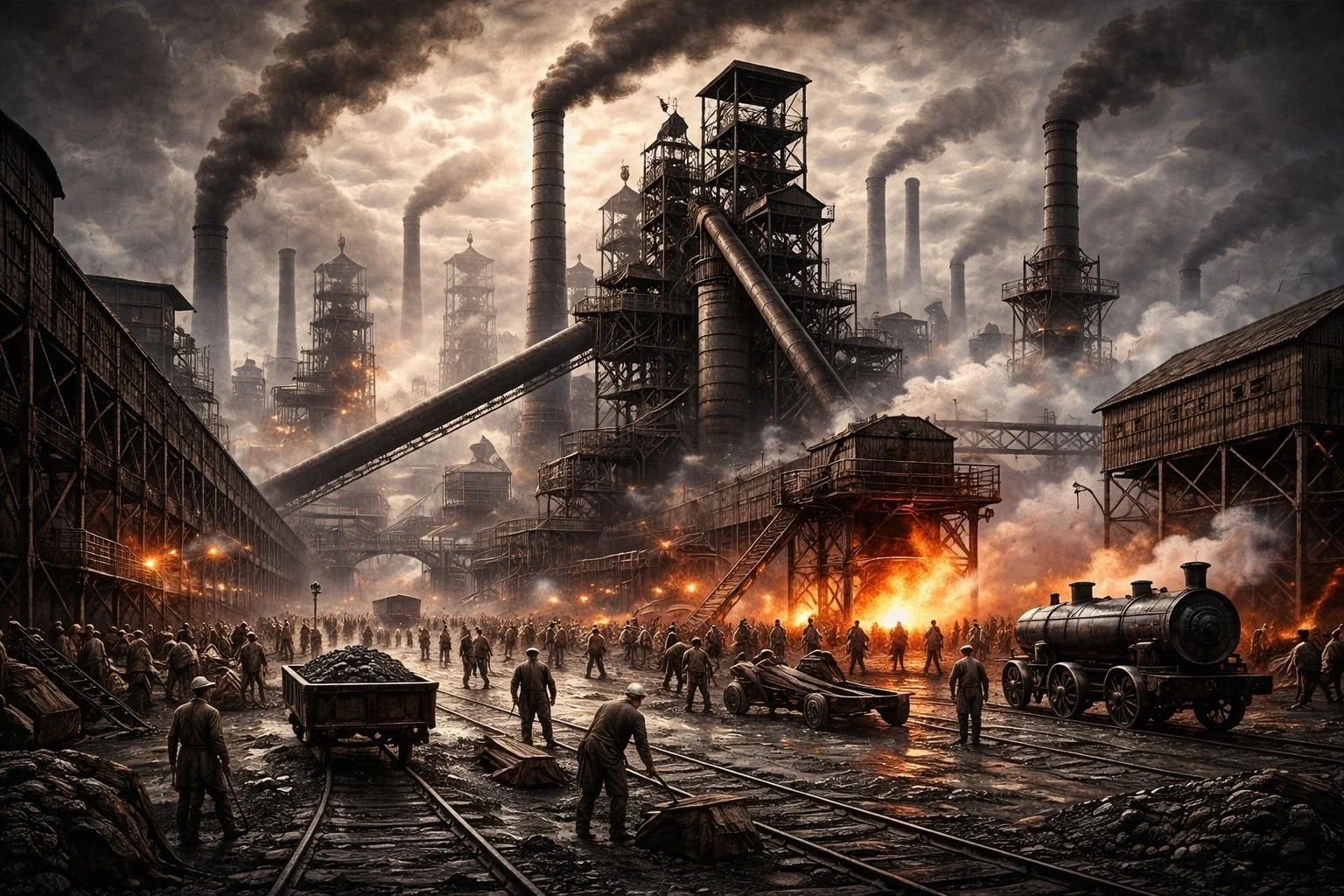
The Sound of the Furnace
A working day in nineteenth-century Dowlais that shapes the world of Unseen Souls.
A working day in Dowlais
Unseen Souls is rooted in places I know, and in lives that are not recorded in any formal history
Dowlais, in particular, is not simply a setting. My grandmother was born there, and I visited as a child in the early 1960s, when the world it had once been had already begun to fade. By then, much had changed, but the presence of the ironworks still shaped the place. My great uncle had worked there, and stories of that life remained.
My father and grandfather were both coal miners. I grew up with a close understanding of what that kind of work demanded. It was hard, physical labour that left its mark, even on the strongest men.
In writing the novel, I have tried to remain as close as possible to accepted historical reality. But I have been less interested in events than in experience. Not simply what happened, but what it felt like to live and work in a place where labour shaped the rhythm of every day.
This note is an attempt to draw closer to that experience.
The working day at the Dowlais Ironworks in the mid-nineteenth century began before the light.
In Dowlais, the rhythm of life was not set by the rising of the sun, but by the demands of the ironworks. The first sound most people heard was not birdsong, but the distant bell or whistle calling men to their shift.
Work did not wait for comfort.
Men rose in darkness, often after only a few hours’ sleep, and made their way through narrow streets already marked by soot and ash. The air carried the smell of smoke long before they reached the furnaces themselves.
It was a world in motion before the day had properly begun.
Heat and Labour
Inside the works, the conditions were relentless.
Furnaces burned at temperatures that few could endure for long without consequence. The heat was constant, pressing in from all sides. Clothing offered little protection. Sweat mixed with soot and settled into the skin.
The work demanded strength, but more than that, it demanded endurance.
Iron had to be moved, shaped, and controlled at speed. There was little margin for error. A moment’s inattention could lead to injury, or worse.
And yet the work continued, hour after hour.
The Body at Work
Labour of this kind left its mark.
Hands hardened. Lungs strained against the dust and fumes. Backs bent under the weight of repeated effort. Injuries were common, and recovery was rarely complete.
There was no expectation of ease.
The body was part of the process, as much as the machinery. It was used, worn, and, when necessary, replaced.
Time and Survival
Time in the ironworks was measured differently.
A shift was not simply a number of hours, but a test of endurance. Meals were brief and functional. Bread, perhaps, or something carried from home. There was little space for rest.
Outside the works, life was organised around recovery.
Families adapted to the rhythm of labour. Women managed households under difficult conditions, often taking on additional work to supplement the family income. Children grew up quickly, drawn into the same cycle as soon as they were able.
Work shaped everything.
What Was Endured
It is easy, looking back, to reduce this world to statistics.
Production figures. Output. Expansion.
But those numbers tell only part of the story.
What mattered, day to day, was the experience of those who lived within it. The heat, the noise, the fatigue. The constant awareness that survival depended on continuing, regardless of discomfort or risk.
There was resilience here, but it was not romantic.
It was necessary.
A World Remembered
The Dowlais of Unseen Souls grows out of this reality.
It is not an exact reconstruction, but an attempt to remain faithful to the conditions that shaped the lives of those who worked there. The aim is not simply to describe the setting, but to convey something of what it felt like to inhabit it.
That world is not entirely distant to me.
I grew up in a mining village in South Wales, in a community where work was central to daily life. Many of those around me followed the same path into industrial labour. I worked in those environments myself, in coal yards and on production lines, where the demands of physical work were constant and unrelenting.
Those experiences inform the way I understand places like Dowlais.
What Remains
The furnaces of Dowlais no longer exist. They lie buried beneath car parks and supermarkets, their presence marked more by memory than by anything that can be seen.
And yet the past has not disappeared entirely.
It survives in fragments. In the old stables of the ironworks. In the Memorial Library and the Guest Reading Room, built as acts of paternal care and quiet control. In the lodge that once marked the entrance to Dowlais House. In the chapels that still stand, where communities gathered for solace, education, and a sense of belonging.
Even the streets retain something of their former shape. Rows of housing, altered but still recognisable, where generations lived within the orbit of the works.
These are not grand monuments. They are traces.
But taken together, they are enough to suggest what this place once was, and what it meant to those who lived here.
To write about such a place is not simply to describe it.
It is to recognise the people who endured it, and to acknowledge the reality of the world they helped to build.Not as abstractions, but as lived environments shaped by effort, necessity, and endurance.
From the research behind Unseen Souls

The Making of Dowlais
How a quiet upland community was transformed by Industrialisation.
What was life really like in Industrial Dowlais?
Unseen Souls is a novel rooted in real history. The places and events are authentic, but the central characters are imagined, shaped by the world they inhabit rather than drawn from any single life.
I have always been drawn less to kings and battles than to the lives of so-called ‘ordinary’ people, who are often anything but ordinary. The story of Eliza Turner reflects that instinct. Her life, though fictional, is grounded in the realities faced by thousands whose names were never recorded.
Before Iron
Before the coming of industry, Dowlais was a quiet upland community on the edge of the Brecon Beacons.
Life there had changed little for generations. The land was harsh, the soil poor, and the winters long. Most families survived through a mixture of small-scale farming, grazing, and seasonal labour. What little they produced might be traded locally, though travel itself was slow and difficult.
Homes were simple stone cottages, often shared with animals. Work was shaped by daylight and the seasons rather than by the clock.
At the centre of life stood the chapel. It provided not only spiritual guidance, but education and a sense of community. Sunday schools offered many their first access to reading, and the rhythms of the week were marked as much by worship as by labour.
This was not an easy life.
But it was a stable one.
The Fracture
By the mid-eighteenth century, that stability began to break.
The discovery of iron ore, coal, and limestone transformed the uplands with unexpected speed. What had been a scattered rural settlement became the focus of industrial ambition.
In 1759, the Dowlais Ironworks was established. At first modest in scale, it marked the beginning of a process that would reshape both the landscape and the lives of those who lived there.
Over the decades that followed, Dowlais grew into one of the most significant ironworks in the world.
The change was not gradual.
It was structural.
Industry and Expansion
As the works expanded, so too did the town.
Population increased rapidly. Housing spread across the hillsides. The demands of production began to determine the organisation of daily life.
Under figures such as John Guest, who took control of the works in the early nineteenth century, Dowlais became a major industrial force. New techniques were introduced. Output increased. The works supplied iron across Britain and beyond.
But this growth depended on labour.
And labour was constant.
A Different Kind of World
The transformation was not only economic. It altered the very nature of life.
Time was no longer governed by the seasons, but by the demands of industry. Work was measured in shifts rather than daylight. The landscape itself changed, marked by furnaces, slag heaps, and smoke.
What had once been a rural community became an industrial environment.
The change affected everything.
Families adapted to new patterns of work. Children entered employment at an early age. Women took on additional labour to sustain households. The distinction between home and work became less clear, as both were shaped by the same pressures.
Dowlais was no longer a place shaped by the land.
It was a place shaped by production.
The Human Dimension
History often records this transformation in terms of scale. Output, expansion, technological progress.
It tells us less about what it meant to live through it.
What did it mean to leave a way of life that had endured for generations?
What did it mean to grow up in a world where work defined not only survival, but identity?
These are the questions that lie behind Unseen Souls.
A World Reimagined
The novel does not attempt to recreate Dowlais exactly as it was. That is not possible.
Instead, it draws on the structure of that world, its transformation, its pressures, and its contradictions, to imagine the lives of those who moved within it.
Eliza Turner is fictional.
The forces that shape her life are not.
What Remains
The story of Dowlais is not only one of industry, but of transition.
A movement from one way of life to another, carried forward by necessity, ambition, and the demands of a changing world.
To look back at it now is to see both what was gained, and what was lost.
And to recognise that the lives lived within that transformation were as complex, as difficult, and as human as our own.
From the research behind Unseen Souls