

Landscape, history and the human thread.
Many of my ideas begin with a walk. Others emerge from history, books, photography and forgotten stories. This notebook gathers them together in one place.
The Lilies in the Woods
On familiarity, attention, and the surprises hidden in familiar places.
(June 11, 2026)
This evening, as I often do, I followed a woodland path a few hundred metres from home.
It is one of my favourite walks in the valley. The path is not laid or maintained in any formal sense. No one designed it. No machinery cut it through the trees. It exists because people have walked this way for years, probably generations. Countless pairs of boots have passed along the same route, gradually wearing a line through the woodland floor.
Even so, few people seem to use it today.
Most visitors to Eryri pass elsewhere, leaving this quiet corner of the valley largely undisturbed.
Part of its appeal is the sense of peace. There is nowhere in particular to get to and nothing to achieve. I simply walk.
This evening, the woods felt especially alive.
Heavy rain had swept through earlier in the day, filling the streams that run through the forest. Their constant rush echoed through the trees, accompanied by birdsong and the occasional movement of leaves in the breeze. The rain had long since passed, but everything remained saturated.
The sky was overcast, spreading a soft, diffuse light through the woodland. There were no harsh shadows, only gentle tones and deep greens. The cloud seemed to act like a giant softbox suspended above the forest.
Tree trunks, rocks, fallen branches and old stonework were covered in a vibrant green carpet of moss that glowed. Ferns crowded the edges of the path, whilst foxgloves rose above them, some standing well over head height. The whole woodland floor seemed to be thriving.
It was whilst walking through this sea of green that I noticed something unexpected.
A cluster of flowers growing beneath the trees.
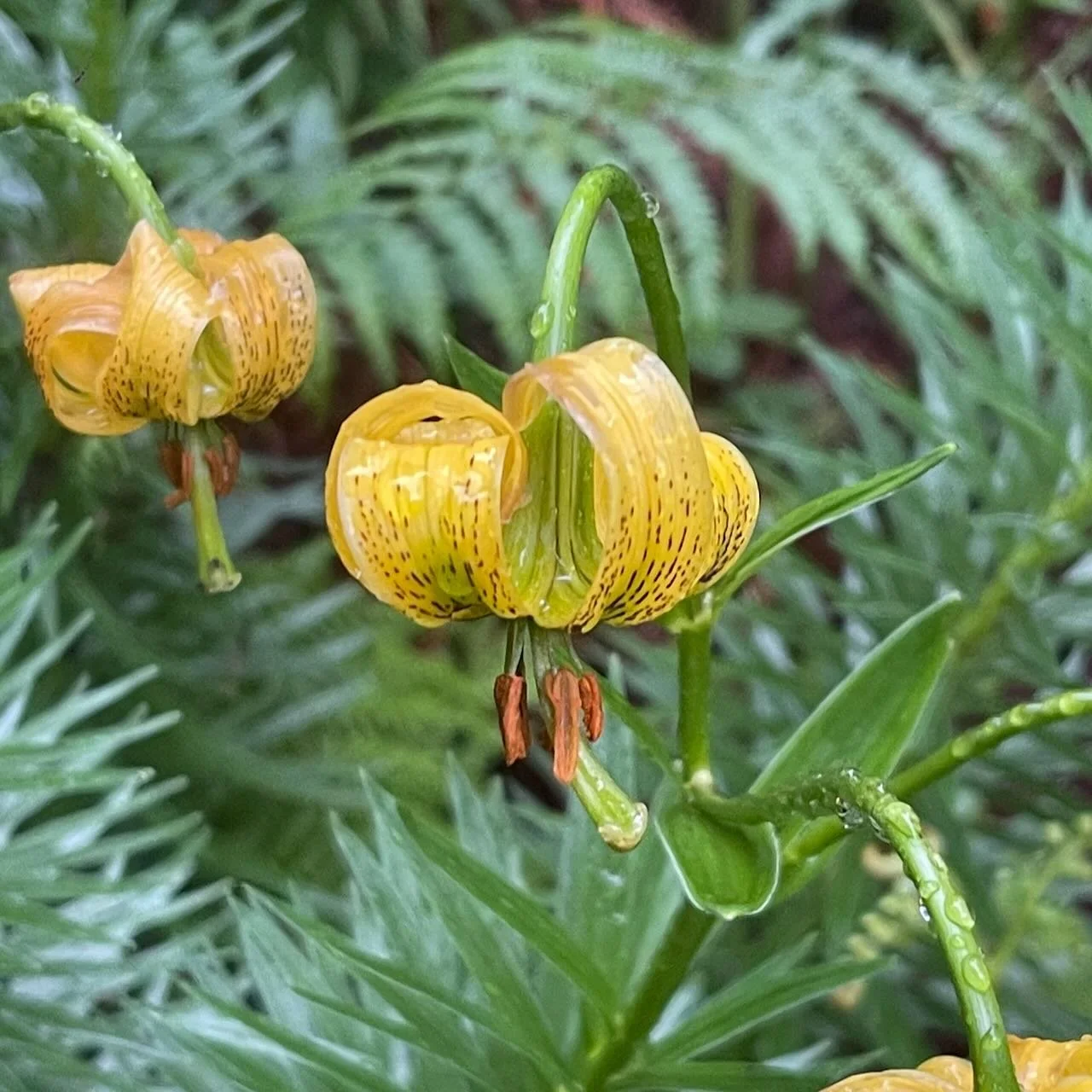
There were perhaps six or ten of them, their orange-yellow petals curled back upon themselves and marked with dark speckles. Droplets of rain still clung to the flowers. Each bloom hung downwards towards the woodland floor.
What struck me immediately was the colour.
Against the greens of the moss and ferns, the flowers seemed almost luminous. They stood out in a way that demanded attention.
And yet there was something else that puzzled me.
I have walked this path for seven years. In all that time, I had never noticed them before.
Perhaps they had always been there.
Perhaps this year’s conditions had encouraged a particularly strong display.
Or perhaps I had simply walked past them dozens of times without truly seeing them.
Later, after returning home, I did a little research and discovered that they were most likely Martagon (Turk’s cap) lilies, or a closely related variety. Their distinctive downward-facing flowers and recurved petals appeared to match the photographs I found.
The identification answered one question, but raised another.
How had they come to be here?
This part of the woodland is genuinely wild. Beyond the path itself there is little sign of human intervention. Ferns, mosses, streams and mature trees dominate the landscape. Yet here was a thriving cluster of lilies growing quietly beneath the canopy.
Perhaps they are the forgotten legacy of a cottage long vanished from the forest. Perhaps they were planted by someone whose name has long since been forgotten. Or perhaps they have always belonged here, unnoticed by most who pass.
The truth is that I do not know.
What I do know is that places reveal themselves slowly.
We often assume that familiarity means understanding. We walk the same paths, see the same views and convince ourselves that we know them. Yet every now and then something appears that reminds us how much remains unseen.
The lilies may have been there for years.
They may have been there every time I walked that path.
Either way, they offered a quiet reminder that even the most familiar places still hold surprises. The longer I spend in these woods, the more I find that they reveal themselves a little at a time, offering up details that were always there, waiting patiently to be noticed.
As the evening light began to fade and the streams continued their journey through the forest, I carried on towards home.
Behind me, the lilies remained amongst the ferns, their heads bowed towards the earth.
Waiting, perhaps, for the next passer-by who may, or may not notice them.
Field Notes and photographs are occasionally shared on Instagram @iamjohnrees

Moel Siabod Hike
Rain after days — brief sun-and-rain bursts in Capel Curig. My cottage in Gwydir Forest, Eryri (Snowdonia), at ~170 m. From my window Moel Siabod rises from the mist.
It’s been raining for days, and today was one of those sunshine-and-showers days we get so often here in Capel Curig. My cottage sits in the Gwydir Forest, within Eryri (Snowdonia) National Park — about 170 metres above sea level. From my window I can see my ‘local’ mountain, Moel Siabod, rising out of the mist.
Despite the variable weather, I decided to take my new companion, Florence — a twenty-week-old spaniel with more curiosity than sense — to experience the hill for the first time. The route begins on a tarmac track past a local farm before branching off into the rough path that winds upward towards Siabod. I’ve walked it many times since we moved here in 2019, though not as often this year. Today reminded me how much I’ve missed it — and how lucky we are to live in such a place.
Siabod remains quieter than the more famous peaks, though the hiking magazines have called it a “hidden gem,” which hasn’t helped. I won’t dwell on route details; they’re easy enough to find. This is the first of what I hope will become a series of Field Notes from our walks across the park and along the north Wales coast — reflections rather than guides.
The path was running with water, but that didn’t bother me. I had good boots, waterproofs, snacks, and a fully charged phone — all essentials that too many people neglect, which is why Mountain Rescue stays so busy. I always start cool when I walk, knowing I’ll soon build up heat and strip off layers as the climb begins.
After the first steep stretch, I stopped to catch my breath. A rainbow arched across the valley, ending somewhere near my cottage — though there was no pot of gold when I got back later. To my right, the Carneddau stood half-shrouded in mist, and a group of sheep regarded Florence and me with the usual suspicion. The only other sounds were the calls of choughs and buzzards wheeling overhead. Florence sat obediently — or perhaps strategically — eyeing the snack pocket she knows too well.
Further up, I paused at a familiar tree that grows from a slab of rock almost at right angles to the hill. There’s something about its stubbornness I’ve always admired — the way it insists on being here, thriving despite the odds. It reminds me of resilience, independence, belonging. If I were a tree, I’d probably do the same.
The track grew rougher and wetter, and after a few stiles we reached the first quarry lake — a mirror of grey sky and muted hills. We stopped for photos and a quick snack before pressing on. Rain returned, and the going got tough, but Florence was in her element, splashing through puddles and chasing rivulets of water.
Soon the ruins of the old slate workers’ cottages came into view. I wandered among the stones, imagining the families who once lived here — the smoke rising from chimneys, the hard laughter of men returning from the quarry. Now only slate heaps remain, piled like a monument to endurance.
The second lake lay ahead, deep and dark beneath the broken cliffs. It’s a place of haunting beauty, but it has claimed lives — over-optimistic swimmers unaware of how cold and deep the water runs. Today three waterfalls fed into it, stirred by days of rain. Looking into that black mirror felt like staring into a void.
By now, the wind had picked up and the rain returned. My watch said I’d climbed just over 1,200 feet — half the height of Siabod — and I could feel the temperature drop. I knew from experience that the ground near Llyn y Foel would be boggy, the path uncertain. The ridge above — Daear Ddu — would be slick and treacherous. The mountain would always be there; better to turn back than to press on.
So Florence and I stopped, took a few more photos, shared a snack, and started the slow descent. I felt that familiar calm — gratitude, really — that comes when you listen to the mountain rather than fight it. I’d forgotten how restorative it can be to stand still in such a place, to feel small in the best possible way.
Field Notes and photographs are occasionally shared on Instagram @iamjohnrees