

Landscape, history and the human thread.
Many of my ideas begin with a walk. Others emerge from history, books, photography and forgotten stories. This notebook gathers them together in one place.
The Independent Path
Today is a milestone moment for me and how I will distribute my work in future.
Today feels like something of a milestone.
Over the last several months I have spent a great deal of time thinking about where my writing sits and where I want it to go.
I considered publishers, submissions and whether I should try to follow the more traditional route.
Eventually I realised something rather obvious.
I do not want to.
At this stage of my life, freedom matters.
The freedom to explore strange ideas.
The freedom to spend six months photographing ruined quarries if I wish.
The freedom to write about industrial South Wales one year and psychological mysteries set in Victorian North Wales the next.
The freedom to follow curiosity rather than markets.
This week I finally stopped overthinking and decided to lean fully into being an independent author.
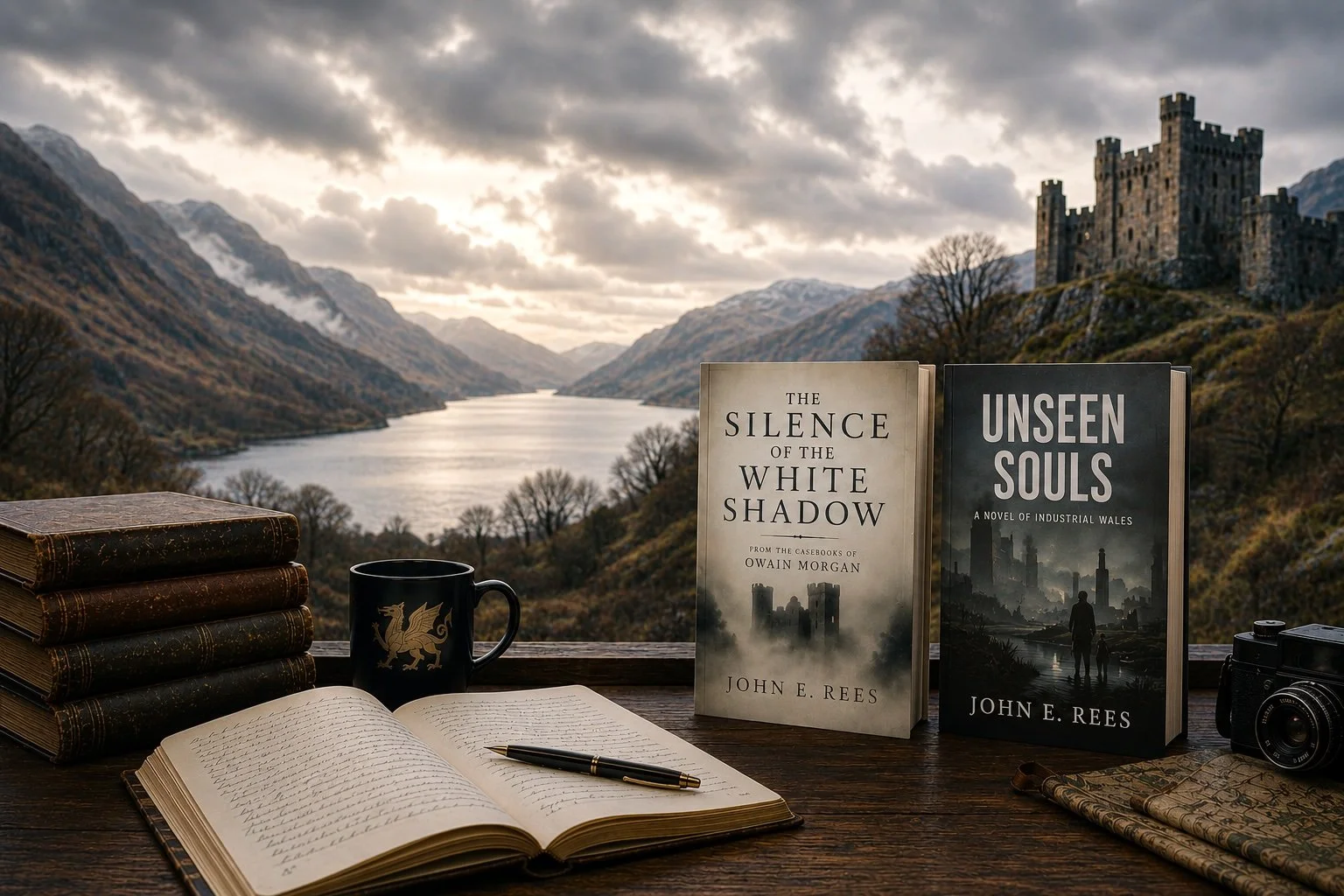
Both Unseen Souls and The Silence of the White Shadow are now being distributed beyond Amazon for the first time.
More importantly, it feels as though the pieces are finally beginning to connect:
History.
Memory.
Landscape.
Psychology.
The human thread running through them all.
I spent much of my working life in technology, moving through very different industries and environments.
Writing has become something different.
A way of exploring people, places, and the lives history often forgets.
There is something strangely liberating about reaching a point where success no longer means building the largest possible audience.
It means building the work you actually want to leave behind.
Quiet progress perhaps.
But progress all the same.
Field Notes and photographs are occasionally shared on Instagram @iamjohnrees

What is History?
Is it an interpretation of ‘facts? or a record shaped as much by the present as by the past?

What E. H. Carr can teach us about the stories we tell about the past.
I have recently completed my second historical fiction novel, The Silence of the White Shadow, set in Victorian Britain.
That means my desk, and my head, are cluttered with research. Industrial towns, social reformers, courtroom accounts, and the occasional ship’s manifest.
Somewhere in the middle of all this, I found myself returning to What Is History? Not because I needed another list of dates or events, but because we are living through a moment when the past itself feels unsettled, contested, rewritten, and increasingly shaped by competing narratives.
Carr’s book was first published in 1961, yet its central argument still feels remarkably current. His warning is simple, but far-reaching. History is not a neutral record of facts, and pretending it is can mislead us.
A note on Carr
Carr was not a historian in the narrow, conventional sense. He trained as a diplomat, worked in the British Foreign Office, and later became a journalist and political thinker, best known for his work on Soviet history.
That background matters. He did not encounter history as a closed archive, but as something active and contested. Narratives, he understood, are not discovered in a pure state. They are shaped. Selected. Framed.
What Is History? grows out of that understanding.
Carr’s central insight
Carr’s most important claim is deceptively simple. There is no such thing as a purely objective historical fact, at least not in the way we often imagine.
Facts do not present themselves fully formed, waiting to be recorded. The historian chooses what to include, what to leave aside, and how to connect events into a meaningful account. Even deciding what counts as a “fact” already involves interpretation.
This does not mean that events did not occur. The Battle of Hastings took place in 1066 whether one approves of it or not. But the meaning of that event, its significance, and the story told about it are not fixed. They depend on perspective, context, and the questions being asked.
The historian as interpreter
Carr described history as ‘a continuous dialogue between the past and the present’.
It is a gentle phrase, but it carries weight.
History is not something we simply inherit. It is something we engage with. The past provides the material, but the historian shapes how that material is understood.
Rather than neutral recorders, historians are interpreters. The past offers the notes, but someone decides how they are arranged and heard.
The problem of objectivity
Carr was sceptical of the idea that historians could ever be fully objective.
For him, objectivity was not a fixed state, but something to be approached through discipline. It required awareness of one’s own assumptions, a willingness to test interpretation against evidence, and the humility to revise conclusions when necessary.
This matters beyond the study of history. In journalism, politics, and public debate, the idea of ‘just the facts’ is often presented as neutral. Yet someone still decides which facts are selected, and which remain unseen.
Beyond the individual
Carr also challenged the idea that history can be explained through the actions of a few exceptional individuals.
Instead, he emphasised the importance of wider forces. Economic conditions, social structures, political pressures, and historical context all shape what becomes possible.
The Industrial Revolution was not simply the result of a single invention. It emerged from a combination of resources, labour, capital, and circumstance. To focus only on individuals is to overlook the conditions that made their actions meaningful.
History and the present
Every historian writes from within their own time.
We decide which aspects of the past matter based on present concerns. That is why interpretations change. The British Empire, for example, is understood very differently today than it was a century ago, even though the underlying events remain the same.
This does not mean that anything can be said about the past. It means that history is never final. It is continually revisited as our questions, values, and perspectives evolve.
Why this matters
More than sixty years after its publication, What Is History? still feels relevant.
We live in a time when historical narratives are contested, when memory is shaped by competing interests, and when simplified versions of the past can spread quickly and widely. In such an environment, the idea of history as a fixed and neutral record becomes not just misleading, but limiting.
Carr’s insight encourages something more demanding. Not simply learning what happened, but asking how and why it is being told in a particular way.
An ongoing conversation
History is not a closed account. It is an ongoing process.
The question is whether we approach it passively, accepting what is presented, or actively, asking who is speaking, what is being emphasised, and what may have been left aside.
Carr’s answer resists easy summary, but it can be understood like this.
History is the interpretation of the past in the light of the present.
And if we do not pay attention to how that interpretation works, we risk accepting a version of the past that was never inevitable.
Stories That Remain
What happens when fictional characters begin to feel real and imagined lives continue after the story ends.
Why I can’t let my characters go
When I retired from corporate life at seventy, I needed to fill the space it left behind.
I had dabbled in photography for decades and built up thousands of images from all over the world. I even produced a few coffee-table books. But in recent years it had lost its pull. I found myself short of inspiration, reluctant to go out and make the images at all.
Writing, on the other hand, had always been there. Proposals, sales documents, messages. Words had paid my way for more than forty years. So I began to wonder whether there might be a novel in me after all.
But what could I write about? What did I really know?
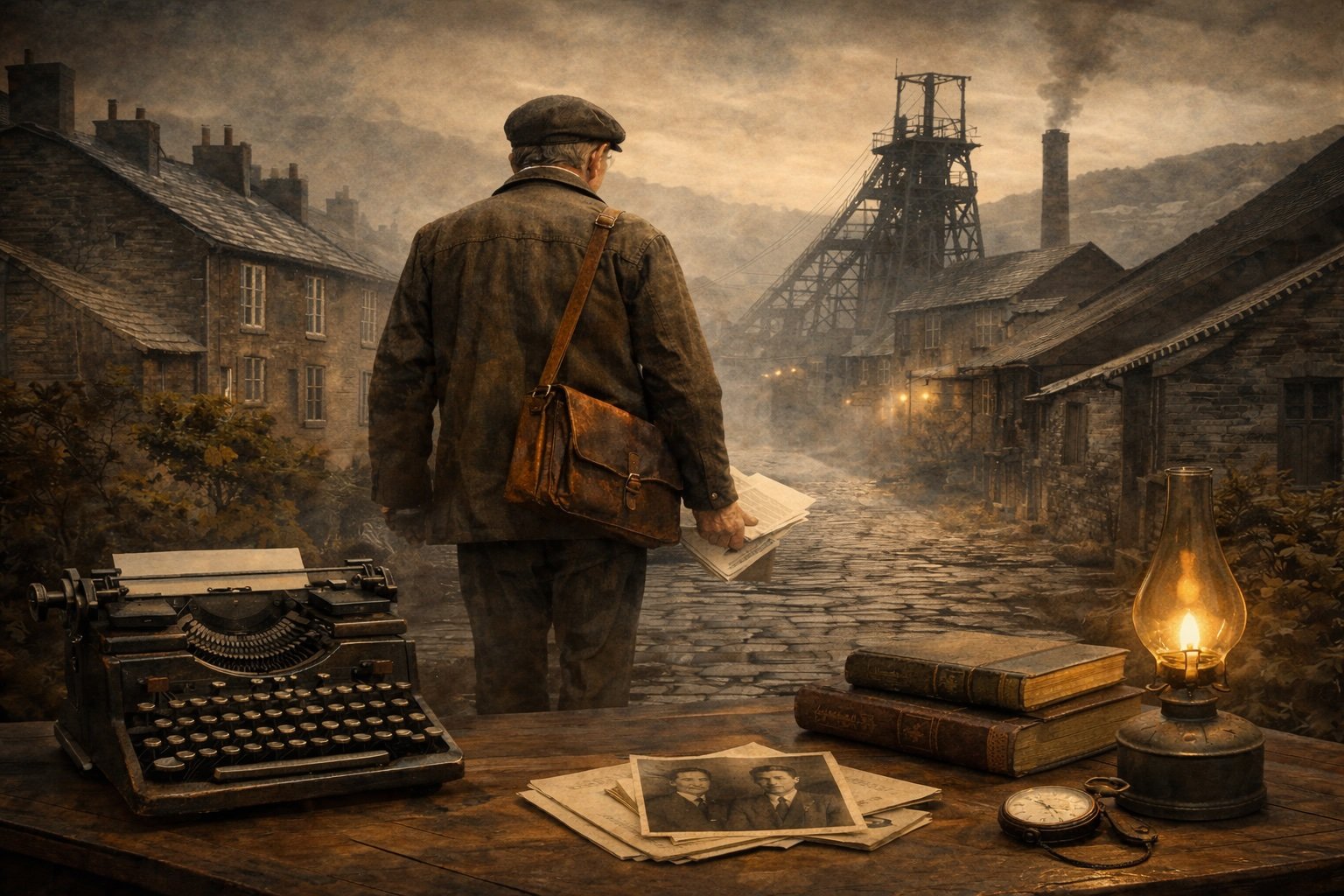
I’ve always been drawn to history, psychology and philosophy. To trying to make sense of life. And I grew up in a mining village in South Wales. My father and grandfather were miners, and as a student I worked in coal yards to support myself through university.
I once read the familiar advice: write about what you know. That was the spark that led me to write my first novel, Unseen Souls.
I immersed myself in memory and research and began writing every day. It felt organic, almost inevitable. I wanted to know what happened next, and that curiosity pulled me forward.
Unseen Souls eventually reached 530 pages. I loved writing it. I still dislike the business of promoting it.
What I didn’t expect was what came after.
I hadn’t planned to start the sequel just yet. There were other ideas waiting. Other projects that might have been more sensible.
But the truth is simpler than that. The characters wouldn’t leave me alone.
They stayed with me after I closed the document. They appeared while I was walking, reading, half-listening to the news. My wife would ask, ‘What have Eliza or Ned been up to today?’ We spoke about them as if they were real. In a way, they were.
I found myself wondering not what should happen next, but what did happen, as though their lives were unfolding somewhere beyond the page, and I was merely catching up.
That, I think, is one of the quiet truths of writing fiction. When it works, characters stop feeling like inventions and begin to feel like people. People shaped by forces larger than themselves. Poverty. Class. Labour. Illness. Belief.
You don’t control them so much as listen.
I write historical fiction grounded in real lives and real conditions. The scaffolding is real. The places existed. The industries existed. The suffering existed. But the inner lives must be imagined with care and humility.
Perhaps that is why the bond can feel so strong. You are not just telling a story. You are carrying something forward.
When a character feels alive, continuing the story does not feel like a creative decision. It feels like a responsibility. Not a burden, but something closer to obligation. As though stopping would be a kind of abandonment.
I suspect many writers recognise this, even if they rarely speak about it. The moment when a book ends, but the people in it do not.
So I have begun the sequel. Not because of a plan or a deadline, but because the characters were still there, waiting.
And that feels like reason enough.
Unseen Souls began as an attempt to understand the lives and histories I grew up alongside. I suspect it will not be the last time I return to that ground.
The Human Thread
My interest is not in history per se but in the people who shape how we see, remember, and live.
In 2026 I celebrated seventy-two years on this earth. Over time, I have come to describe the ideas that shape my writing as The Human Thread.Now seems like a good time to explain what I mean.
The most important lesson I have learned is simple: change is inevitable; how we respond to it is personal.
But we do not all respond in the same way. We are shaped by personality, upbringing and circumstance. Some hesitate. Some leap. Some quietly endure.
There is a saying that ‘nostalgia ain’t what it used to be’, and that is true. We smooth the rough edges of memory and bathe the past in a golden glow. What remain are curated fragments — bright scenes, first loves, old friendships — that feel purer in retrospect than they did at the time.
What interests me is not the recovery of the past — that is gone forever — but the continuity between past and present.
That continuity is what I call The Human Thread.
Growing up in a South Wales mining village gave me first-hand experience of how physically demanding and economically precarious life can be. Working as a labourer to support myself through university deepened that understanding.
My studies in history, economics and psychology enabled me to understand the forces that shape societies and the motives that drive individuals. Those early years of physical labour stayed with me. They taught me about strain, endurance and dignity — lessons no lecture hall could fully convey.
It is no surprise, then, that I became preoccupied with how the mind works — with why people act as they do, and how belief and temperament shape decisions. That curiosity lies at the heart of my writing.
In Unseen Souls, I explore the harsh working and living conditions of the Dowlais ironworks in the mid-nineteenth century. It follows the life of Eliza Turner, who breaks free from an apparently inevitable future. Her artistic ability becomes the means of her escape. There is, inevitably, something of my own history in that story. I know those valleys intimately, through family and friends, many of whom still live there.
Another of my fictional characters is Professor Owain Morgan, a late Victorian scholar of the mind who seeks not merely to solve crimes but to understand the motives behind them. His investigations are less about guilt than about response — how fear, pride, love or insecurity shape the choices people make. I see elements of my own development in Owain. His adventures are set in North Wales, where I now live and which I know intimately.
We live in an age of noise. Political spectacle dominates. Cultural arguments flare and vanish. The temptation is either to retreat into nostalgia or to surrender to cynicism. Both are evasions.
The Human Thread demands something steadier.
It asks us to remember without romanticising.
To criticise without contempt.
To build without forgetting the cost.
In my fiction, I inhabit the inner lives of my characters because I have lived long enough to recognise the patterns that shape them — the weight of expectation, the strain of responsibility, the quiet calculations behind every choice. In my essays, I explore how ideas — philosophical, political and psychological — travel quietly through generations. These are not separate pursuits. They are part of the same inquiry.
What does it feel like to live through change?
What do we inherit without noticing?
What are we responsible for passing on?
History is often marked by great declarations, laws and charters that appear to alter the course of events. But they endure only because of how people accept, resist or reinterpret them.
In the years ahead, my aim is simple: to add my own thread - carefully, honestly and with hope.