
Do You Know What You’re doing?
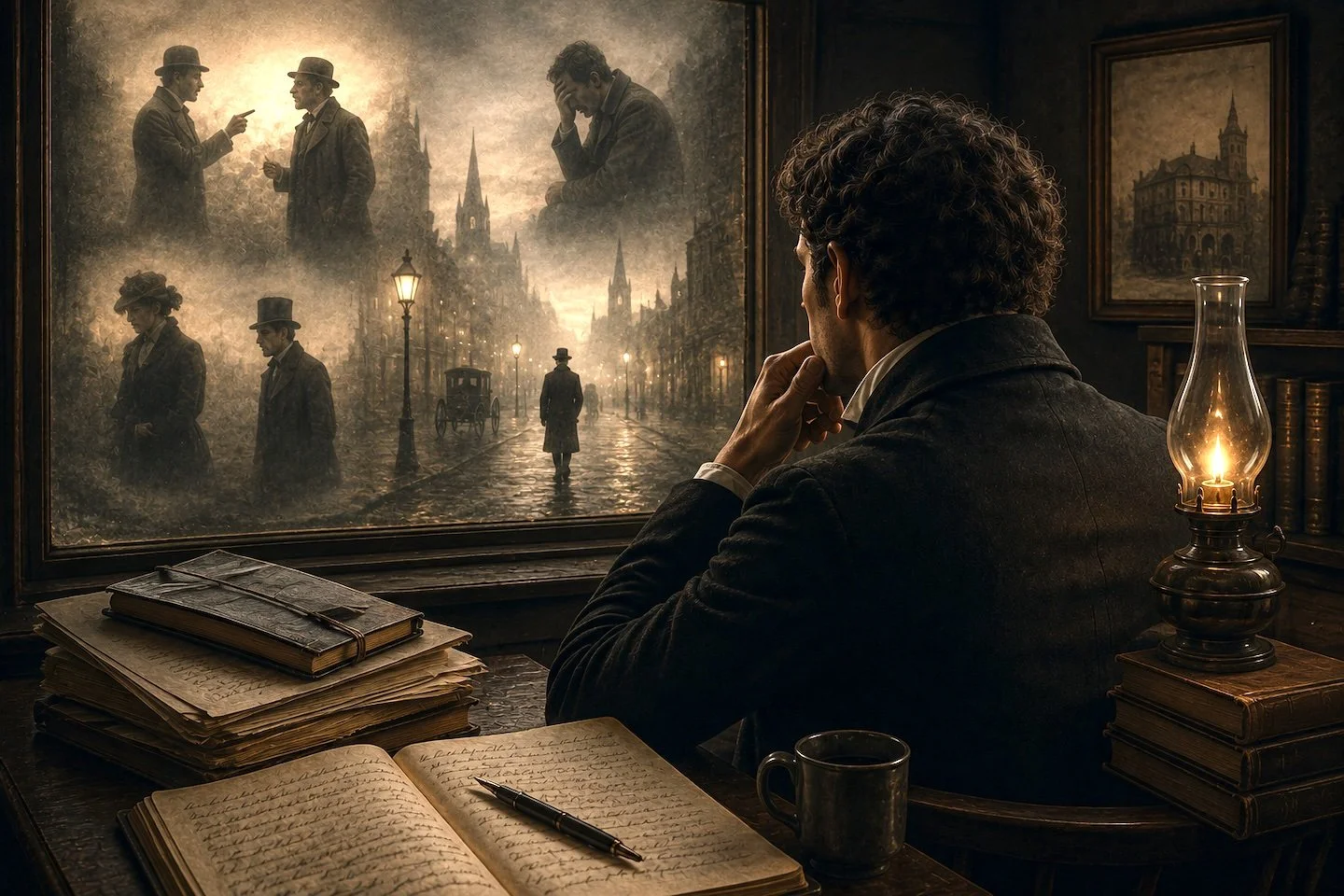
How well do we really understand our own behaviour?
I’ve been thinking a great deal about motive recently, largely because of a fictional character.
Professor Owain Morgan, the central character in my historical fiction, is interested in human conduct. When somebody commits an act of violence, betrays another person or does something apparently out of character, he wants to know why.
But increasingly, as I write him, I’ve realised that the interesting question isn’t simply why somebody did something.
It is whether they know themselves.
Ask someone why they did something and, more often than not, they will give you an answer. Usually, we can explain ourselves remarkably quickly.
But should the speed with which we answer make us a little suspicious?
Imagine somebody cuts across you on the road. You sound the horn, shout something at them and spend the next five minutes furious about what an idiot they are.
‘Why did you get angry?’
Because they cut me up.
Perfectly reasonable. And perfectly true.
But is it the whole reason?
Perhaps you were already late. Perhaps you’d had an argument before leaving home. Perhaps something at work had been worrying you. Perhaps you interpreted the other driver’s carelessness as deliberate arrogance. Perhaps you were simply tired.
On another morning, exactly the same incident might have produced little more than a muttered complaint.
The other driver hasn’t changed. Something in you has. And perhaps that is what makes these apparently insignificant moments interesting. Under ordinary circumstances we maintain a reasonably stable version of ourselves. But place us under enough pressure and something else may become visible: impatience, resentment, insecurity, anger, pride.
The behaviour may expose a fault line in our character that we didn’t know was there.
That doesn’t necessarily mean the fault line caused the behaviour. Nor does it mean that everyone carries some hidden capacity for violence or wrongdoing. It simply suggests that circumstances can sometimes reveal aspects of ourselves that remain invisible when life is going well.
And afterwards, when somebody asks why we behaved as we did, we may reach for the most obvious explanation.
‘He cut me up.’
True. But perhaps not complete.
The Stories We Tell About Ourselves
Most of us carry around a reasonably coherent idea of our own character.
We believe ourselves to be generous or careful, independent or loyal, rational or compassionate. We know, broadly speaking, what sort of person we are.
Then we do something that doesn’t quite fit.
We lose our temper. We avoid somebody we ought to help. We say something cruel. We remain silent when perhaps we should have spoken.
Now we have two things that need reconciling: what we did and what we believe about ourselves.
So we explain.
‘I was tired.’
‘He provoked me.’
‘There was nothing I could have done.’
‘It wasn’t really my responsibility.’
Any of those explanations might be true. The interesting question is whether any of them tells the whole story.
Human beings appear to have a considerable talent for producing accounts of their own behaviour that preserve a tolerable relationship with themselves.
We don’t necessarily lie. Indeed, the most effective explanation may be one we sincerely believe.
That distinction between dishonesty and self-deception fascinates me.
A lie requires us, at some level, to know that what we are saying is untrue. Self-deception is much more elusive. We may genuinely believe the account we have constructed.
An Old Question
None of this began with modern psychology.
Philosophers have been worrying about self-knowledge for centuries. By the nineteenth century, when psychology was beginning to emerge from philosophy as a discipline in its own right, questions of habit, will, character, conscience and motive were being examined with increasing intensity.
William James wrote about habit and the processes through which actions become embedded in behaviour. Alexander Bain explored the relationship between mind, character, habit and conduct.
They didn’t possess our modern vocabulary, and we should be careful not to make Victorian thinkers sound like twenty-first-century psychologists.
But the underlying question is strikingly familiar.
How well do we understand ourselves?
Modern psychology has given us further reasons to question how completely we understand our own behaviour. Research into rationalisation and the limits of introspection suggests that we may not have access to everything that contributed to a decision.
Not because we are constantly lying. Because we may genuinely not know.
When the Behaviour Matters
The incident on the road is trivial. Five minutes later, perhaps we’ve forgotten about it.
But the same question becomes rather more interesting when the behaviour matters.
Why did you lie?
Why did you betray someone?
Why did you keep the money?
Why did you hit him?
Why did you remain silent?
We instinctively search for motive because motive makes behaviour comprehensible. Courts consider it. Historians look for it. Novelists depend upon it. But perhaps we sometimes expect too much from the answer.
Suppose somebody says they hit another person because they were angry.
That may be entirely true. But anger describes an emotional state. It doesn’t necessarily explain why anger became violence.
Why this person?
Why at this moment?
Why did an insult that might have been ignored yesterday become intolerable today?
What had accumulated before the blow?
And that brings me back to Owain Morgan.
His interest is not simply in establishing that someone acted through jealousy, greed, fear, anger or revenge. He wants to understand what happened within that person before the act became possible.
Why did jealousy matter so much?
What produced the fear?
Why did resentment accumulate rather than disappear?
What changed?
The act itself may take seconds. The journey towards it may have taken months or years.
That idea lies at the heart of the novel I’m currently writing, Fault Lines.
The conditions for a geological fracture may exist long before an earthquake makes them visible. Pressure accumulates, sometimes unseen. The earthquake is simply the moment at which the fracture becomes apparent.
People are not rocks, of course. But the metaphor continues to intrigue me.
Perhaps the event we notice is sometimes merely the visible fracture.
Understanding it requires us to look for the pressure that came before.
The Uncomfortable Part
There is an obvious danger in all this.
If every motive conceals another motive, and every explanation can be dismissed as rationalisation, then nobody can ever be believed about their own behaviour.
I don’t believe that.
Sometimes we know perfectly well why we did something. Sometimes the simplest explanation really is the best one.
The interesting possibility is not that our explanations are always wrong.
It is that they may sometimes be incomplete.
We are participants in our own lives, but we are also their narrators. We select events, establish causes and construct explanations that allow the story to make sense.
Usually that story is probably close enough to the truth.
But perhaps there are moments when it is worth asking one more question. Not because we are trying to catch ourselves in a lie, but because the first explanation may not be the only one.
I’ve spent much of my life asking questions in order to understand problems, people and, more recently, fictional characters. The more questions I ask, the less convinced I become that human behaviour has a single, tidy explanation
Perhaps the uncomfortable possibility isn’t simply that we sometimes deceive other people about our motives.
It is that the person we may find easiest to convince is ourselves.
So the next time somebody asks why you did something, and the answer comes immediately to mind, perhaps there is another question worth asking.
Is that really the whole reason?