
The Questions I Ask Myself
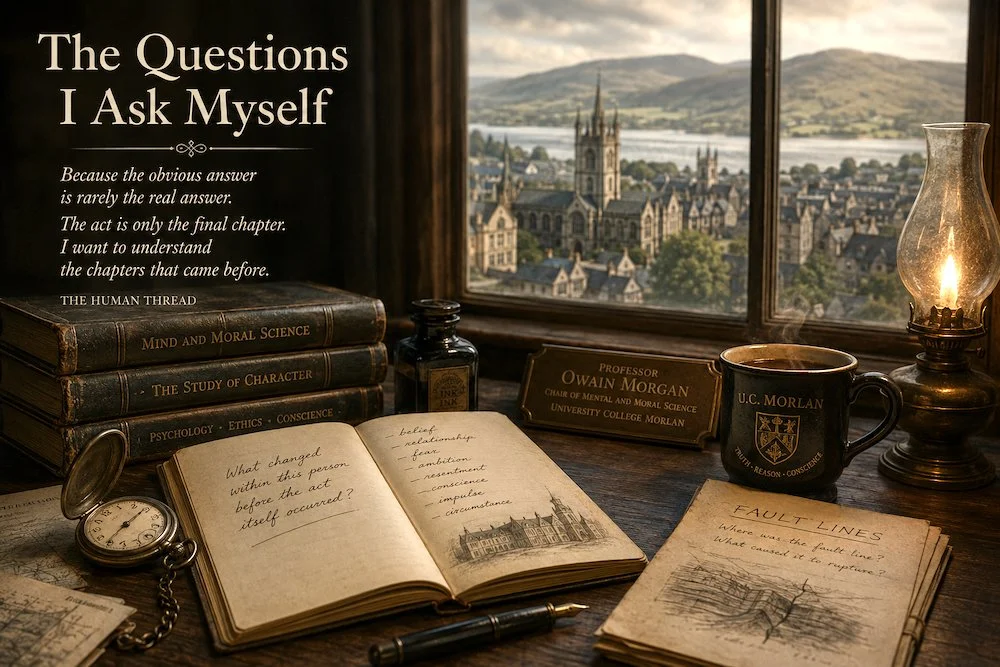
I spent much of my 45-year corporate career asking questions. It was how I came to understand the problems my clients were trying to solve, because the obvious answer was rarely the real answer. Sometimes the problem as first described wasn’t really the problem at all. You asked questions, listened, and gradually something different, but related and sometimes more complicated, emerged
Since retiring from corporate life, I find myself doing much the same thing, although the questions have changed. Why this character? Why this story? Why this place or this particular moment in history? Why would somebody behave in that way?
Increasingly, I find myself asking questions about my own writing too. Why historical fiction? Why late Victorian Wales? Why create someone like Professor Owain Morgan? Why invent an entire university for him to inhabit? And what connects all of this to an idea I have come to call The Human Thread?
Perhaps this is simply how I make sense of things. When a new idea begins to take shape, I question it until I begin to understand what I’m actually trying to write. I thought it might be useful to share some of those questions, particularly for anyone writing, or thinking about writing, stories of their own.
What do I write?
Historical fiction, mostly, although increasingly I write essays too. Both come from much the same curiosity. I’m interested in how history shapes ordinary lives and what those lives reveal about enduring patterns of human behaviour.
The period changes, as do the circumstances and the society in which people live. People themselves, perhaps, rather less so.
Why historical fiction?
History provides the circumstances in which character is revealed. Wars, industrialisation, political change and social upheaval matter enormously, but I’m usually more interested in what those events meant to the people who actually lived through them.
How did they respond? What did they fear or believe? What choices did they make when the world around them began to change?
History records events. Fiction allows us to imagine their human consequences.
Why ordinary people rather than famous historical figures?
Because history tends to remember those who held power, left records or became associated with great events. I’m fascinated by the countless lives it mentions only in passing, or doesn’t mention at all: the quarryman, the servant, the schoolteacher, or the woman trying to become an artist in a world that has already decided what sort of life she ought to lead.
They may never appear in a history book, yet they experienced the same enormous changes as the people whose names we remember. Fiction allows us to stand beside them for a while.
Why late Victorian Wales?
The easy answer would be because I know Wales and its landscape, but I don’t think that’s really enough.
Late Victorian Wales fascinates me because it was a society in transition. Industry, education, religion, politics and ideas about society were changing rapidly, while old certainties were being challenged by a modern world that seemed to be arriving with extraordinary speed.
That creates tension, and tension is where character becomes interesting.
Which leads to Owain Morgan. Who is he?
Professor Owain Morgan holds the inaugural Chair of Mental and Moral Science at the fictional University College Morlan in Bangor. He lives at a fascinating intellectual moment, when psychology is beginning to emerge but has not yet established itself as the discipline we recognise today.
Owain studies human conduct and, in particular, the relationship between character, belief, conscience and action. When he becomes involved in a criminal investigation, therefore, he isn’t primarily interested in solving a puzzle. He wants to understand the person who committed the act.
Where others might ask who, how and when, Owain is inclined to ask a different question:
What changed within this person before the act itself occurred?
What does that mean?
Owain doesn’t believe an act exists in isolation. Whether something is carefully planned, morally justified, emotionally inevitable or committed in a moment of impulse, the action has emerged from something that came before it.
It might be a belief or a relationship, fear or ambition, resentment or humiliation. It might be the gradual erosion of conscience or one impulsive second in which reflection failed.
But even an impulse raises another question. Why was this particular person vulnerable to acting impulsively at this particular moment? The impulse may explain when something happened, but it doesn’t necessarily explain why the impulse took that particular form.
For Owain, the act is the final chapter. He wants to understand the chapters that came before.
Is he another Sherlock Holmes or Hercule Poirot?
Not really, although any fictional investigator inevitably owes something to those who came before.
Holmes reconstructs the event through observation and deduction. Poirot is deeply interested in motive and the psychology of those involved. Owain is interested in something slightly different again: the changes in character and judgement that preceded both.
He uses observation and conversation to reconstruct those changes. He doesn’t simply want to know what somebody did, or even why they did it. He wants to understand what changed within them before doing it became possible.
That last distinction is the important one.
And is that where the idea for the next Owain Morgan novel, Fault Lines, comes from?
Very much so.
A geological fault line doesn’t suddenly appear when an earthquake occurs. It may have existed unseen for an immense period of time, with pressure accumulating along it until the earthquake finally reveals the fracture.
That began as a metaphor for the story I was writing, but I gradually realised that it described Owain’s entire way of thinking.
Where was the fault line? Was it in someone’s character, beliefs, relationships or circumstances? What pressure accumulated around it, and what finally caused it to rupture?
Nor does the fault necessarily have to be a weakness in the conventional sense. Pride, loyalty, love, ambition, duty or the desire to belong may all be strengths in one set of circumstances and sources of fracture in another. What matters is the pressure placed upon them, and what happens to a person when that pressure becomes too great.
The visible act may occupy only a moment. The story that produced it may have taken years.
Why create a fictional university?
Initially, because I needed somewhere for Owain to belong, but University College Morlan gradually became much more than that. A university gives me somewhere to explore ideas as well as stories: religion, philosophy, science, education, politics and the emerging study of the mind.
The industrial world around Morlan provides one way of examining society; the university provides another. It allows characters not simply to experience a changing world, but to argue about it, study it and attempt to understand what it is becoming.
Morlan is imaginary, but it is rooted in the intellectual, social and cultural landscape of nineteenth-century Wales. Making it fictional gives me the freedom to imagine the conversations, personalities and disciplines I need without rewriting the history of a real institution. It has also become one of those imaginary places that now feels surprisingly real to me.
What interests me most as a writer?
Character under pressure. Perhaps that is the thread running through almost everything.
History and society create pressure, as do families, ambition, love, poverty, expectation, belief and fear. Character determines how people respond to those pressures. Sometimes they endure them, sometimes they change and sometimes they surprise us.
And sometimes something fractures.
That’s where stories begin.
And what is The Human Thread?
It’s the name I’ve given to something I kept encountering without initially knowing what to call it.
Societies change, technologies change and institutions rise and disappear. The circumstances of a life lived in 1897 can seem extraordinarily remote from our own, yet jealousy, ambition, love, fear, loyalty, self-deception, kindness, resentment and the need to belong remain immediately recognisable.
That continuity fascinates me. The Human Thread is my attempt to follow it: the enduring patterns of human behaviour that connect people across different places, circumstances and generations.
What do I hope readers take from the books?
First and foremost, I hope they enjoy the story, but perhaps I hope for something else too. I’d like someone to finish one of my books feeling that they have spent some time in another world, but have also recognised something familiar within it.
The setting may belong to history, but the questions usually don’t.
Which, now that I think about it, probably explains why I keep asking them.