
Socrates
The Discipline of Questioning
The Big Idea
Wisdom begins with the recognition of ignorance.
Socrates believed that the first step towards understanding is not the acquisition of knowledge, but the acknowledgement that one does not yet possess it. To say ‘I do not know’ was not a failure, but a necessary starting point, a position from which inquiry could begin honestly.
He held that human beings often act wrongly not out of deliberate malice, but because they do not see clearly. Knowledge and goodness, in his view, were closely connected. To understand what is right is, in part, to be drawn towards it.
This gives his philosophy an unusual generosity. Ignorance is not a moral defect, but a condition to be addressed through reflection.
The task, therefore, is not to assert certainty, but to examine it.
The Man and the Moment
Socrates was born in Athens around 470 BCE, at a time when the city was intellectually confident and politically dynamic. Democracy was developing, public debate was central to civic life, and the ability to persuade was often valued more highly than the ability to understand.
Into this environment stepped a man who questioned both.
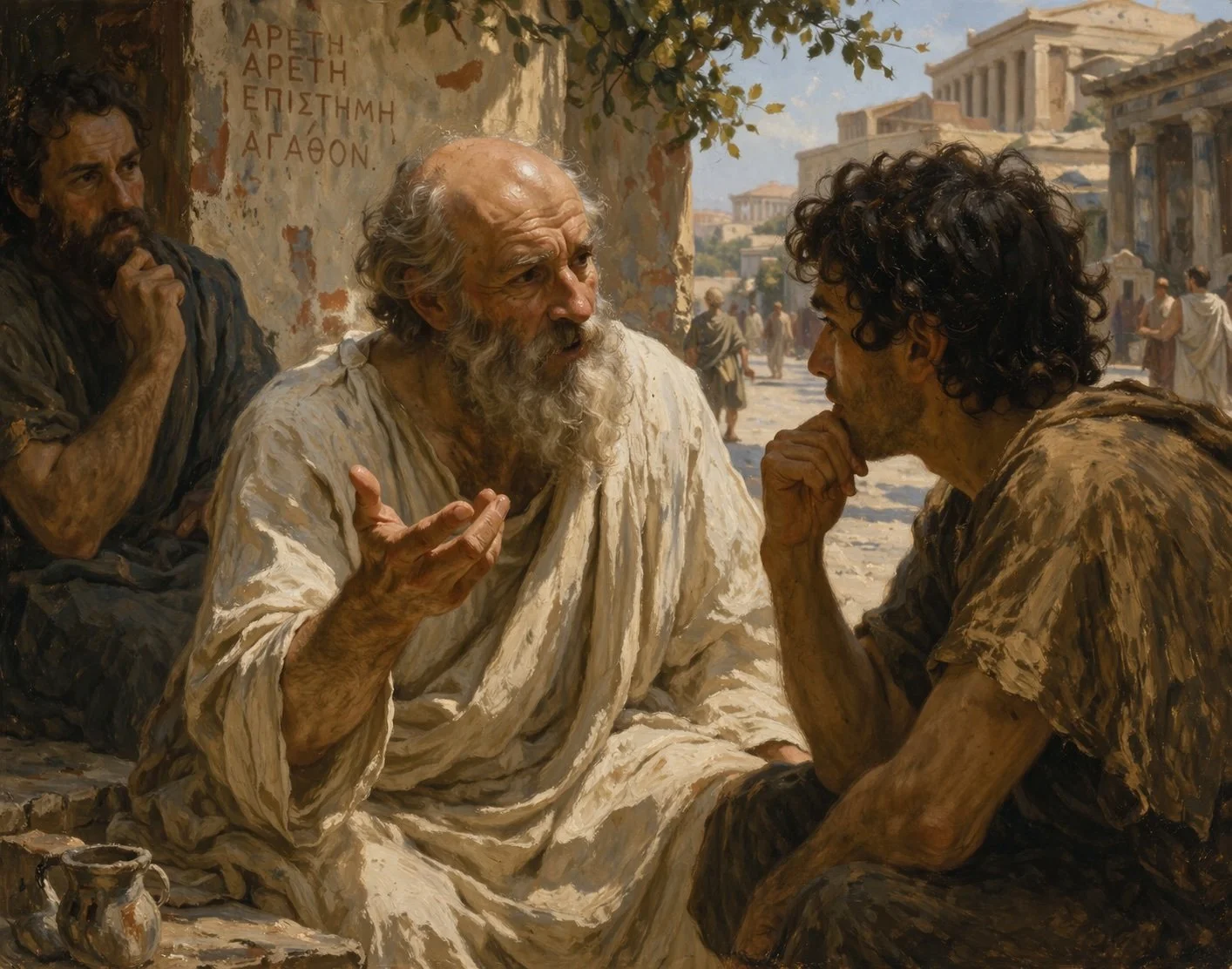
He lived simply, wore little, and spent much of his time in conversation, particularly in the agora, where ideas were exchanged as readily as goods. He had served as a soldier and was known for personal courage, yet his true focus lay in examining the assumptions that shaped human behaviour.
According to tradition, the Oracle at Delphi declared that no one was wiser than Socrates. Rather than accepting this, he sought to test it by questioning those who claimed knowledge: politicians, poets, and craftsmen. What he found was not ignorance alone, but a confidence unsupported by understanding.
He concluded that if he possessed any wisdom, it lay in recognising the limits of his own knowledge.
From that recognition emerged a method.
Why It Mattered
Socrates transformed philosophy from a study of the natural world into an examination of human life.
He asked not what the world is made of, but how we should live within it. Questions of justice, courage, and virtue became central, not as abstract ideas, but as matters requiring careful definition and continuous scrutiny.
His method was deceptively simple. He asked questions, examined the answers, and continued until contradictions appeared. What began as confidence often gave way to uncertainty, and uncertainty opened the possibility of deeper understanding.
This process could be uncomfortable. It exposed assumptions, revealed inconsistencies, and unsettled those who preferred certainty to inquiry.
Yet it established something enduring.
Thinking, for Socrates, was not an exercise in display, but a discipline. It required patience, honesty, and a willingness to recognise error. In this sense, questioning became not merely an intellectual activity, but a moral one.
In Owain Morgan’s Method
Socrates’ influence on Owain Morgan is fundamental.
Owain does not impose conclusions. He draws them out.
Through questioning, he allows individuals to reveal the structure of their own thinking. A statement is examined, a clarification requested, a contradiction introduced, and the process continues until something shifts.
What begins as certainty may, under careful inquiry, become less stable.
This is not interrogation in the conventional sense. It is a method of uncovering.
Owain listens closely, not only to what is said, but to how it is sustained. Where answers depend on assumption, he applies pressure. Where confidence rests on inconsistency, he allows it to unfold.
Truth is not forced. It is approached.
The Present Question
If understanding begins with the admission of ignorance, then the difficulty lies not in acquiring knowledge, but in recognising the limits of what we know.
Confidence often arrives before understanding. Familiar explanations are accepted without examination, and certainty can take hold without being tested. The appearance of clarity may conceal unresolved assumptions.
To question this is not to undermine knowledge, but to strengthen it.
The challenge is not simply to ask questions, but to remain with them long enough for something more precise to emerge
The Legacy
Socrates left no written work. His ideas survive through the accounts of others, most notably Plato, who preserved both his method and his presence.
His influence extends beyond philosophy. The practice of questioning assumptions, testing arguments, and seeking clarity through dialogue forms the basis of intellectual inquiry across disciplines.
He also established a model of thought grounded in integrity. To pursue truth, even at personal cost, became part of his legacy, reinforced by his refusal to abandon his principles when faced with trial and execution.
His death in 399 BCE marked the end of a life devoted to inquiry, but not the end of his influence.
The Essence
“The unexamined life is not worth living.”
Understanding does not begin with answers.
It begins with the willingness to question what appears certain, and to remain with that uncertainty until something more solid can be found.