
When Power Believes It Is Right
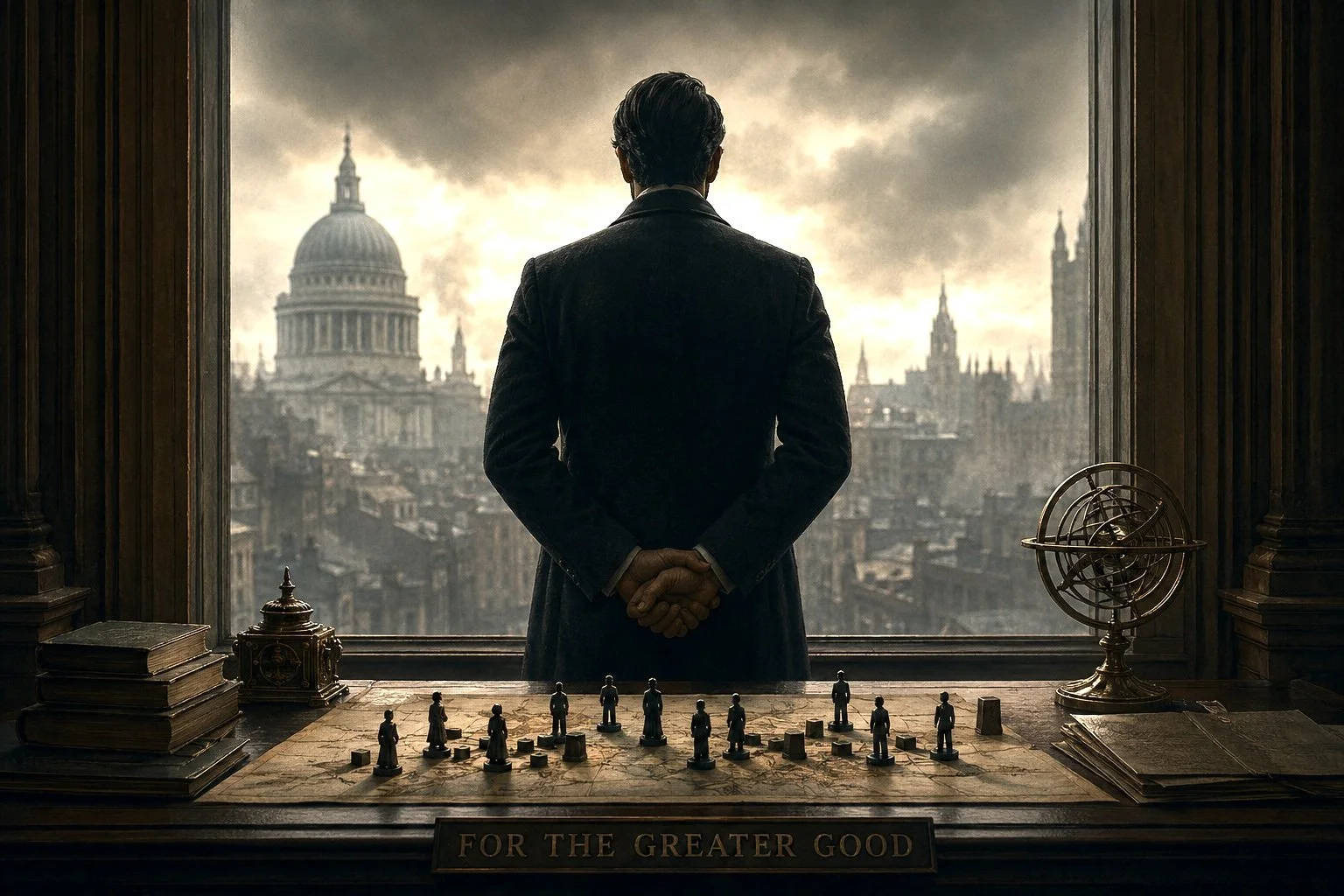
How authority, self-deception and moral certainty can make the unacceptable seem justified
There is a great deal of anger in the world today.
Much of it is directed towards people in positions of authority and power. Politicians are perhaps the most visible examples, but they are far from the only ones. We watch decisions being made that cause suffering, destroy lives or deepen divisions, sometimes by people who appear utterly convinced that what they are doing is necessary, justified or even right.
It is tempting to reach for a simple explanation.
They are cruel. They are corrupt. Perhaps they are simply evil.
But I’m not sure that tells us the whole story. Sometimes labels become a substitute for thought.
I have been thinking about this while researching Fault Lines, the new novel in my series featuring Owain Morgan, a fictional professor of Mental and Moral Science in late-Victorian Wales.
Owain is interested in motive, character and human conduct. More particularly, he is interested in what happens within someone before an action takes place.
The question at the heart of Fault Lines is one I keep returning to:
What changes within a person before they become capable of an act they once believed themselves incapable of committing?
While researching that question, I found myself thinking about people who possess considerable authority: political leaders, certainly, but also industrialists, military commanders, religious leaders and others whose decisions can profoundly affect the lives of those over whom they exercise power.
And another question emerged.
How does someone in a position of great authority come to believe that actions causing enormous harm are justified?
Do people choose evil?
More than two thousand years ago, Socrates argued that people do not willingly do what they recognise as evil. His argument, preserved largely through Plato, was that wrongdoing involves, at some level, a failure of judgement about what is good.
That seems difficult to accept. Surely people know when they are behaving badly?
Often they undoubtedly do. But there is a difference between knowing that an action will cause harm and believing that causing that harm is unjustified.
Someone exercising power rarely needs to tell himself:
What I am doing is evil.
There are easier explanations available.
I am protecting my country.
I am preserving order.
The threat is too great.
History will prove me right.
Or perhaps the most powerful of all:
There is no alternative.
The consequences haven’t changed. What has changed is the story the person tells himself about them.
The stories we tell ourselves
This is where self-deception becomes more interesting to me than simple hypocrisy.
Hypocrisy suggests that we know the truth but deliberately present something different to other people. Self-deception raises a more uncomfortable possibility.
We may come to believe our own explanation.
Most of us probably do this on a small scale. We interpret our motives generously, remember the circumstances that support our version of events and minimise those that don’t.
We preserve an important belief:
I am fundamentally a reasonable person.
Perhaps even:
I am a good person.
Immanuel Kant called our propensity towards moral wrongdoing “radical evil”. He did not mean that some people are simply monsters. His concern was more unsettling: our capacity to recognise a moral rule and nevertheless subordinate it to our own interests.
Normally this would be wrong, but these are exceptional circumstances.
The greater good requires it.
They left me no choice.
The moral rule survives. We have simply created an exception for ourselves.
What happens when you have power?
This becomes more troubling when combined with authority.
Most of us live among restraints. Other people contradict us. Our decisions can be challenged. We encounter the consequences of our mistakes.
But what happens as someone becomes increasingly powerful?
People may become reluctant to contradict them. Advisers learn which opinions are welcomed. Disagreement begins to look like obstruction, perhaps eventually disloyalty.
Success creates another problem. If someone repeatedly makes decisions and survives the consequences — or is rewarded for them — those outcomes can become evidence of good judgement.
A dangerous cycle becomes possible:
Conviction creates power. Power reduces restraint. Reduced restraint strengthens conviction.
The person at the centre of this process need not experience themselves as becoming more dangerous.
They may simply experience themselves as becoming more certain.
Does power change character?
Aristotle believed that character is formed partly through habit. We become, in some measure, what we repeatedly do.
The first compromise with conscience may be difficult. The second may be easier. Eventually an action that once required considerable justification may no longer feel like a compromise at all.
The boundary has moved.
And because it moved gradually, the person crossing it may barely have noticed.
This particularly interests me in Fault Lines. We tend to look at a terrible act and work backwards, searching for the flaw in the person who committed it.
But perhaps there is no single flaw waiting to be discovered.
There may instead be pressure, habit, opportunity, resentment, fear, ambition, humiliation, entitlement and a succession of apparently small decisions.
Until something once unthinkable becomes possible.
And then justifiable.
Power rarely acts alone
People in positions of enormous authority may make decisions, but they rarely carry them out alone. Large-scale harm requires institutions: officials, advisers, lawyers, administrators, managers, soldiers, police officers and countless others.
Responsibility becomes dispersed. Each person performs a relatively small part of something whose total consequences may be enormous.
This was part of what Hannah Arendt was trying to understand when she wrote about the banality of evil after observing the trial of Adolf Eichmann.
What disturbed Arendt was not that Eichmann appeared unusually monstrous, but that he did not. She later wrote: “The deeds were monstrous, but the doer … was quite ordinary.” What particularly interested her was his thoughtlessness: a failure to examine critically what he was doing and to consider its meaning beyond the system in which he operated.
Her argument remains controversial, but the question it raises is deeply unsettling.
What if extraordinary wrongdoing does not always require extraordinary wickedness?
What if people can participate in actions causing enormous harm not because they consciously choose evil, but because obedience, conformity and bureaucracy gradually replace individual moral judgement?
And what happens when the person at the top has himself become convinced that what he is doing is right?
Language can help. Detention rather than imprisonment. Collateral damage rather than civilian deaths. Threats rather than opponents. Necessary force rather than violence.
Words create distance between decisions and their human consequences.
There may, of course, be another category. Some acts of cruelty are so extreme, deliberate and repeated that describing them as evil seems entirely reasonable. There may also be individuals whose psychological make-up differs profoundly from that of most people.
But those are not really the people who interest me here. I am more interested in something potentially more unsettling: people who retain an ordinary capacity for moral judgement and yet gradually construct a world in which actions causing enormous harm become reasonable, necessary or right.
Understanding is not excusing
Trying to understand why someone behaves badly can sound like trying to excuse their behaviour.
The distinction is fundamental.
To understand an action is not to excuse it.
A person remains responsible for the choices they make and for consequences they could reasonably have foreseen.
But simply calling somebody evil doesn’t explain anything.
It closes the enquiry.
If someone is evil, we have our answer. They belong to a category different from ourselves. There is something reassuring about that.
The alternative is much less comfortable.
Human beings appear remarkably capable of constructing explanations for their own behaviour. We interpret our motives generously, minimise inconvenient consequences, transfer responsibility and seek out people who confirm the version of ourselves we prefer to believe.
Most of us probably recognise those tendencies, at least faintly, in ourselves.
Power may simply give ordinary human tendencies extraordinary consequences.
When power believes it is right
Does power corrupt judgement?
Perhaps.
But I wonder whether something more subtle happens.
Perhaps power gradually removes some of the restraints that once kept our judgement honest.
The person who can be contradicted must defend an argument. The person who encounters consequences must reconsider decisions. The person surrounded by equals must negotiate.
Remove those things and gradually the distance between:
I believe I am right.
and:
I must be right.
can become remarkably small.
Perhaps the most dangerous person in a position of great power is therefore not someone who knows they are doing wrong.
It may be someone who has become incapable of imagining that they could be wrong.
And that takes me back to Fault Lines.
Owain Morgan’s interest is not simply in establishing what somebody has done. He wants to understand what happened within that person before the act became possible.
Where was the fault line?
What pressures were acting upon it?
What restraints disappeared?
And at what point did something previously unthinkable become not merely possible, but justified?
That, ultimately, is what I find myself exploring as I write the novel.
Not whether someone is good or evil, but how character, circumstance and power can combine until a person crosses a line they might once have believed they never could.
And perhaps the most unsettling possibility of all is that, having crossed it, they may still believe they were right.