
Edmund Burke
Tradition, Change, and the Limits of Certainty
The Big Idea
Society cannot be rebuilt from theory alone.
Edmund Burke believed that human beings understand far less about the societies they inhabit than they often imagine. Customs, institutions, loyalties, and habits are not random survivals from the past. They are the accumulated result of generations learning, adapting, failing, and correcting themselves over time.
This does not mean society should never change.
Burke was not opposed to reform. What troubled him was the belief that complex social structures could be swept away and replaced according to abstract principles devised in the present.
Watching the French Revolution unfold, he saw inherited institutions being dismantled in the name of reason and progress. To many, this looked like liberation.
To Burke, it looked dangerously overconfident.
His concern was not simply political. It was psychological.
Human beings, he believed, are prone to certainty, especially when convinced they are acting for noble reasons. Ideas can become intoxicating. They can encourage people to believe that history, tradition, and lived experience are obstacles rather than sources of wisdom.
Burke doubted that societies were so easily understood.
Or so easily repaired.
The Man and the Moment
Edmund Burke was born in Dublin in 1729 and later moved to London, where he became a politician, writer, and one of the great parliamentary speakers of his age.
Unlike many philosophers, Burke worked within public life rather than outside it. His ideas emerged not from abstract speculation, but from observing governments, institutions, and political movements in practice.
He supported the American colonies in their dispute with Britain, believing they were defending inherited rights rather than attempting to destroy the social order itself.
France was different.
The French Revolution appeared to Burke as something far more radical: an attempt to reconstruct society from first principles. Institutions, customs, religion, and hierarchy were being discarded in favour of universal ideals that had not yet been tested in lived reality.
In Reflections on the Revolution in France (1790), Burke warned that destroying inherited structures too quickly would not produce freedom, but instability and eventually violence.
At the time, many dismissed him as alarmist.
History proved less certain.
Why It Mattered
Burke’s importance lies in his understanding of social continuity.
He argued that societies are not held together solely by laws or economic arrangements, but by a deeper network of habits, assumptions, loyalties, and inherited forms of behaviour. Much of this structure is informal and only partially visible, yet it shapes how people live together.
For Burke, tradition was not sacred because it was old.
It mattered because it embodied experience.
Human beings are fallible. They overestimate their own wisdom and underestimate complexity. Tradition, though imperfect, represents knowledge accumulated slowly across generations.
This leads to one of Burke’s central insights.
Ideas do not arrive in empty spaces.
They enter societies already shaped by memory, custom, identity, and expectation. When change moves too quickly through these structures, disruption follows, often in ways no one fully anticipates.
Burke therefore treated restraint not as weakness, but as a form of intelligence.
A recognition that societies are living arrangements rather than theoretical systems.
The Legacy
Burke became one of the foundational figures of modern conservative thought, though reducing him simply to conservatism risks missing the wider significance of his work.
His lasting contribution was not merely political, it was psychological.
Burke understood that human beings repeatedly mistake confidence for knowledge. They assume complex systems can be redesigned because they appear comprehensible from the surface.
Yet societies rarely function through explicit rules alone. They depend upon habits, shared expectations, informal loyalties, institutions people scarcely notice, and assumptions accumulated slowly across generations.
This is partly why Burke remains strikingly contemporary.
Modern societies often place enormous faith in disruption. Technological change accelerates faster than institutions adapt. Political movements promise rapid transformation. Social structures that took decades or centuries to form can be questioned, reorganised, or dismantled within remarkably short periods.
Burke’s warning was never that change is dangerous. It was that complexity is easy to underestimate.
Good intentions, moral certainty, and rational plans do not eliminate unintended consequences. Sometimes they intensify them.
His work also anticipated later insights about human behaviour.
People are rarely governed by reason alone. They are shaped by belonging, identity, fear, attachment, status, and inherited assumptions they scarcely recognise in themselves.
Burke understood that societies possess emotional structures as well as political ones. And both matter.
In Owain Morgan’s Method
Each of the thinkers I write about influence the thinking of my fictional creation, Professor of Moral and Mental Science, Owain Morgan.
Burke’s influence on Owain lies in his understanding that behaviour rarely emerges from individuals alone.
People inherit worlds before they inherit choices
Family expectations, class assumptions, institutions, customs, professions, loyalties, and social hierarchies create frameworks that shape behaviour long before individuals become consciously aware of them.
For this reason, Owain rarely examines actions as isolated events. He asks different questions.
What structures surround this person?
What expectations govern them?
What loyalties constrain them?
What assumptions feel natural simply because they have never been challenged?
Burke also teaches Owain something psychologically important.
People do not merely defend beliefs. They defend continuity.
Individuals often protect systems, relationships, traditions, and identities even when those structures cause them difficulty, because losing familiar structures can feel more threatening than enduring imperfect ones.
This becomes particularly important during periods of rapid change.
Owain pays close attention to moments where inherited expectations collide with new realities: institutions under strain, social roles becoming unstable, families adapting to unfamiliar conditions, or individuals caught between competing worlds.
These moments matter because behaviour frequently becomes less predictable when the structures surrounding people begin to weaken.
Burke helps Owain recognise that motive is rarely contained entirely within individual psychology.
To understand behaviour, one must often understand the worlds people are attempting to preserve.
Sometimes what appears irrational is simply an attempt to prevent continuity from collapsing.
The Present Question
How much instability can a society tolerate before change itself becomes destabilising?
Modern politics increasingly rewards replacement. Leaders are expected to produce visible results immediately. Institutions are criticised for moving too slowly. Governments, parties, and organisations frequently respond to failure not through gradual correction, but through rapid substitution.
Replace the leader.
Replace the policy.
Replace the institution.
Then repeat.
At the time of writing this (late May 2026, this is what’s happening to Labour Party and the embattled PM, Sir Kier Starmer.
It also explains the rise on the Reform party and splintering of the two party system.
Burke would likely recognise something familiar in this. Not because he opposed change. But because he understood that continuity itself performs a social function.
When societies become accustomed to constant disruption, something deeper begins to erode.
Institutional memory weakens.
Long-term planning becomes difficult.
Public confidence declines.
Politics becomes increasingly organised around immediate correction rather than patient construction. Treating the effect rather than the cause.
Recent political life in the UK offers numerous examples of this tendency. Leadership changes accelerate. Governments become shorter-lived. Policies are introduced, reversed, replaced, and reintroduced before their consequences are fully understood.
The assumption behind this pattern is simple.
If outcomes disappoint, change faster.
Burke questioned whether this logic could eventually become self-defeating.
Sometimes instability is not merely the result of failed systems.
Sometimes instability emerges because societies lose confidence in continuity itself.
Burke’s warning was never that reform is dangerous. It was that constant reconstruction may gradually destroy the conditions that make successful reform possible.
Key Works
A Vindication of Natural Society (1756) - A satirical exploration of political reasoning and the dangers of abstract thought detached from reality.
Thoughts on the Cause of the Present Discontents (1770) - An examination of political power, corruption, and constitutional balance.
Reflections on the Revolution in France (1790) - His most influential work, defending continuity, restraint, and inherited social order against revolutionary idealism.
The Essence
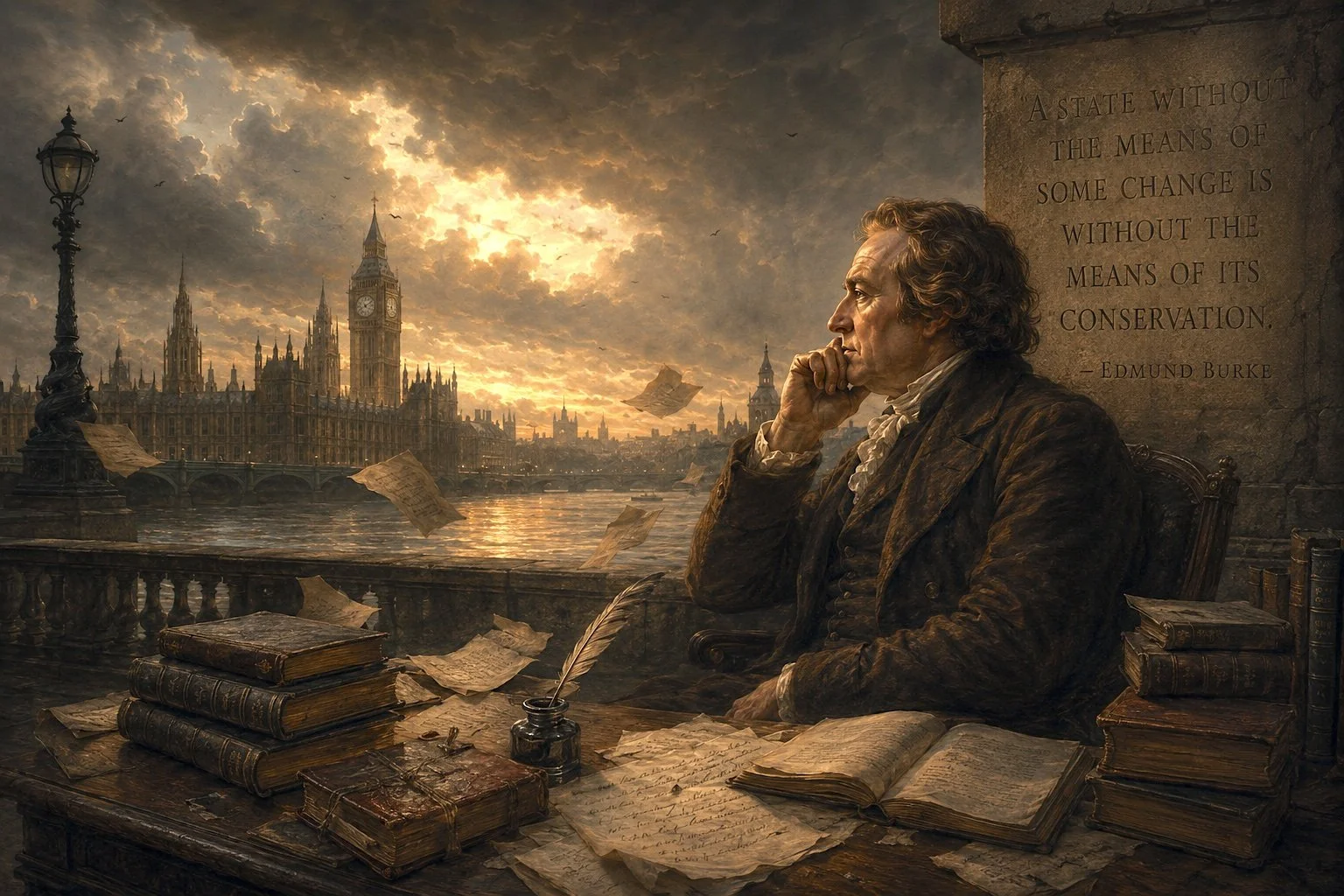
‘A state without the means of some change is without the means of its conservation.’
Burke reminds us that stability and change are not enemies.
A society survives not by resisting change, but by recognising that much of what makes social life work was not consciously designed in the first place.
Follow the thread:
These ideas do not stand alone. They form part of a wider conversation that shapes Owain Morgan’s understanding of the world.