
Gottfried Leibniz
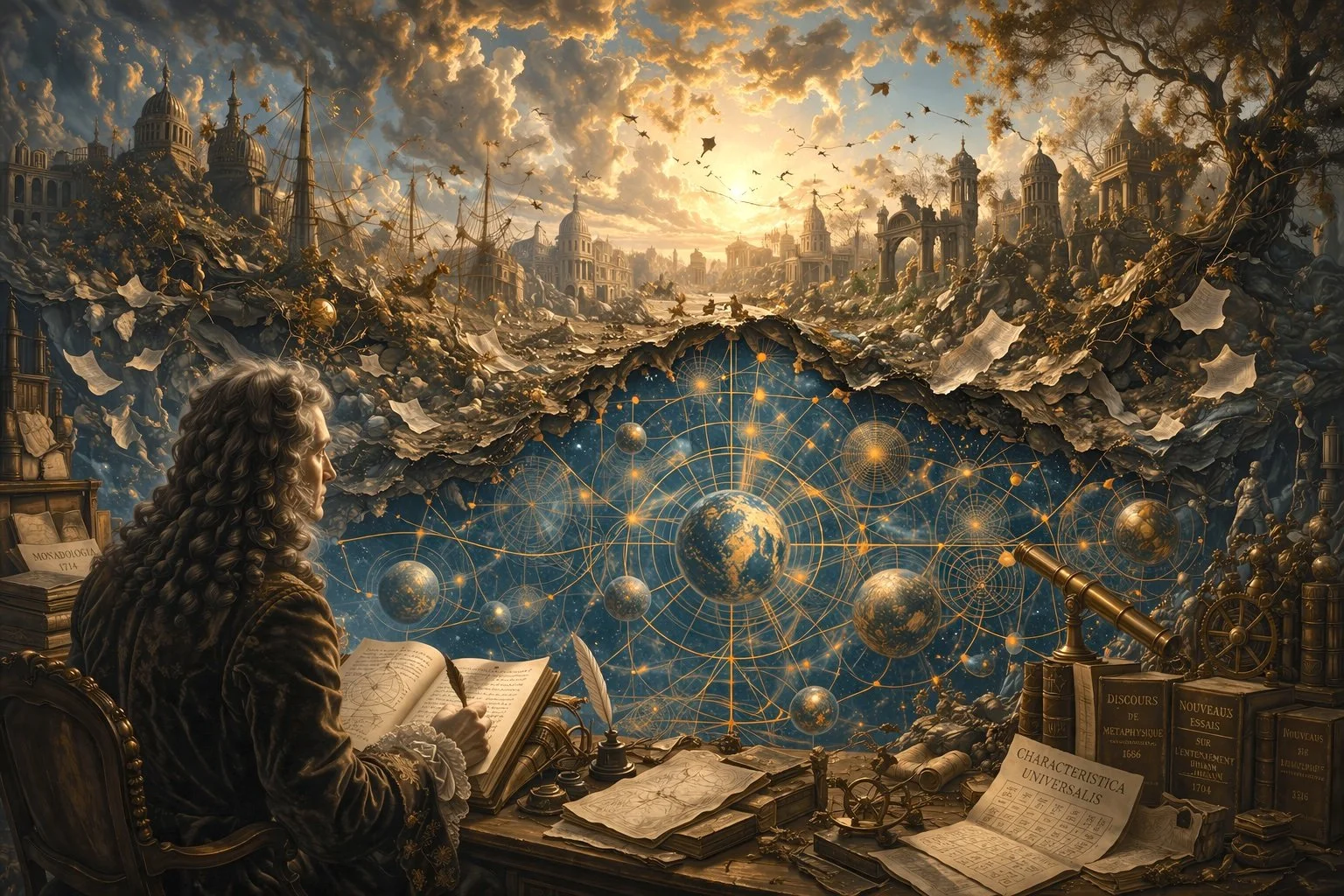
‘Everything happens for a reason,’ said Leibniz, centuries before it became a fridge magnet.
The Big Idea
Leibniz believed that reality is not random, but already arranged.
Everything that happens, no matter how chaotic it appears, follows from a deeper order. Nothing is accidental. Nothing falls outside the structure of the whole. We may not see that structure clearly, but that does not mean it is not there.
From this, he drew a bold conclusion. If the universe is governed by reason, then it must be the best of all possible worlds.
Not perfect, but the most coherent. A world in which freedom, consequence, joy, and suffering all have their place within a larger design.
It sounds improbably optimistic. But Leibniz was not naïve.
He was trying to answer a difficult question. How can a world full of suffering still make sense?
His answer was not that suffering is good, but that it is part of a system in which everything fits together. A universe without risk would also be a universe without freedom. A world without failure would be one without meaning.
Leibniz did not believe we are pushed around by fate. He believed we unfold according to a structure so complete that nothing falls outside it. Even suffering, he thought, has a role. The universe, like a symphony, requires its minor chords.
The Man and the Moment
Gottfried Wilhelm Leibniz was born in Leipzig in 1646, the son of a philosophy professor and a book-loving mother.
He grew up in a Europe still recovering from the Thirty Years’ War, a century marked by plague, poverty, and theological conflict. Certainty was dangerous, tempers short, and stability fragile.
From the beginning, he was a prodigy. By twelve he was reading Latin; by fifteen he was inventing alphabets; by his twenties he was producing work on logic that left senior scholars frowning thoughtfully into their ink pots.
He travelled widely, serving dukes, debating Jesuits, and exchanging letters with scientists across Europe. Where others specialised, Leibniz connected. He wanted everything to fit together: faith and reason, science and theology, politics and philosophy.
In Paris he met Christiaan Huygens, who introduced him to advanced mathematics. From that encounter, and many sleepless nights, came calculus, developed independently of Isaac Newton. Newton accused him of plagiarism, and the dispute became one of the great intellectual rivalries of the age.
Leibniz, characteristically, kept working.
He imagined a universal language, a symbolic system capable of expressing all knowledge logically. He called it the characteristica universalis. It never fully materialised, but it laid important groundwork for symbolic logic and, much later, computing.
Binary numbers fascinated him: zero and one, nothing and something. ‘God made the universe from nothing,’ he wrote, ‘as one from zero.’ The idea now sits quietly at the foundation of modern computing.
He also built a calculating machine, a complex mechanical device capable of performing arithmetic. It was ingenious, if not entirely practical.
Why It Mattered
Leibniz’s great gift was synthesis. He joined ideas that others preferred to keep separate.
Where Descartes divided mind and matter, a view later known as Cartesian dualism, Leibniz sought unity. Where science described laws and religion described purpose, Leibniz tried to show that they were part of the same system.
Reality, he argued, is a single, interconnected whole. His metaphysics rests on entities he called monads, indivisible centres of perception that make up everything that exists.
Each monad reflects the entire universe from its own perspective, like a drop of dew mirroring the sky. Nothing interacts directly. Instead, everything unfolds in what he called a pre-established harmony, set in motion from the beginning.
In this sense, the universe does not improvise. It unfolds.
This allowed Leibniz to address one of the deepest problems of his age. If the world is governed by laws, where does God fit? And if God is good, why does suffering exist?
His answer was that both questions have the same solution. The laws of nature are not separate from divine purpose; they are its expression. And suffering is not a flaw in the system, but a consequence of the kind of world that allows freedom, complexity, and meaning.
A world without suffering might be simpler. But it would also be poorer.
Without shadow, no light. Without risk, no courage. Without loss, no love.
For Leibniz, evil was not a force in itself but a limitation of perspective. We see fragments; the whole remains beyond us. What appears broken in isolation may be necessary in context.
It was a bold idea, and an uncomfortable one.
To those living through war and loss, it could feel distant, even dismissive. Being told that suffering is necessary rarely comforts those experiencing it.
Yet Leibniz held his ground. Perfection, in his view, was not the absence of disorder but the coherence of the whole. Harmony does not mean happiness. It means structure, balance, and intelligibility.
The Legacy
Not everyone was persuaded.
Voltaire took Leibniz’s optimism, examined it closely, and turned it into satire. In Candide, Leibniz reappears as Dr Pangloss, insisting that all is for the best while enduring a series of increasingly absurd misfortunes.
Voltaire’s critique was sharp and enduring. Optimism, he suggested, is easier from a distance.
Between Leibniz and Voltaire lies a familiar tension. How do we remain hopeful without becoming detached from reality? How do we acknowledge suffering without surrendering meaning?
Despite the criticism, Leibniz’s influence endured.
His binary system underpins modern computing. His dream of a universal symbolic language echoes through programming and logic. Even his monads find an unexpected parallel in a networked world, where countless individual perspectives reflect a shared reality.
In Our Time
If Leibniz were alive today, he might admire the structure of the internet before noticing the noise that travels through it.
Billions of perspectives, each convinced of its own clarity.
He would likely recognise patterns beneath the disorder: systems, connections, underlying logic. He might even see in artificial intelligence an extension of his own project, an attempt to formalise thought and capture reasoning in symbolic form.
Yet he would still ask a familiar question.
Does structure guarantee understanding? Does coherence ensure meaning?
He might conclude that harmony is still present, but harder to hear.
And somewhere, no doubt, he would still be arguing with Newton.
Key Works
Discourse on Metaphysics (1686). A concise exploration of God, freedom, and rational order.
New Essays on Human Understanding (1704). A detailed and courteous response to John Locke’s empiricism.
The Monadology (1714). A remarkably compact attempt to explain the structure of reality.
The Essence
‘The world is not perfect, but it is perfectly intelligible.’
Leibniz, more or less.
Everything fits together, even if we cannot yet see how. It is a comforting thought, though not always an easy one to accept.
Leibniz might still look at the world, with all its contradictions and noise, and see not chaos, but a pattern waiting to be understood.
Follow the thread:
Read Aristotle, Hobbes, Machiavelli, and others who shaped how we think.