
Voltaire
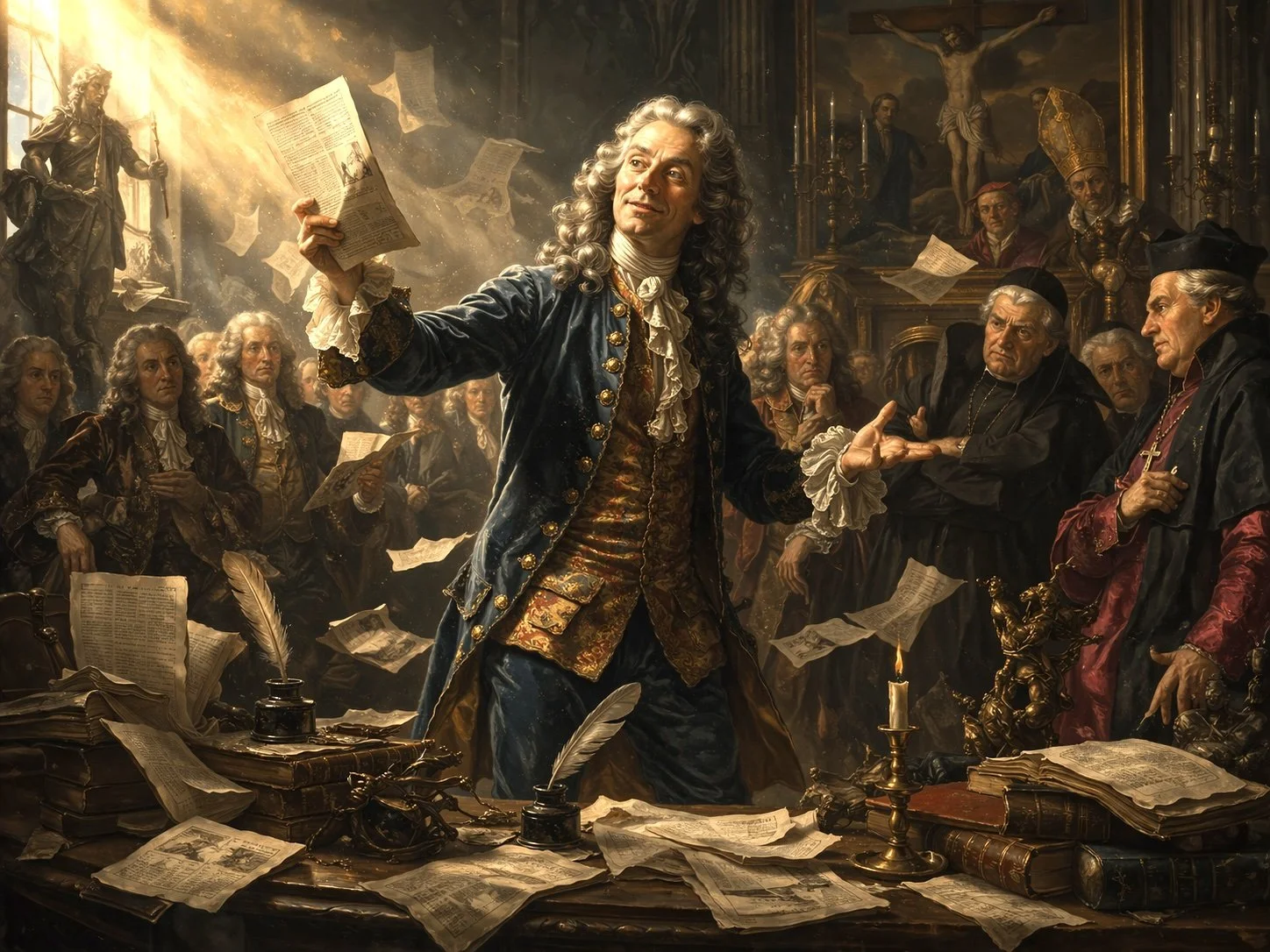
‘If God did not exist, it would be necessary to invent him.’ (Voltaire).
There are philosophers who sit quietly and think. Some of them even sit on rocks and stare out to sea. I do that myself sometimes, and I recommend it.
Then there are philosophers who refuse to sit still at all. They argue, provoke, laugh, and occasionally set fire to the furniture.
Voltaire did both, though rarely at the same time.
He was the Enlightenment’s loudest laugh. Razor-sharp, relentlessly impatient with stupidity, and armed with a pen that proved ideas can draw blood. If Leibniz tried to make peace with the universe, Voltaire wanted to file a formal complaint.
He did not believe that everything happened for the best. He believed things happened, often for the worst, and that it was our responsibility to make them slightly less so.
The Big Idea
Voltaire’s philosophy is not a system. It is a stance.
Think for yourself. Question authority. And, if possible, do both with enough clarity and wit that others cannot ignore you.
These ideas feel obvious now. In the eighteenth century, they were dangerous.
Voltaire believed that reason and ridicule were the twin engines of progress. Superstition, fanaticism, and blind obedience were not merely foolish but dangerous, and laughter was often the quickest way to expose them.
He was not an atheist in the modern sense. He believed in God, but more as a watchmaker than a shepherd. The universe, he thought, had been set in motion and left to run. Organised religion, on the other hand, struck him as a human invention, one that too often turned fear into authority and belief into control.
If Leibniz said, ‘This is the best of all possible worlds,’ Voltaire replied, ‘You really should get out more.’
The Man and the Moment
François-Marie Arouet, later Voltaire, was born in Paris in 1694, the son of a respectable notary who hoped his youngest child would become a lawyer. Voltaire had other ideas.
By his twenties he had already been imprisoned in the Bastille for writing poems that powerful people did not find amusing. On release, he made matters worse by reinventing himself. Voltaire was sharper, faster, and far more memorable than Arouet. It was branding before the word existed.
France at the time was a delicate alliance of throne and altar. Criticise either and you risked prison, exile, or worse. Voltaire responded by refining his wit until it could cut with precision.
He made a fortune from plays and essays, lost it through miscalculation, and regained it through shrewd investment. Even his life seemed to follow an irregular but somehow consistent pattern.
Exile followed to England, Holland and Switzerland. In England he encountered Locke, Newton, and Shakespeare, and discovered something that would shape his thinking. Freedom of expression was possible, though not evenly distributed. He admired England’s tolerance, its irreverence, and the remarkable fact that one could criticise power and survive.
When he returned to France, he did so as both celebrity and irritant. A philosopher with an audience, and a voice that carried.
Why It Mattered
Voltaire was not a system-builder like Descartes or Kant. He was something different. A public thinker, writing not for scholars alone but for society.
He believed ignorance was not a lack of intelligence but a failure of courage. People often prefer comfortable beliefs to uncomfortable truths. Voltaire made it his task to unsettle that preference.
Unlike many philosophers of his time, he wrote in French rather than Latin. He wanted to be read in cafés, not confined to universities. Philosophy, in his view, belonged in conversation.
His targets were hypocrisy, dogma, and cruelty. When Jean Calas, a Protestant merchant, was tortured and executed on false charges, Voltaire led the campaign to clear his name. It became one of the first recognisably modern appeals to justice. A single voice confronting institutional power.
He captured his position in a phrase that still resonates: écrasez l’infâme. ‘Crush the infamous thing’. Not belief itself, but fanaticism. Any system that turns conviction into cruelty.
Voltaire trusted individuals more than crowds, conversation more than doctrine, and questions more than certainty.
The Legacy
Voltaire changed what it meant to be a philosopher.
Thinking became visible. Criticism became a form of public responsibility.
He helped shape modern ideas of tolerance, free expression, and the separation of church and state. Even those who disagreed with him recognised the force of his voice. Frederick the Great once remarked that he would rather have Voltaire’s wit than half his army.
His influence persists wherever power is questioned and authority examined. Satire, properly used, became not merely entertainment but a moral instrument.
He was sceptical, sharp, occasionally self-satisfied, but consistently committed to reason. Not abstract reason, but humane reason. The kind that notices suffering and refuses to justify it.
In Our Time
If Voltaire were alive today, he would be difficult to ignore.
He would write constantly. He would provoke regularly. He would be dismissed, misquoted, and, occasionally, understood.
He would turn his attention to censors, conspiracists, and those who mistake volume for insight. He would remind us that outrage is easy, but thinking requires effort.
In an age that often rewards certainty, Voltaire’s voice feels unexpectedly current. Laughter is not trivial. It can expose pretence, unsettle authority, and reveal the fears that hide behind conviction.
He might look at modern discourse and observe, with some restraint, that while the stage has changed, the performance has not. Ignorance still finds its way into positions of influence.
And he would continue writing.
Key Works
Candide (1759). A comic dismantling of optimism, in which disaster accumulates until philosophy gives way to practicality.
Letters on England (1733). A reflection on British tolerance and intellectual life, written with admiration and strategic boldness.
Treatise on Tolerance (1763). A measured and humane argument for compassion over dogma.
The Essence
‘Common sense is not so common.’
— Voltaire
Voltaire laughed at tyranny, challenged superstition, and exposed hypocrisy not because it was fashionable, but because silence would have been a form of complicity.
He showed that humour can be a form of courage, that wit can sharpen reason, and that clarity, when combined with conviction, can have real consequences.
Follow the thread:
Read Aristotle, Hobbes, Machiavelli, and others who shaped how we think.