
Immanuel Kant
The Limits of Knowledge and Structure of Reason
The Big Idea
We do not see the world as it is.
We see the world as our minds make it possible for us to see.
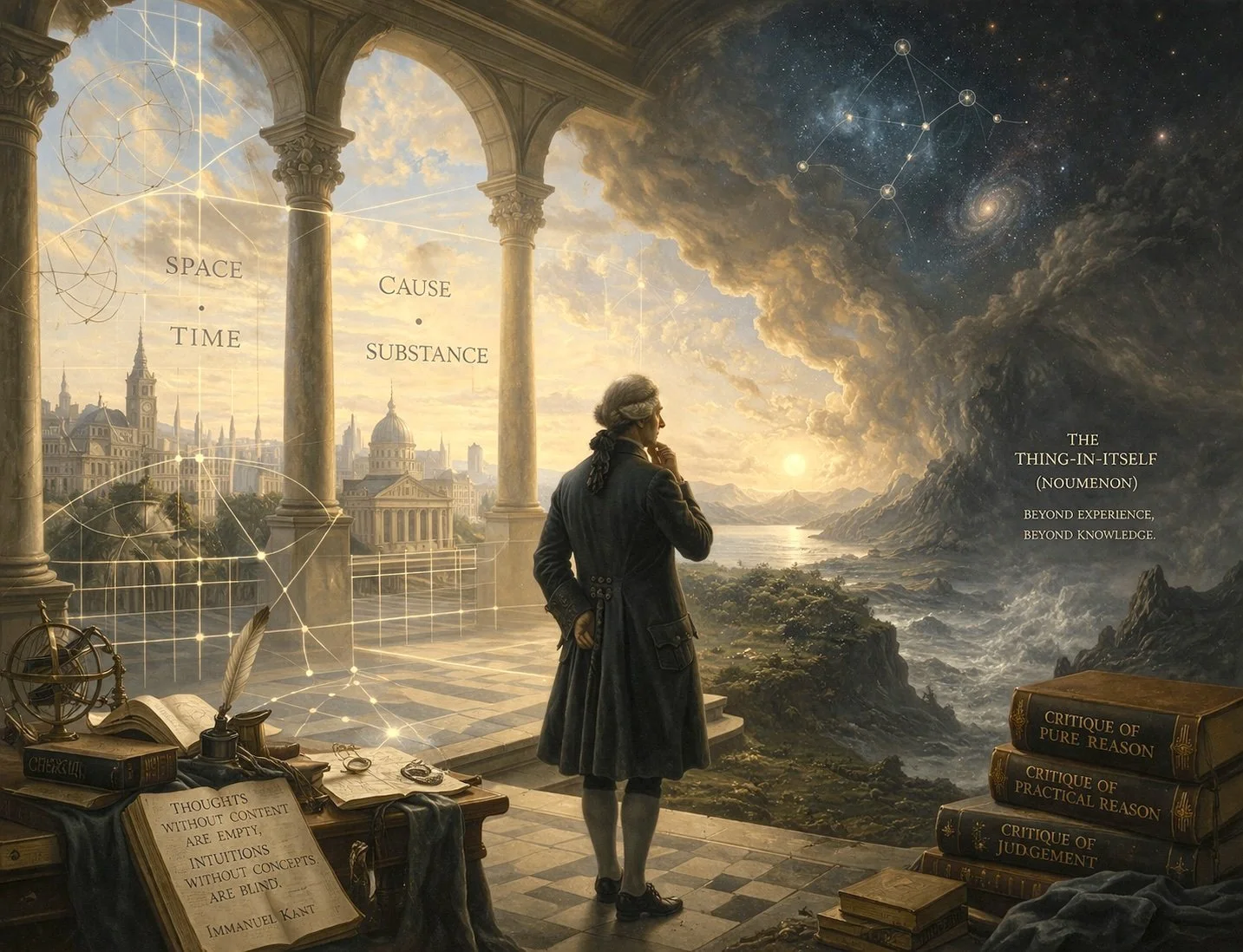
Kant argued that the mind is not a passive observer of reality, but an active participant in shaping experience. Before we are aware of anything at all, the mind is already organising what we perceive, placing it within space and time, and applying concepts such as cause, substance, and unity.
We never encounter the world in a raw, unstructured form. We encounter it as something already arranged into a coherent pattern.
This leads to a decisive distinction.
There is the world as it appears to us, which Kant called phenomena, and there is the world as it is in itself, which he called the noumenal. The first is accessible to knowledge. The second lies beyond it.
Kant’s insight is not that knowledge fails, but that it has limits.
We understand the world, but only as it appears within the conditions of human experience.
The Man and the Moment
Immanuel Kant was born in 1724 in Königsberg, in Prussia, a city known for its order and discipline. He spent almost his entire life there, studying, teaching, and writing with remarkable consistency.
His outward life was uneventful. He did not travel widely, never married, and lived according to a routine so regular that it became a local curiosity. Yet beneath this apparent stillness, his thinking was engaged in a profound transformation of philosophy.
Kant was raised in a religious household shaped by Pietism, which emphasised moral discipline and inward reflection. While he moved away from its theological claims, he retained its seriousness about duty and ethical life.
The decisive moment in his intellectual development came through his encounter with the work of David Hume. Hume’s scepticism, particularly concerning causation, suggested that reason could not justify many of the beliefs upon which science and everyday life depend.
Kant recognised the force of this challenge.
He later wrote that Hume had ‘awoken him from his dogmatic slumber’, prompting a long period of reflection that culminated in the publication of Critique of Pure Reason in 1781.
In this work, Kant set out not merely to answer Hume, but to redefine the scope and limits of human knowledge.
Why It Mattered
Kant’s achievement lies in his attempt to reconcile two competing traditions.
On one side stood rationalism, which held that knowledge arises from reason. On the other stood empiricism, which grounded knowledge in experience. Kant argued that both were necessary, but neither sufficient on its own.
Experience provides the content of knowledge.
The mind provides its structure.
Without experience, thought has nothing to work upon. Without the organising activity of the mind, experience would remain chaotic and unintelligible. As he expressed it, ‘Thoughts without content are empty; intuitions without concepts are blind.’
This synthesis explains why knowledge is possible.
The world we experience appears ordered because the mind imposes order upon it. Scientific laws describe patterns that hold within this structured field of experience.
But Kant insisted on a limit.
These laws apply only to the world as it appears to us. They cannot extend beyond it. The thing-in-itself, the reality that exists independently of our perception, remains beyond direct knowledge.
This preserves both confidence and restraint.
We can trust knowledge within its proper domain, but we must recognise that it cannot answer every question.
In Owain Morgan’s Method
Kant’s influence on Owain Morgan lies in his awareness of the limits of perception.
Owain understands that what individuals report is not the world as it is, but the world as it has been experienced and organised by the mind. Memory, interpretation, and expectation all shape what is perceived and later described.
For this reason, he treats testimony with careful discipline.
He distinguishes between the event itself and the way it appears within the mind of the witness. Two individuals may describe the same occurrence in different ways, not necessarily through deception, but because each has encountered it through a different structure of understanding.
Owain does not seek an impossible direct access to reality. He works through appearances, comparing accounts, testing them against evidence, and recognising that understanding must be constructed within these limits.
In this sense, Kant provides a form of discipline.
Not everything can be known directly, but much can be understood through careful and structured inquiry.
The Present Question
If our knowledge is shaped by the structure of the mind, then the question is not simply what we know, but how that knowledge is formed.
What appears certain may depend upon assumptions that are rarely examined. Patterns may be recognised and accepted without considering the conditions that make them visible.
To reflect on this is not to weaken knowledge, but to clarify it.
Understanding requires an awareness of its own limits, and a recognition that certainty, where it exists, is bounded by the conditions through which experience becomes possible.
This introduces a necessary humility.
Not everything that exists can be known, and not everything that is known can be assumed to be complete.
The Legacy
Kant’s influence is central to modern philosophy.
His work reshaped debates about knowledge, laying the foundation for later developments in German idealism and influencing thinkers such as Hegel and beyond. His ethical philosophy, particularly the idea that individuals must be treated as ends in themselves, has had a lasting impact on moral and political thought.
He provided a framework within which science, ethics, and human dignity could be understood without relying entirely on tradition or authority.
His legacy is not a single conclusion, but a method of thinking.
To ask what can be known, how it can be known, and where the limits lie.
Key Works
Critique of Pure Reason (1781). An examination of the limits and conditions of knowledge.
Groundwork of the Metaphysics of Morals (1785). A foundational text in moral philosophy.
Critique of Practical Reason (1788). A development of his ethical theory.
Critique of Judgement (1790). A study of aesthetics and purposiveness.
The Essence
‘Two things fill the mind with ever new and increasing admiration and awe: the starry heavens above me and the moral law within me.’
We understand the world not as it is in itself, but as it appears within the conditions of human experience, and within those limits, reason provides both structure and restraint.