
Jean-Jacques Rousseau
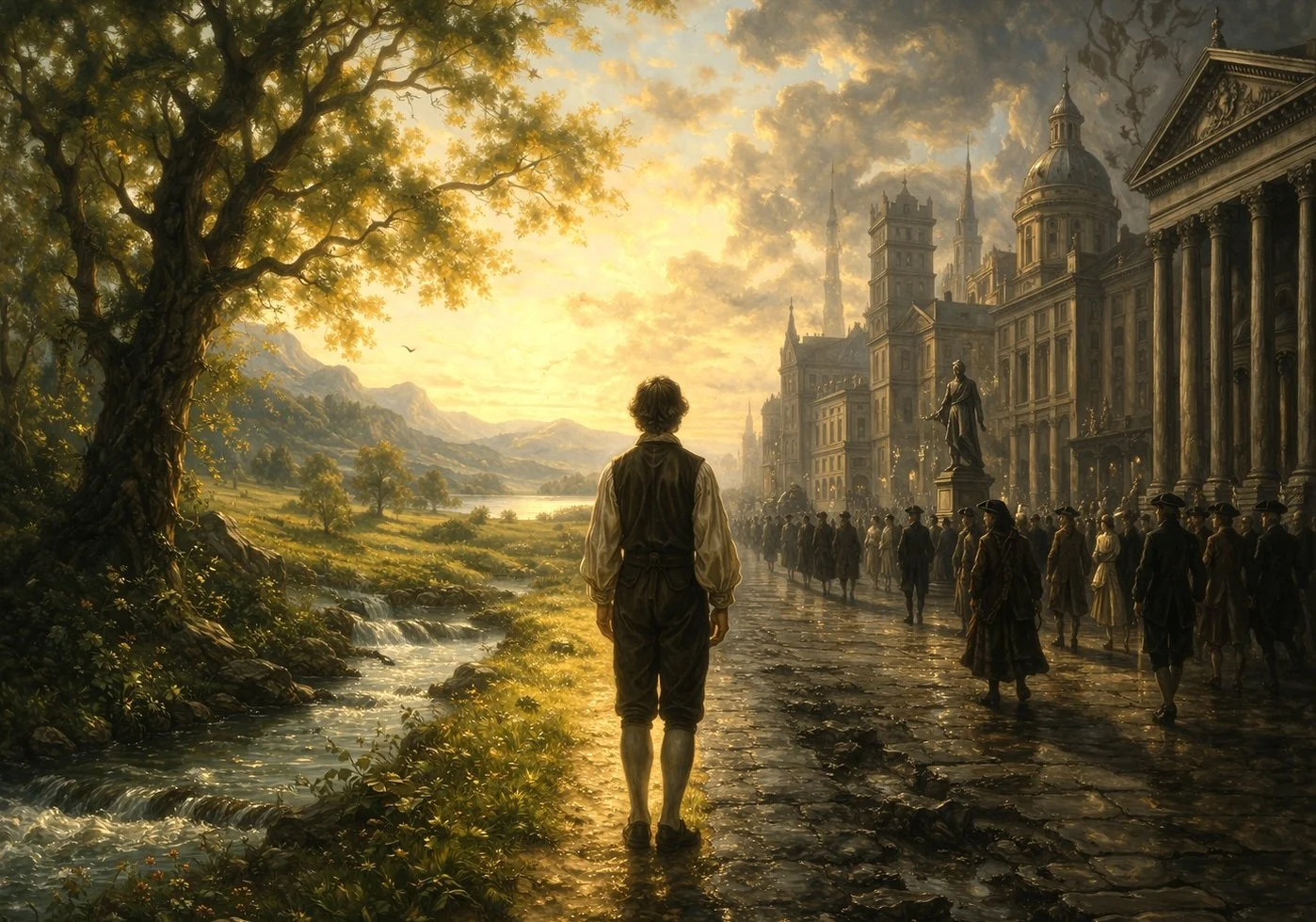
Nature, Society, and the Cost of Civilisation
The Big Idea
Civilisation does not necessarily improve us.
Rousseau believed that human beings are not born selfish or corrupt, but begin life with a natural capacity for compassion, curiosity, and freedom. It is not our instincts that deform us, but the social world we construct around ourselves.
As societies develop, they introduce comparison, status, property, and the desire for recognition. What begins as simple self-awareness becomes something more burdensome: the need to be seen, judged, and valued by others.
From this, inequality emerges.
The problem, for Rousseau, is not that society exists, but that it reshapes human nature in ways that distance us from ourselves. We become preoccupied with appearance rather than substance, with reputation rather than character.
Progress, in this sense, carries a cost.
The Man and the Moment
Jean-Jacques Rousseau was born in 1712 in Geneva, a small republic shaped by independence and restraint. His early life was unsettled. His mother died shortly after his birth, and his father’s absence left him without stability, a condition that would mark both his temperament and his thought.
Largely self-educated, Rousseau moved through Europe in a series of modest roles, observing society from its edges rather than its centre. This distance gave him a perspective that many of his contemporaries lacked.
When he arrived in Paris, the Enlightenment was at its height. Thinkers such as Voltaire and Diderot celebrated reason, progress, and the advancement of knowledge. Rousseau did not reject these outright, but he questioned their consequences.
His breakthrough came in 1750, when he argued that the arts and sciences had not improved moral life, but had contributed to its corruption. The claim ran against the confidence of the age, yet it established his reputation.
He remained an uneasy figure within intellectual circles, admired but often at odds with those around him. His disagreements, including a well-known rupture with Hume, reflected both his independence of thought and the volatility of his character.
Why It Mattered
Rousseau altered the way human nature was understood.
Where earlier thinkers had emphasised reason or self-interest, Rousseau placed feeling, sympathy, and moral intuition at the centre of human life. He argued that inequality arises not simply from material differences, but from the social structures that encourage comparison and competition.
His claim that ‘man is born free, and everywhere he is in chains’ captured this tension. The chains he described were often invisible, formed through expectation, status, and the pressure to conform.
In The Social Contract, he sought a solution. True freedom, he argued, is not the absence of restraint, but participation in a system of laws that reflect the common good. When individuals help to shape those laws, they remain free, even within society.
This idea is both powerful and difficult. It offers a vision of collective responsibility, but also raises questions about how the ‘common good’ is defined, and by whom.
In Émile, Rousseau extended his thinking to education, arguing that children should be allowed to develop naturally rather than being forced into rigid forms of instruction. He saw childhood not as something to be corrected, but as something to be understood.
In Owain Morgan’s Method
Rousseau’s influence on Owain Morgan lies in his sensitivity to the pressures of society upon the individual.
Owain recognises that behaviour is rarely formed in isolation. It is shaped by expectation, by status, and by the need to maintain a particular image. Individuals do not simply act; they perform, often without fully realising it, in response to the world around them.
This becomes particularly visible in moments of conflict.
A person may act not from necessity, but from pride, fear of humiliation, or the desire to preserve their standing. What appears to be a rational decision may, on closer examination, reflect a deeper concern with how one is perceived.
Owain therefore looks beyond the act itself.
He considers the social context in which it occurs, the pressures that bear upon the individual, and the ways in which identity has been shaped by comparison and expectation.
To understand behaviour, one must understand the world that formed it.
The Present Question
If society shapes character, then the question is not simply how we live, but what kind of environment we are creating.
The structures within which we exist influence how we think, how we act, and how we understand ourselves. Comparison, expectation, and the pursuit of recognition can alter behaviour in ways that are not always visible.
It is therefore possible for a society to advance materially while diminishing something less tangible.
The difficulty lies in recognising this.
To ask whether progress has improved us is to question assumptions that are rarely examined, and to consider that what appears to be development may also involve loss.
The Legacy
Rousseau’s influence extends across political thought, education, and literature.
His ideas contributed to the intellectual climate that shaped the French Revolution, particularly the belief that authority derives from the people rather than from inherited power. At the same time, his concept of the general will has been interpreted in ways that reveal both its strength and its danger.
In culture, his emphasis on feeling and authenticity helped give rise to Romanticism, influencing writers, composers, and artists who sought to express the inner life rather than conform to established forms.
His reflections on childhood and development continue to inform modern approaches to education and psychology.
Perhaps most significantly, he made subjectivity central. The inner life, with all its contradictions, became something to be examined rather than concealed.
Key Works
Discourse on the Origin of Inequality (1755). An examination of the social roots of inequality.
The Social Contract (1762). A study of freedom, law, and collective authority.
Émile, or On Education (1762). A rethinking of childhood and learning.
Confessions (published posthumously). A deeply personal account of his life and thought.
The Essence
‘Man is born free, and everywhere he is in chains.’
Human beings are not simply shaped by nature, but by the worlds they create, and what appears to be progress may, at times, carry a quieter cost.