
Alexander Bain
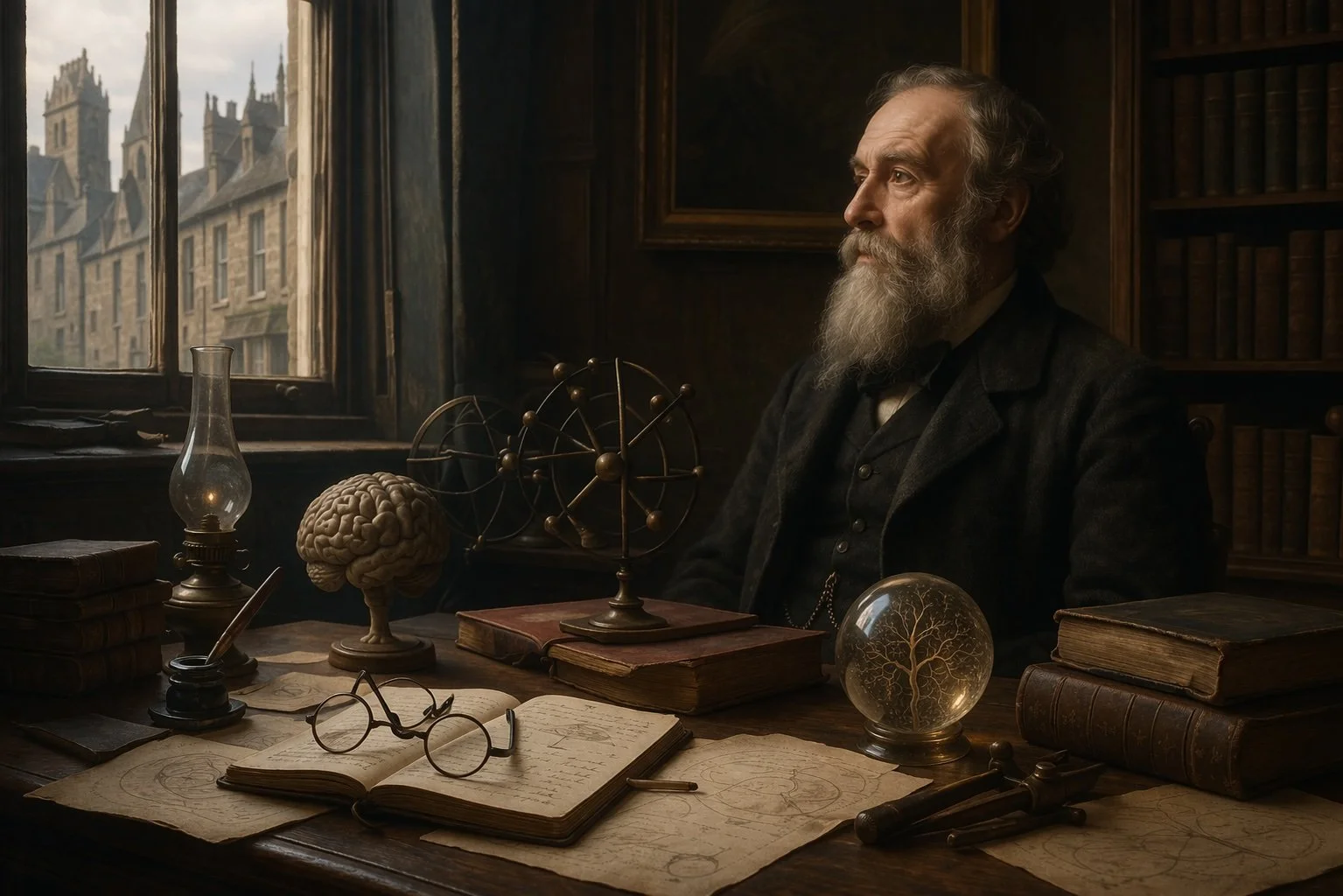
Habit, Repetition, and the Formation of Mind
The Big Idea
We do not simply think. We become the patterns of our thinking.
Alexander Bain argued that much of human behaviour is not the product of isolated decisions, but of repetition. What we do, feel, and think over time leaves traces, making similar responses more likely in the future.
In this way, habit is not incidental. It is formative.
Actions repeated become tendencies. Tendencies, sustained, become character.
The mind is not only a place of thought. It is where patterns are quietly laid down and reinforced.
The Man and the Moment
Alexander Bain was born in Aberdeen in 1818, the son of a weaver. His path into intellectual life was shaped not by privilege, but by ability and persistence.
He studied at the University of Aberdeen and later returned as a professor, becoming one of the earliest figures to argue that the mind could be studied with the same seriousness as the natural sciences.
Bain worked at a moment of transition. Psychology had not yet separated itself from philosophy, but the questions were becoming more precise. Thinkers were beginning to ask not only what the mind is, but how it works.
He moved within the circle of John Stuart Mill and contributed to public life in London before returning to Scotland, where he played a significant role in shaping education and the emerging discipline of psychology.
He was not a system-builder in the grand philosophical sense. His work is quieter, more observational. But it moves in a clear and decisive direction.
Why It Mattered
Bain’s importance lies in his understanding of habit and association.
He saw that behaviour is rarely spontaneous. It emerges from patterns formed over time. Each action strengthens a tendency. Each emotional response reinforces a pathway.
Ideas, in his account, do not exist in isolation. They are linked through association, and those associations are often shaped by feeling. A memory carries an emotional tone, which influences how it is recalled and what it leads to next.
Over time, these associations organise themselves into recognisable structures.
Thought begins to follow familiar routes. Emotion attaches itself to certain patterns. Behaviour becomes, in part, the continuation of what has already been formed.
This does not eliminate freedom, but it reframes it.
We act, but we do so within patterns we have helped to create.
The Legacy
Bain’s influence is often indirect, but it is substantial.
His work anticipates later developments in psychology, particularly in the study of learning, habit, and behaviour. What he described through observation finds echoes in what we now understand as neural pathways and behavioural conditioning.
He helped to shift attention away from abstract definitions of the mind and toward its functioning.
Not what the mind is, but what it does.
In doing so, he contributed to the emergence of psychology as a discipline grounded not only in speculation, but in careful observation of human behaviour.
It is this way of seeing that Owain carries into his work.
In Owain Morgan’s Method
Bain sits quietly at the foundation of Owain Morgan’s method.
Owain does not treat behaviour as an isolated event. He looks for the pattern behind it — the repetitions, the habits of thought, the emotional tendencies that make a particular action more likely over time.
Where others focus on the moment of decision, he is interested in what prepared the ground for that moment.
Not simply what is said, but what is said again.
Not a single reaction, but a recurring way of responding.
These are not incidental. They are traces of habit.
In this sense, motive is not a single impulse. It is the convergence of tendencies — memory, emotion, and repetition — gradually formed and reinforced.
To understand an action is to understand the structure that made it likely.
The Present Question
If behaviour is shaped by patterns we barely notice, how free are we in any given moment?
And if those patterns can be observed, recognised, and perhaps altered, what responsibility do we have to examine them?
Bain does not remove agency. He complicates it.
He suggests that understanding ourselves requires attention not only to what we do, but to what we have done repeatedly.
Key Works
The Senses and the Intellect (1855). A foundational study of perception, association, and thought.
The Emotions and the Will (1859). An exploration of feeling, action, and the formation of behaviour.
Mental Science (1868). A synthesis of his psychological and philosophical work.
The Essence
‘The repetition of an act tends to render it easier, and therefore more certain.’
Bain reminds us that the mind is not static. It is shaped over time.
What we repeat, we reinforce. What we reinforce, we become.
And in that quiet process, character takes form.