
Aristotle: The Philosopher Who Inspired Monty Python
On observation, balance, and why living well is harder than it looks
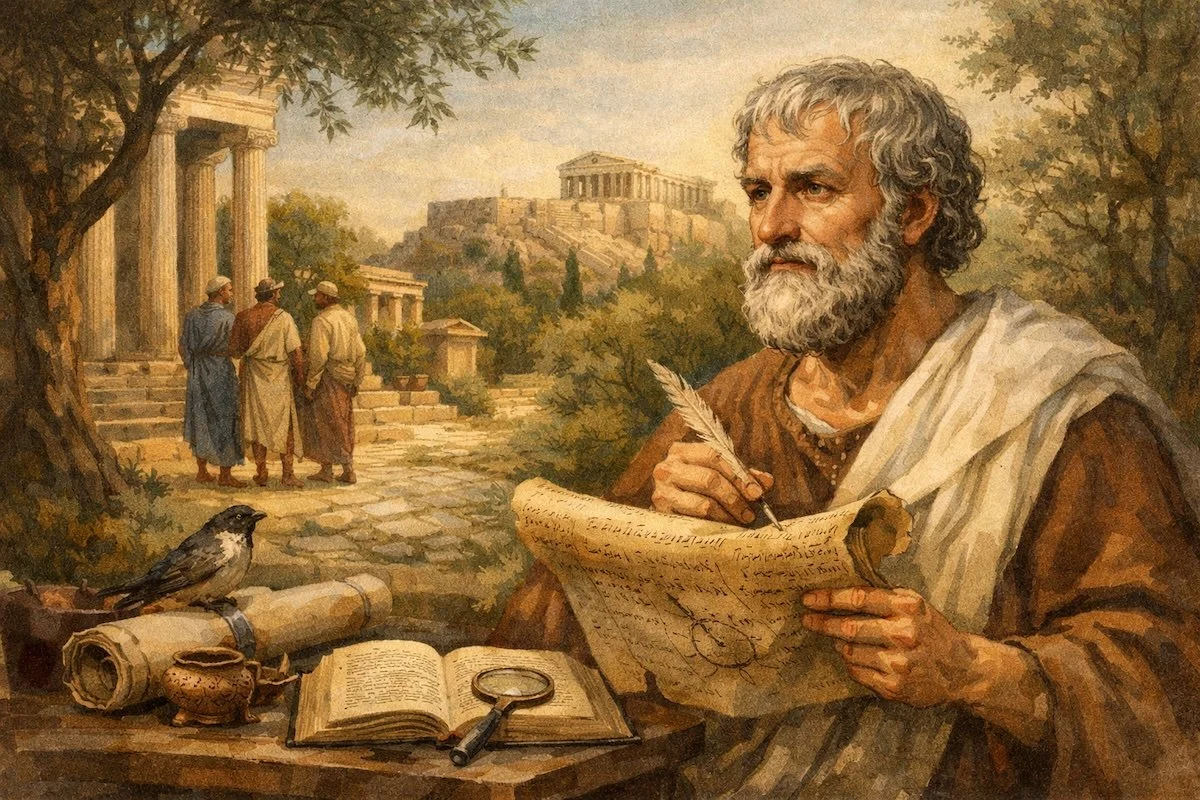
I’m a man of a certain age and, like many students in the 1970s, I adored the zany, intellectual comedy of Monty Python. That’s why whenever I hear or think of the name Aristotle, like one of Pavlov’s dogs, I instantly add: ‘was a bugger for the bottle’.
It’s a line from The Philosophers’ Song, a gloriously silly pub singalong that managed to name-check most of Western philosophy between rounds of beer. And yet, behind the laughter, there’s something oddly fitting about Aristotle being immortalised in a drinking song. He was, after all, the philosopher of balance, the man who believed in moderation, the golden mean between excess and deficiency. Though I doubt he’d have recommended stress-testing that theory in a student bar.
If Plato built castles in the clouds, Aristotle was the one who came along, admired the architecture, and then asked, ‘Yes, but how does the plumbing work?’
The Big Idea
Knowledge begins with noticing.
Aristotle believed that truth doesn’t live in some distant heaven of perfect ideas. It lives here, in the messy, material world we actually inhabit. To understand life, you don’t need to close your eyes and contemplate eternal Forms as Plato suggested. You need to open them, look carefully, and pay attention to what is in front of you.
This was a decisive shift away from his teacher Plato, who trusted reason to lift us above appearances. Aristotle trusted experience to ground us within them. He believed that knowledge begins with the senses, with observation, and with the slow accumulation of understanding.
In that sense, Aristotle was the first great empiricist. That’s a fancy word for something very simple: he trusted his eyes more than his imagination. Look. Observe. Compare. Repeat. Philosophy with mud on its boots.
The world, he thought, is intelligible because it has order. That order isn’t hidden in some divine blueprint; it reveals itself through careful attention. The task of the thinker is not to escape reality but to understand how it works.
The Man and the Moment
Aristotle was born in 384 BCE in Stagira, a small town in northern Greece. His father was a physician to the Macedonian royal court, which meant Aristotle grew up surrounded by medicine, anatomy, and the idea that knowledge should be useful as well as beautiful.
At seventeen, he travelled to Athens to study at Plato’s Academy, where he stayed for nearly twenty years. Imagine the scene. Plato, serene and idealistic, talking about perfect Forms. Aristotle, younger and sharper, nodding respectfully and quietly thinking, ‘All very well, but how does any of this actually work?’
He adored Plato but disagreed with him profoundly. Plato looked upward toward abstract perfection. Aristotle looked outward toward concrete reality. One searched for eternal truths beyond the world. The other found meaning within it.
When Plato died, Aristotle left Athens. He travelled, married, wrote, and gathered observations. He also took on a pupil who would become rather famous: Alexander of Macedon, later known as Alexander the Great. It must have been an unusual pairing. The philosopher devoted to moderation tutoring a future conqueror with global ambitions.
When Aristotle eventually returned to Athens, he founded his own school, the Lyceum. Teaching took place while walking through gardens and colonnades. His followers became known as the Peripatetics, from the Greek for ‘those who walk about’. Philosophy, for Aristotle, was not a sedentary activity.
Once again, Monty Python springs to mind.
Why It Mattered
Aristotle’s lasting achievement was his insistence that everything could be studied systematically. Not just stars and stones, but ethics, politics, poetry, friendship, and happiness.
He believed that understanding comes from breaking things down and asking clear questions. What is this thing made of? What shape does it take? What caused it? And what is it for?
These became his famous four causes:
1. Material – what something is made of
2. Formal – its structure or pattern
3. Efficient – what brings it into being
4. Final – its purpose
That final cause, purpose, or telos, sits at the heart of Aristotle’s thinking. He believed that everything in nature tends toward something. An acorn aims to become an oak. A knife aims to cut well. A human being aims to flourish.
His word for that flourishing was eudaimonia (you-die-MOH-nee-uh). It’s often translated as ‘happiness’, but that misses the point. Aristotle didn’t mean feeling good. He meant living well: developing your capacities, acting virtuously, and becoming the kind of person you were capable of being.
Virtue, he argued, is not a feeling or a rule. It’s a habit. And habits are formed through practice.
He also believed in balance. His Doctrine of the Mean held that virtue lies between extremes. Courage sits between cowardice and recklessness. Generosity between stinginess and extravagance. Wisdom between rigidity and chaos.
Plato gave us ideals. Aristotle gave us instructions.
The Legacy
For nearly two thousand years, Aristotle was the authority. His works became the backbone of medieval education, preserved by Islamic scholars and reintroduced to Europe by Christian thinkers. To disagree with Aristotle was, at times, to flirt with heresy.
Thomas Aquinas referred to him simply as ‘The Philosopher’, as if the job title had already been filled.
His influence shaped logic, science, theology, law, and education. Even when later thinkers overturned his conclusions, they did so by arguing with him. Galileo, Copernicus, and Newton all wrestled with Aristotle’s legacy before moving beyond it.
And yet, for all his brilliance, he could be wrong. Spectacularly so. He believed heavier objects fall faster than lighter ones. He thought women were ‘deformed men’, a claim I strongly advise against repeating in polite company. Interestingly, he also believed eels were born spontaneously from mud!
What these errors reveal is not stupidity, but confidence. Aristotle trusted observation, but sometimes his observations were limited or misinterpreted. His system worked brilliantly until it hardened into doctrine.
The danger of Aristotle was not his thinking, but how unquestioningly it was accepted.
In Our Time
If Aristotle were alive today, he’d probably have several research grants, a lab coat with coffee stains, and a podcast called The Golden Mean. One week he’d be on Radio 4 discussing ethics; the next he’d be on Springwatch explaining how badgers illustrate purpose in nature.
He would love data. He would hate social media. Twitter, (I still think ‘X’ is a stupid name) would offend his sense of logic. TikTok would give him a mild existential crisis.
And he would have questions about AI. Serious ones.
What is its telos? What is it for? If it has no purpose of its own, only instructions, then it is clever imitation, not intelligence. Until a system can pursue its own ends, Aristotle would argue, it remains a tool.
He would also remind us, endlessly, about balance. Moderation in consumption. Moderation in outrage. Moderation in certainty. Though given the state of the world, he might allow the occasional extra glass of wine.
Even philosophers have their limits.
Key Works
The Nicomachean Ethics (c. 340 BCE) – Aristotle’s great work on how to live well. Happiness as flourishing, not pleasure.
Politics (c. 330 BCE) – An attempt to design a reasonable state grounded in education and balance.
Poetics (c. 335 BCE) – The first work of literary criticism, analysing tragedy with surgical precision.
Metaphysics (compiled c. 340–320 BCE) – A dense and ambitious inquiry into being itself.
On the Soul (De Anima) (c. 350 BCE) – Early psychology, asking what it means for something to be alive.
The Essence
‘We are what we repeatedly do. Excellence, then, is not an act, but a habit.’ — Aristotle
Wisdom, Aristotle reminds us, isn’t about knowing everything.
It’s about paying attention, cultivating balance, and becoming slightly better tomorrow than you were yesterday.
And perhaps, now and then, putting the bottle down.