
When Power Demands Honour
Oil, obedience, and the ethics of taking what was never given
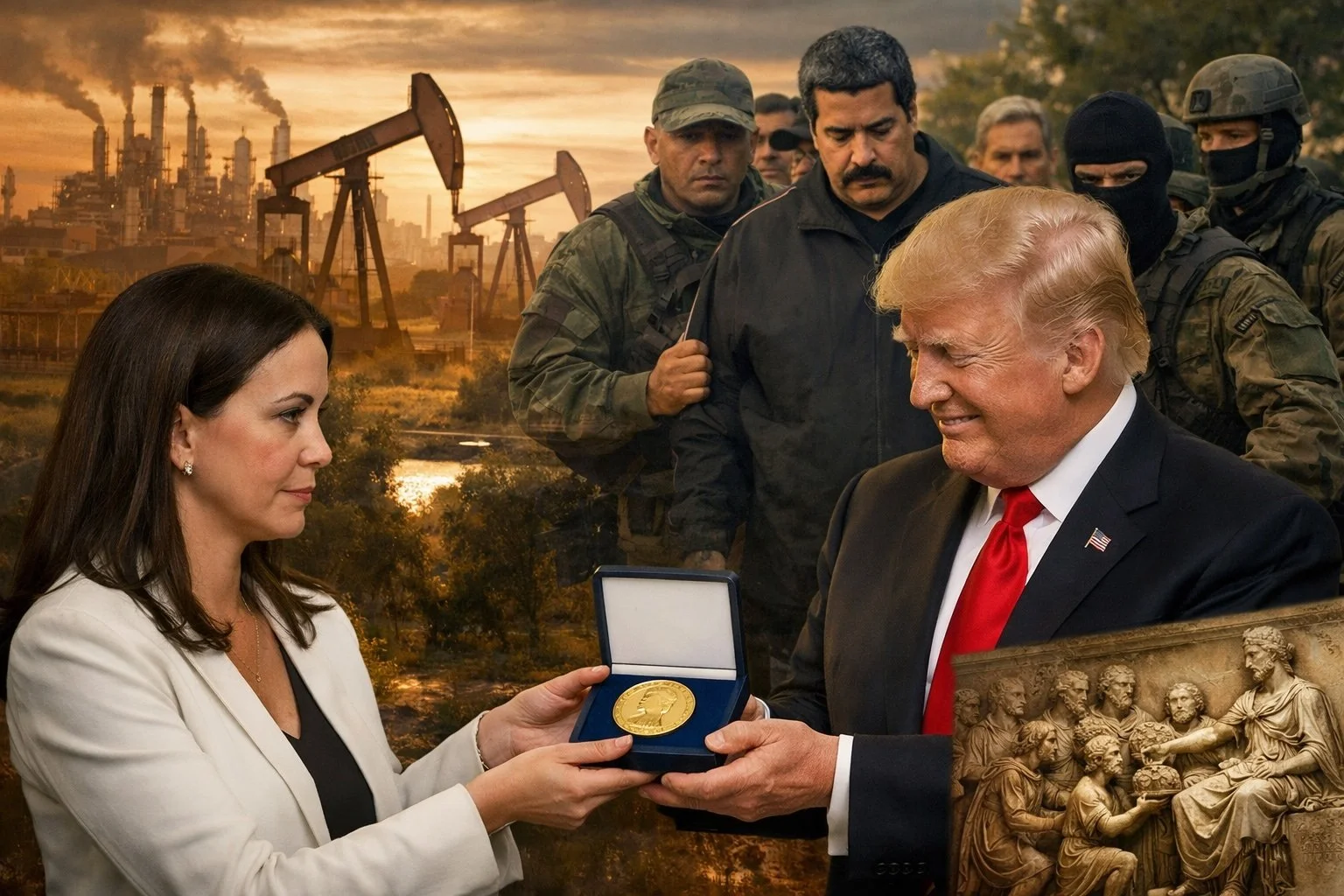
Venezuelan opposition leader María Corina Machado has handed her Nobel Peace Prize medal to Donald Trump at the White House, presenting it as recognition of his ‘commitment to Venezuela’s freedom’.
The symbolism is elegant. The reality is not.
Because what has unfolded in Venezuela is not a clean story of liberation. Whatever one thinks of Nicolás Maduro — and moral judgements about him are easy enough to make — the principle matters more than the personality. A state was intervened in, a leader sidelined, and cooperation continued with much the same political machinery, now reframed as acceptable.
This is not emancipation. It is rearrangement. And it is happening in a country with the largest proven oil reserves on earth.
Medal and meaning
The Nobel Peace Prize committee has been explicit: the medal may be given away; the prize itself never transfers. That distinction is not pedantic. It is ethical.
A prize is not a possession. It is a judgement made at a particular moment, about particular actions, by an institution claiming moral independence. Once that judgement exists, it belongs to history, not to negotiation.
Accepting the symbol while implying the judgement has shifted collapses the line between recognition and entitlement. Honour becomes something that can be passed on to validate a preferred narrative.
Power and the language of inevitability
Trump has long insisted that he should have received a Nobel Peace Prize. This gesture does not read as humility; it reads as confirmation. A sense that reality has finally corrected itself.
But this is how power speaks when it no longer feels constrained. It does not argue. It accumulates symbols. It allows others to do the praising, so the insistence appears voluntary. What looks like gratitude is, in fact, asymmetry.
Oil beneath the rhetoric
Venezuela’s oil reserves exceed those of Saudi Arabia. That single fact sits beneath almost every claim made about its future.
Sanctions, diplomatic pressure, selective recognition, and sudden moral clarity do not occur in a vacuum. They follow resources. They always have.
Working with familiar elites while keeping extraction flowing is not a rupture with the past; it is continuity with a new vocabulary. Freedom becomes the word that smooths the transition. Peace becomes the label applied after the fact.
In that context, a medal does important work. It lends ethical polish to what is, at heart, a strategic settlement.
Honour by accumulation
This episode does not stand alone.
Over the years, Trump has publicly received, accepted, or displayed gifts and symbolic honours from multiple foreign governments and political actors, portraits, ceremonial objects, medals, letters of praise, and lavish gestures framed as personal recognition rather than diplomatic formality.
Each individual gift can be explained away. Together, they form a pattern.
These are not merely diplomatic courtesies exchanged between states. They are personalised tokens, offered to the man rather than the office, and often publicised in ways that blur the line between statecraft and homage.
What matters ethically is not the legality of any single gift, but the cumulative effect. When leaders accept repeated symbolic affirmations from abroad — especially from regimes seeking favour, legitimacy, or access — recognition begins to flow upwards rather than outwards.
This is how honour quietly changes shape.
Power made visible
There is also the matter of setting.
Under Trump, the Oval Office has increasingly resembled a television set, heavy with gold ornamentation, polished surfaces, gleaming fixtures, and visual cues designed to project wealth, dominance, and permanence. It is a space curated not for restraint or civic modesty, but for spectacle. Every utterance is televised and Trump is the star. The Presidency as a reality TV series that thrives on ratings.
Some dismiss this as merely bad taste. That misses the point.
Overt displays of wealth in seats of power are never neutral. They are signals. Gold does not simply decorate; it asserts. It says this authority is abundant, unassailable, and unquestionable. The viewer is not invited into deliberation, but positioned as an audience.
Historically, republics have favoured understatement for a reason. Plainness suggests limits. Modesty implies accountability. Excess belongs to courts and empires.
When political power adopts the language of luxury, it stops asking to be judged. It asks to be admired.
An old ritual in modern dress
History offers no shortage of parallels.
Empires have always preferred homage to debate. Roman provinces offered gifts to emperors not because they admired them, but because refusal was dangerous. Medieval courts understood the same rule: honour was not earned upward; it was displayed downward.
Today the rituals are subtler. Photo opportunities replace tribute. Medals replace statues. But the logic endures.
Praise confirms power.
Power accepts praise.
And the story becomes settled.
Why this matters
When symbols of moral judgement are absorbed into geopolitical theatre, they cease to judge anything at all. They become instruments, not of peace, but of persuasion.
The public is invited to accept a simplified narrative: tyrant removed, freedom restored, virtue rewarded. Complexity is inconvenient. Interests are left unnamed.
And so honour is no longer bestowed. It is exchanged.
A final thought
The most revealing thing about power is not how loudly it speaks of freedom, but how readily it accepts honour for delivering it.
When medals travel more easily than truth, and moral language is asked to do the work of strategy, we are not witnessing peace. We are watching an old story — tribute, power, and resources — told once again in the vocabulary of virtue.