
Did Donald Trump Actually Break the System?
Or did he simply open the cracks we preferred not to see?
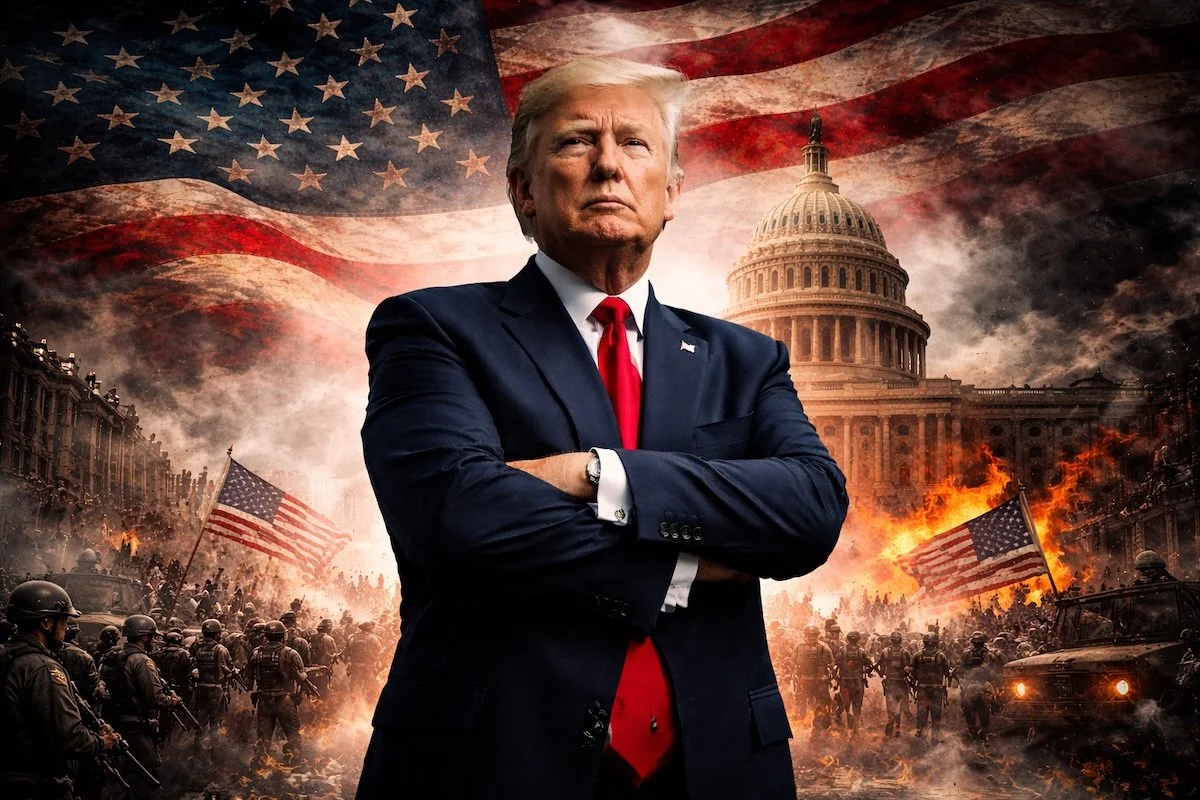
Donald J. Trump is everywhere, all the time.
He governs like a reality television host who has wandered into the Oval Office and decided the cameras should never be switched off. He holds court in cabinet rooms surrounded by journalists. He speaks in superlatives, threats, jokes, and half-finished ideas. He says things no other modern leader would dare say out loud.
Many see him as a threat to global stability. Others see him as a truth-teller, tearing down a corrupt establishment.
But here is the harder, more uncomfortable question:
Did Trump actually break the system — or did he simply reveal how fragile it already was?
That distinction matters, because if the system was already cracked, removing Trump does not fix it.
The System Everyone Assumed Would Hold
For decades after the Second World War, the global order rested on a set of shared assumptions.
Not moral perfection. Not universal harmony. But rules.
Borders were fixed.
Alliances mattered.
Democratic states did not threaten one another’s sovereignty.
Power was constrained by institutions, norms, and the expectation of continuity.
It was messy, imperfect, often hypocritical. But it held.
Trump did not invent the forces undermining this order. Globalisation hollowed out communities. Trust in institutions eroded. Media fragmented. Economic inequality widened. Political language grew more brittle and theatrical.
What Trump did was stop pretending.
He treated norms as optional. Alliances as transactional. Truth as negotiable. Power as personal.
And the system, exposed to full daylight, bent far more easily than anyone expected.
Why the Second Term Feels More Dangerous
Trump’s first term was chaotic, but constrained.
He faced internal resistance: career civil servants, experienced military leaders, institutional inertia. Many of his most extreme instincts were slowed, diluted, or quietly ignored.
Now that restraint is gone.
This second term is marked by deliberate ideological consolidation.
Loyalists over professionals.
Sycophancy over expertise.
Personal loyalty over constitutional duty.
Positions are filled not by those who know how the system works, but by those who promise not to question it. The aim is no longer disruption alone, but control.
This is not accidental. It reflects a lesson learned the first time around: institutions only restrain you if you allow them to.
Power Without Restraint, At Home and Abroad
Domestically, we see the unprecedented use of federal power against political opponents. The normalisation of troops deployed in or threatened against Democratic-led states. Rhetoric that treats internal dissent as disloyalty rather than democratic disagreement.
Internationally, the shift is even starker.
Trump speaks admiringly of Vladimir Putin and Xi Jinping, not because of shared ideology, but because he respects unconstrained authority. Leaders who rule without interference. Who silence opposition. Who do not answer awkward questions.
At the same time, he undermines alliances designed precisely to prevent that model from spreading.
NATO is treated not as a cornerstone of collective security, but as a protection racket. Support becomes conditional. Commitments become leverage. Trust erodes.
Adversaries notice. Allies plan accordingly.
When Even Neighbours Become Negotiable
Perhaps the most revealing moments are not the loudest ones, but the ones initially dismissed as jokes.
When Trump suggested acquiring Greenland, many laughed. A property developer’s fantasy. A diplomatic faux pas.
But it was not a joke. It was a worldview.
Greenland was not discussed as a nation or a people, but as an asset. Strategic location. Resources. Utility. Something to be acquired if the price was right.
The same instinct appears in the casual destabilisation of relations with Canada. Tariff threats. Trade wars. Language of dominance rather than partnership. Not disagreement between equals, but discipline of a subordinate.
Since 1945, one of the quiet pillars of global stability has been the assumption that borders between democratic allies are settled.
Once that assumption weakens, everything changes.
Small states hedge.
Allies doubt guarantees.
Strongmen test limits.
The danger is not that Greenland will be bought or Canada coerced.
The danger is that the norm itself erodes.
Gaza, Grandeur, and the Language of Real Estate
Nowhere is the mindset clearer than in Trump’s rhetoric about Gaza.
Not as a humanitarian catastrophe. Not as a diplomatic crisis. But as a development opportunity. A place to be ‘rebuilt’, rebranded, reshaped — a Middle Eastern Mar-a-Lago.
This is power stripped of moral vocabulary. Suffering reduced to inconvenience. Displacement reframed as opportunity.
It is not policy. It is property logic applied to human lives.
And once that logic is accepted, nothing is off the table.
Power as Threat, Not Guarantee
Underlying all of this is a simple calculation Trump understands instinctively.
The United States possesses unmatched military force and enormous economic leverage. And Trump is willing to say, out loud, what previous leaders implied only cautiously: that power exists to be used.
Not merely to deter adversaries, but to discipline allies.
Tariffs become punishment.
Security guarantees become bargaining chips.
Military protection becomes conditional.
Support us — or pay a price.
This is not alliance leadership. It is dominance politics.
Trump knows that few countries can meaningfully resist American pressure in the short term. He knows that the US dollar anchors global finance, that American markets matter, that US military power dwarfs that of most allies. And he appears increasingly prepared to turn those facts into explicit threats.
That is why the tone has changed.
Greenland is not about territory.
Canada is not about trade.
NATO is not about defence.
They are about submission.
Once power is framed this way, relationships change. Allies stop trusting guarantees and start hedging. They look for alternatives. They make quiet arrangements elsewhere. They prepare for a world in which protection comes at the cost of obedience. And history suggests that when great powers treat allies as vassals, alliances do not strengthen. They fracture.
Grievance as Foreign Policy
One detail, small on the surface, reveals a great deal.
Trump has repeatedly complained, in private correspondence and public remarks, that he was never awarded the Nobel Peace Prize. The grievance is telling. Not because the prize matters, but because the reaction does.
Rather than treating it as an honour decided by an independent committee, he appears to have taken it personally, as a slight to be corrected. The tone is not strategic; it is emotional. A sense of having been overlooked curdles into resentment, and resentment hardens into posture.
This matters because grievance has begun to shape behaviour. The fixation on recognition coincides with a visible loss of interest in the hard, unglamorous work of diplomacy. Conflict resolution is slow, incremental, and cooperative. Sulking is fast. Punishment is easier than persuasion.
Nowhere is this clearer than in the lead-up to his appearance at the World Economic Forum in Davos. Instead of reassuring allies, he arrives having imposed tariffs, threatened partners, and openly antagonised countries whose cooperation underpins global stability.
Allies are treated as obstacles. Neighbours as leverage. Institutions as irritants. Even symbolic gestures, such as the renewed fixation on acquiring Greenland, are framed less as policy than as personal score-settling.
This is not realism. It is pique.
When a leader’s self-image becomes entwined with global outcomes, diplomacy stops being about outcomes and starts being about ego repair. Wars are no longer tragedies to be prevented, but backdrops against which status is negotiated.
The question, then, is not whether this is deliberate chaos or calculated brinkmanship. It is whether a system built on restraint can withstand leadership driven by grievance.
Is this instability, or the performance of strength by someone who cannot tolerate being ignored?
The answer matters, because the world cannot afford foreign policy conducted as a series of personal slights.
Trump Didn’t Just Expose the System — He Tested It
Trump did not invent authoritarian instincts, nor did he create geopolitical rivalry. Those forces were already there.
What he did was test how much of the global order depended on restraint rather than enforcement. On leaders choosing limits. On institutions being obeyed because they were respected, not because they were feared. On the long-standing habit of powerful states pretending that power needed moral explanation.
When that pretence disappears, systems do not collapse overnight.
They thin.
They hollow out.
They become brittle.
Rules still exist, but only on paper. Norms survive, but only until they are inconvenient. Alliances endure, but only as long as they serve immediate interests.
That is the danger of erosion rather than explosion. It looks survivable right up until it isn’t.
Why This Matters Now
The real question, then, is not whether Trump is uniquely dangerous.
It is whether the world he is helping to normalise will remain once he is gone.
A world where power is personal rather than institutional.
Where norms are optional rather than binding.
Where alliances are conditional rather than assumed.
Where truth is tactical rather than shared.
Where borders feel negotiable.
Where institutions exist only until they get in the way.
That is not a stable order. It is a competitive one. And history is not kind to those.
Trump did not simply reveal a fragile system. He demonstrated how easily overwhelming power can be turned from protection into pressure — and how quickly allies begin to fear the hand that once steadied them.
The question now is not whether the cracks exist. It is whether anyone is able and willing to repair them.