
René Descartes: The Man Who Doubted Everything
Four centuries after “I think, therefore I am”, we’re still searching for certainty in an age of illusion, algorithms, and artificial minds.
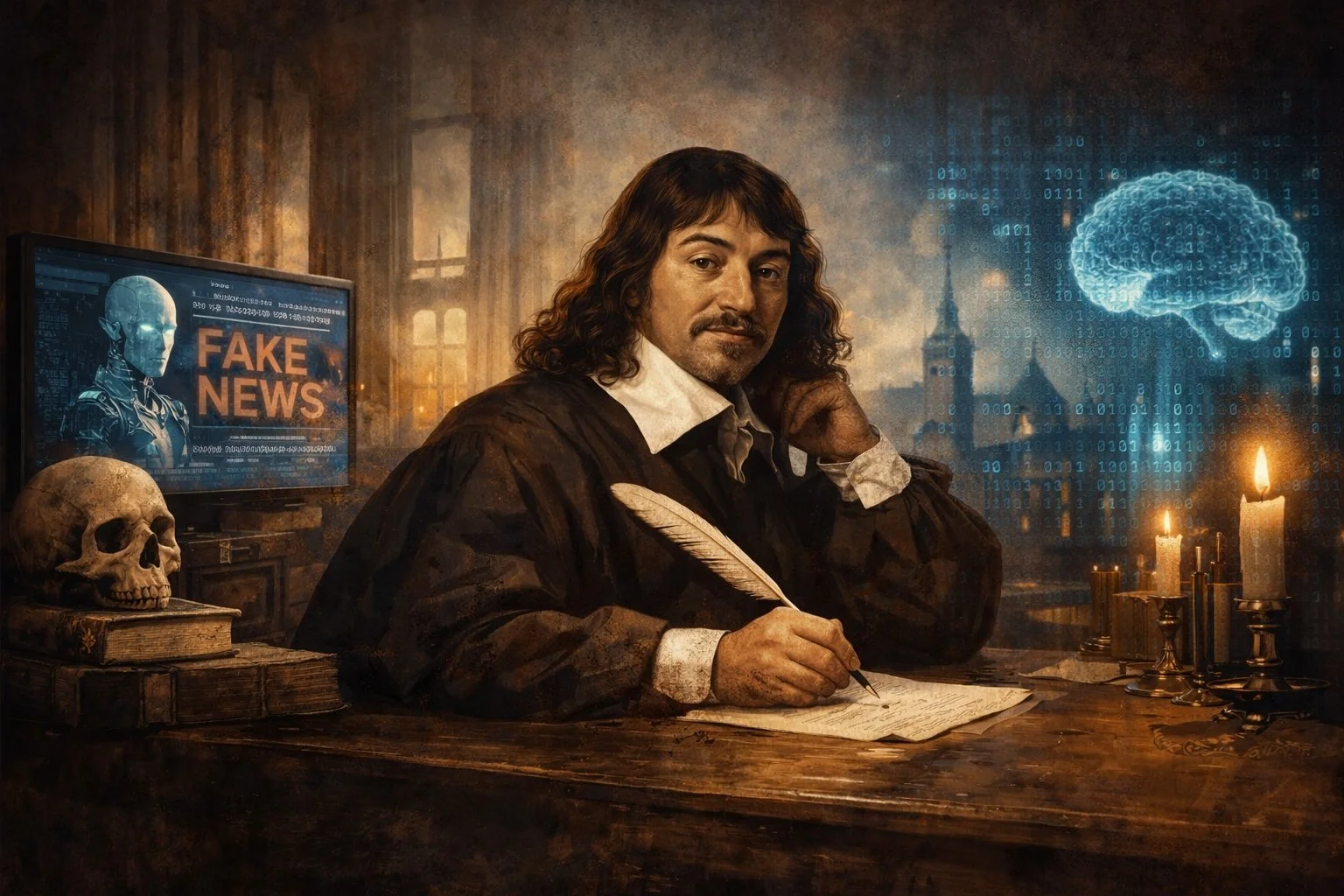
The Big Idea
Descartes wanted certainty.
He looked around seventeenth-century Europe and saw war, plague, superstition, priests arguing with scientists, and scientists trying not to get burned by priests. Nothing seemed stable. Everything could be wrong.
So he did something radical. He decided to doubt absolutely everything.
Not just gossip or tradition, but his senses, his memories, even the existence of the chair beneath him. He stripped away every belief that could possibly be false, determined to find something that doubt itself could not touch.
At the end of this intellectual demolition, one thing stubbornly remained.
Cogito, ergo sum.
I think, therefore I am.
It was philosophy’s great moment of clarity. Not shouted from a bathtub like Archimedes, but murmured into the void by a man who had spent too long alone with his thoughts.
The idea still ripples outward. Even the legendary Jethro Tull frontman and songwriter Ian Anderson, one of the most well-read men in rock, has picked up Descartes’ melody. On his recent album Curious Ruminant, he sings:
‘Answering, why am I anywhere
Orbiting construct of Jung and Freud
Psycho-dreaming asteroid
My ghostly whisper, “Cogito ergo sum.”’
Four hundred years on, the question still drifts through space and song. How do we know we exist? Descartes found his answer in thought. The rest of us are still tuning up.
The Man and the Moment
René Descartes was born in 1596 in La Haye, France, now helpfully renamed Descartes. He was a delicate child and was sent to the Jesuit college at La Flèche, where he received the best education money and Catholic discipline could buy. It filled him with logic, Latin, and a lifelong suspicion of received wisdom.
He studied law, joined the army, and wandered across Europe during the Thirty Years’ War, a conflict so brutal it made Hobbes look cheerful. One cold morning in 1619, while stationed in Germany, Descartes experienced three vivid dreams which convinced him that he was destined to reform human knowledge itself. Most people would have asked for a change of regiment. Descartes decided to reinvent philosophy.
He began to suspect that the only secure foundation for knowledge lay not in the world, but in the mind. To understand reality, you first had to understand thinking. This was the birth of rationalism: the belief that reason, not faith, tradition, or even sensory experience, is the final judge of truth.
Descartes spent much of his life moving between Holland and France, writing, calculating, and avoiding trouble. His books were eventually placed on the Church’s Index of Prohibited Works, which was generally how you knew you were doing something interesting.
In 1649 he accepted an invitation from Queen Christina of Sweden to tutor her in philosophy. Unfortunately, she insisted on lessons at five in the morning. Descartes, accustomed to late-night thinking and warm rooms, caught pneumonia in the Swedish winter and died within months.
Doubt, it turned out, was safer than Stockholm.
Why It Mattered
Descartes’ brilliance lay in his audacity. He dared to start from nothing, to rebuild knowledge from the ground up.
His Discourse on Method and Meditations on First Philosophy mark the moment the modern world began to think for itself. By grounding existence in consciousness, he turned inward and found the universe waiting.
‘I think, therefore I am’ was not arrogance. It was humility. Everything else could be illusion, but the fact of thinking proved there was at least a someone doing the doubting.
From this single certainty, Descartes divided reality into two kinds of thing. Mind and matter. Res cogitans, the thinking thing, and res extensa, the extended thing. This became known as Cartesian dualism, and it has been causing arguments ever since.
How does an invisible mind move a physical body? How can a thought, which has no weight, lift an arm or break a heart?
Even Monty Python felt compelled to intervene. ‘René Descartes was a drunken fart,’ they sang, which at least settled the question of whether mind and body could cooperate on a Friday night.
Descartes did not have brain scanners or mindfulness apps, but he had a powerful intuition. Consciousness itself is mysterious and primary. Without it, nothing else makes sense.
He also invented analytical geometry, the coordinate system that underpins modern science. Every graph you’ve ever stared at in confusion traces back to him. He is the reason the Cartesian plane exists, and why schoolchildren everywhere greet it with quiet dread.
More importantly, he shifted authority away from church and crown. Truth was no longer something handed down. It was something discovered through method and reason. That single move changed everything.
The Legacy
Descartes lit a fuse that still burns.
His insistence on reason launched the Enlightenment. His mind–body split helped give birth to psychology. His method of doubt became the engine of scientific inquiry. Einstein, Freud, and Alan Turing all worked in his long shadow.
He also gave us a new kind of loneliness. Once you begin with the self, everything else becomes uncertain: the outer world, other minds, even God. In chasing certainty, Descartes accidentally locked humanity inside its own head.
You can see his inheritance everywhere today. ‘I think, therefore I am’ has quietly become ‘I post, therefore I am’. Identity now feels like performance. Reality arrives filtered through screens. The Cartesian self has gone digital.
And yet there is something admirable in his solitude. Descartes believed that clarity was possible if we dared to question everything. In an age of noise, outrage, and manufactured certainty, that kind of disciplined doubt feels radical again.
In Our Time
If Descartes were alive today, he would be fascinated by artificial intelligence. Machines that reason, or at least imitate reasoning, would pose exactly the question that haunted him. Can something think without being aware that it thinks?
He might sit in a café watching people scroll and mutter, ‘Cogito, ergo sum,’ then glance around and add, ‘Do they?’
He would follow the modern debate about consciousness with interest. Neuroscientists search the brain for the mind and find only more brain. Descartes would listen politely and remind them that the very act of questioning presupposes a questioner. Thought is not a glitch in matter. It is the light by which matter becomes known.
He would also be alarmed by how easily certainty is now manufactured. Deepfakes, conspiracy theories, algorithmic outrage. The illusions he once feared have gone viral. The danger today is not doubting too much, but knowing when to stop.
Still, he would probably keep his sense of humour. Asked what he thought of AI, he might smile and say, ‘I compute, therefore I am. At least until the battery dies.’
Key Works
Discourse on Method (1637) An accessible manifesto for clear thinking, written in French rather than Latin so ordinary readers could follow the argument.
Meditations on First Philosophy(1641) A deeper dive. Six meditations that dismantle the world and rebuild it from pure reason.
Principles of Philosophy(1644) An attempt to unify science and metaphysics. A seventeenth-century theory of everything.
The Essence
‘Cogito, ergo sum.’ — Meditations on First Philosophy
I think, therefore I am.
The rest, as Ian Anderson might say, is feedback.
Next in the Series:
Baruch Spinoza — the quiet lens-grinder who went looking for God not above the world, but within it.