
Thomas Aquinas: Patron Saint of Overthinking
If Aristotle was the man who made philosophy walk, Thomas Aquinas was the one who made it kneel, and then tried to make it stand up again without losing its dignity.
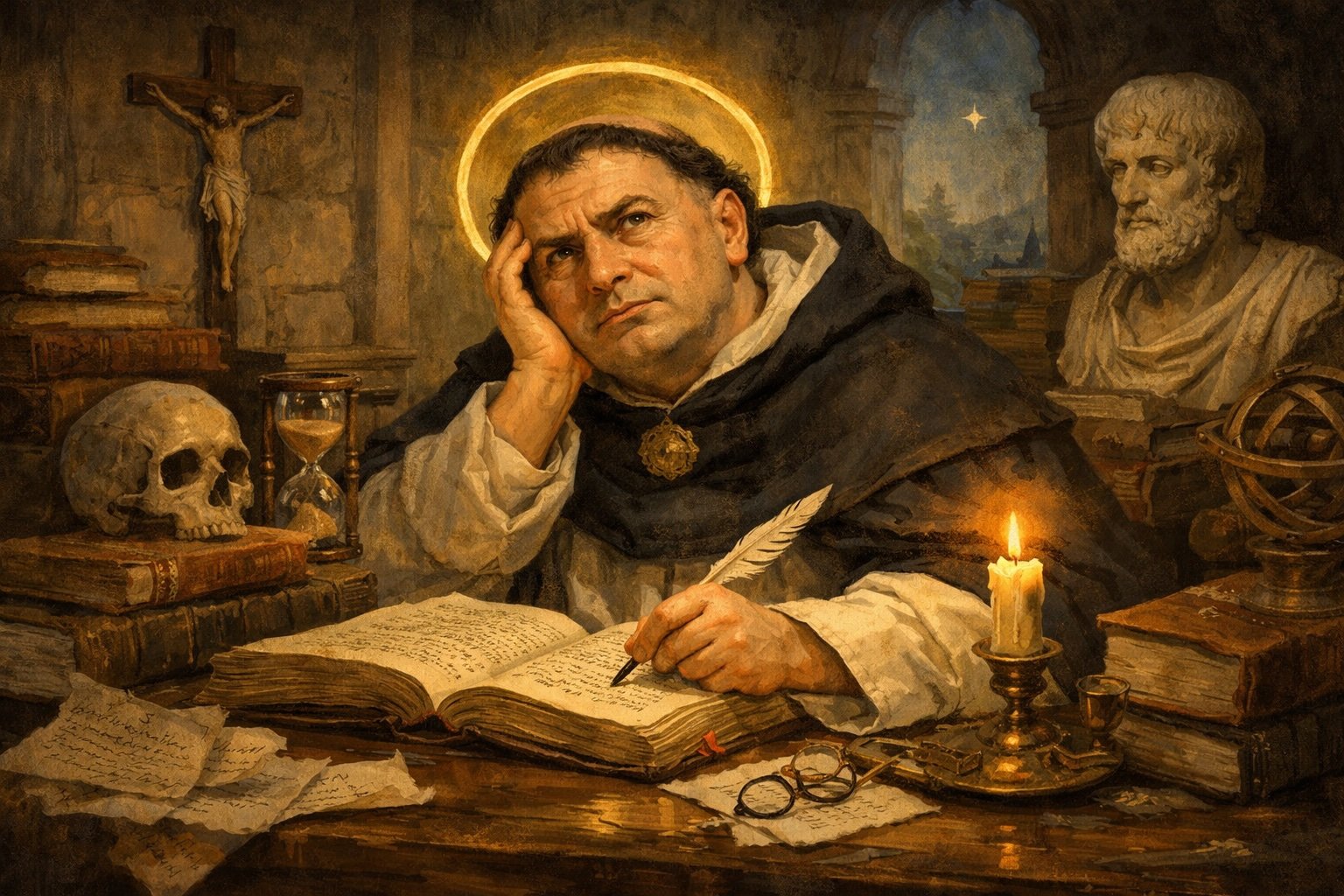
The Big Idea
Faith and reason don’t have to fight. Aquinas believed that truth is one, and that philosophy and theology both lead to it, just by slightly different routes.
Reason helps us understand the world. Faith helps us understand what reason can’t quite reach.
It was a bold move in an age when the Church claimed ownership of truth and Aristotle was still pagan contraband. But Aquinas saw no contradiction. If truth is real, he argued, it shouldn’t matter who found it first.
The Man and the Moment
Thomas Aquinas was born in 1225 near Naples, into a noble family who were not entirely thrilled when their son decided to join a group of wandering monks called the Dominicans. They had hoped he’d become an abbot, preferably one with land, status, and a healthy income. Instead, he ran off to pursue a life of poverty, chastity and argument. Where did they go wrong, they must have wondered.
His brothers were so outraged that they kidnapped him and locked him in the family castle for over a year, hoping he’d come to his senses. According to legend, they even sent in a woman to ‘distract’ him from his vows. Thomas chased her out with a burning log and carved a cross into the door for good measure. Hardly a party animal. Or perhaps simply a man with a very clear sense of purpose.
Eventually, the family gave up and let him go. He studied in Naples, Cologne and Paris under another great mind, Albert the Great, who supposedly said of his quiet, heavy-set pupil, ‘He may be slow to speak, but he will make the world ring with his teaching.’ He wasn’t wrong.
Thomas wrote constantly. Commentaries, essays, sermons, and eventually his life’s work, The Summa Theologica, a vast, cathedral-like system of Christian thought. It wasn’t just theology. It was architecture built out of ideas.
And through it all ran the influence of Aristotle. Thomas called him simply ‘The Philosopher’, as if no other existed. The ultimate fan-boy move.
Why It Mattered
Aquinas’s great achievement was to give faith a backbone of reason. He believed that God gave us minds for a reason, to use them. Where some saw philosophy as a threat to religion, he saw it as its best defence.
He argued that we can know certain things about God through reason alone. That there must be a First Cause, an Unmoved Mover, something that explains why anything exists at all. His famous Five Ways were attempts to demonstrate God’s existence logically, using observation rather than scripture.
In a sense, he baptised Aristotle, taking Greek logic and giving it a theological purpose. If Aristotle saw the world as an ordered system, Aquinas saw it as an ordered system with an author.
But he was no blind dogmatist. He knew that reason has limits, that beyond the boundaries of logic, faith must take over. Faith, for Aquinas, was the handrail you reach for when the staircase disappears into mist.
What made him remarkable was his patience. He didn’t shout down opponents or excommunicate them. He reasoned with them. Each argument in the Summa begins with objections, which he carefully presents before offering his reply. It’s intellectual judo, and a style of debate social media could learn from.
The Legacy
Aquinas died young, at just forty-nine, on his way to a church council in Lyons convened by Pope Gregory X. He fell ill on the journey. Some say after striking his head on a low-hanging branch, others that his body simply gave out after a lifetime of fasting, overwork and relentless thinking.
The monks at Fossanova Abbey took him in, but his mind had already travelled further than his body could follow. After his death, he was divided up like a sacred jigsaw. Bones, relics and assorted saintly fragments distributed across Europe. The Church never did waste a good theologian.
He left behind over eight million words of writing. No spellcheck. No grammar checker. No autocorrect. Just ink, quill, elbow grease, and probably a heroic case of RSI. His output makes modern doctoral theses look like Post-it notes.
Within fifty years, he was canonised. That means made a saint, not fired from a cannon, though some of his critics might have preferred that. The Church named him patron of scholars, students, and anyone trying to think clearly under pressure.
His ideas became the backbone of Catholic theology. Thomism is still studied and argued over eight centuries later.
Even beyond theology, his influence lingers. The belief that faith and reason can coexist, that science and spirituality can converse without shouting, owes him a lasting debt.
Near the end of his life, after years of writing, Aquinas experienced what he described as a revelation. After that, he stopped writing entirely, saying that everything he had produced now seemed ‘like straw’.
You have to admire a man who builds an intellectual cathedral and then calmly admits it isn’t the real thing.
In Our Time
If Aquinas were alive today, he’d probably be moderating online debates between atheists and believers, politely, firmly, and with the patience of a saint, which he would eventually become. He’d be the calm voice in the comment section saying, ‘Perhaps we can find some common ground before someone starts shouting.’
He’d love long-form podcasts. The kind where people finish sentences. He’d charm Melvyn Bragg on In Our Time and irritate everyone by making both sides sound reasonable.
He might even run a Substack called Summa for the Soul. Part theology, part moral philosophy, part advice column for people suffering from existential dread.
He’d be fascinated by artificial intelligence. He’d see it as human reason reaching toward creation, but he’d still ask the awkward question. ‘Yes, but does it have a soul?’
And if someone told him faith was outdated, he’d smile that patient Dominican smile and reply, ‘Outdated for whom?’ Then he’d calmly dismantle Richard Dawkins on Newsnight without raising his voice, and somehow make everyone watching feel slightly better about humanity.
Key Works
Summa Theologica (1265–1274). Aquinas’s magnum opus. Not so much a book as a one-man attempt to explain absolutely everything. Theology, ethics, metaphysics. Best attempted with patience and snacks.
Summa Contra Gentiles (1259–1265). A reasoned explanation of Christian doctrine aimed at non-believers. Evangelism with logic rather than threats.
Commentaries on Aristotle (1260s). Aquinas’s respectful dialogue with ‘The Philosopher’. Translation, clarification, and occasional intellectual wrestling.
On Being and Essence (1252–1256). A short, dazzling attempt to explain what it means to exist. Small book, enormous question.
Catena Aurea (c. 1260). A ‘Golden Chain’ of commentary on the Gospels, weaving together earlier thinkers. Proof that even saints liked a good quotation.
The Essence
‘To one who has faith, no explanation is necessary. To one without faith, no explanation is possible.’ — Thomas Aquinas
Reason builds the bridge, but faith still has to cross it.
Next up, from the saint to the schemer. Machiavelli, the man who taught politics to stop pretending it had morals. Think Peter Mandelson in a doublet and hose.