
What Has Become Normal
Reflections on Democratic Drift in Trump’s America
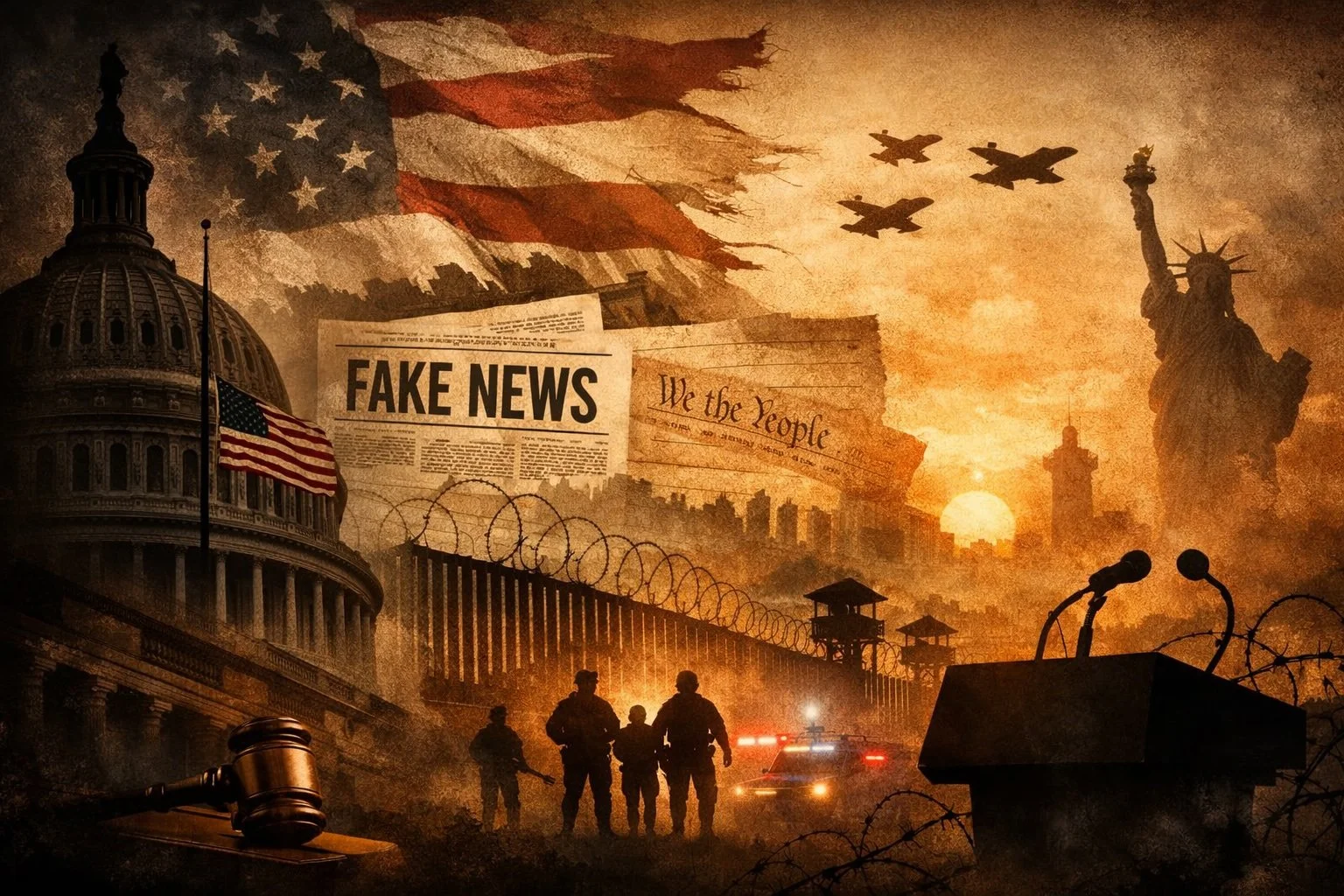
One of my most read essays last year asked whether certain political patterns in the United States echoed darker moments in European history.
That was April 7th 2025.
A great deal has happened since then so it seems worth returning to the question to test it. To see what has changed, and perhaps more importantly, what has quietly settled into the political background.
When I wrote that earlier piece, my argument was not that America stood on the brink of Nazism. It was that certain methods — familiar from the history of authoritarian movements — deserved scrutiny.
Those methods included:
The erosion of constitutional norms.
The elevation of personal loyalty above institutional principle.
The manipulation of grievance as political fuel.
Attempts to pressure or reshape legal processes, particularly through the Department of Justice.
The sustained delegitimisation of the press through the language of “fake news”.
The distortion or dismissal of unfavourable data, including the sidelining of officials who deliver inconvenient economic or policy information.
None of these actions, taken individually, constitute dictatorship. Democracies are resilient. Courts intervene. Institutions push back.
But repeated over time, they form a recognisable pattern.
Authoritarianism rarely begins with overt rupture. It begins with the steady weakening of guardrails.
From Shock to Shrug
Over the past year, the most striking development has not been a single dramatic event, but adaptation.
Executive orders stretch the boundaries of constitutional interpretation and are immediately contested. Court rulings are framed as partisan. Legal reversals are dismissed as obstruction. Major economic decisions are announced with sweeping certainty, then revised. Each episode triggers outrage — and then fatigue.
The cumulative effect matters.
When controversy is constant, citizens lose the capacity to distinguish between what is extraordinary and what is merely routine. Political turbulence becomes ambient. Democratic strain becomes expected.
Shock gives way to shrug.
This process — normalisation through repetition — has marked the early stages of democratic decline in many historical cases. Not collapse, but adjustment.
Loyalty and the Legal Process
One of the clearest markers of democratic health is the perceived independence of legal institutions.
When prosecutors, judges, and investigators are publicly characterised as enemies rather than as constitutional actors, the effect is corrosive. When legal scrutiny is recast as persecution, accountability becomes politicised.
Even unsuccessful attempts to pressure or reshape the Department of Justice alter expectations. They test limits. They signal priorities.
The question is not whether each effort succeeds. It’s whether the repeated testing of boundaries shifts the public’s sense of what is acceptable.
And, as we have seen, boundaries, once stretched, rarely contract easily.
The Press and the Control of Narrative
Free societies depend on adversarial journalism. Governments will always criticise the press. That is neither new nor inherently dangerous.
The concern arises when press briefings themselves become instruments of narrative distortion and propaganda rather than clarification.
When official spokespeople routinely dismiss uncomfortable questions as illegitimate, accuse journalists of asking the “wrong” questions, or present statements demonstrably at odds with verifiable facts, the issue moves beyond spin.
Political spin is strategic framing. Systematic distortion is something different.
When citizens cannot rely on official briefings to convey accurate information — particularly on matters of law, economics, or national policy — the informational foundation of democracy weakens.
Truth does not need to be abolished to be destabilised. It only needs to be blurred.
Hollowing Rather Than Overthrow
Comparisons with 1930s Germany often dominate public debate, but more recent examples offer a clearer structural parallel.
In countries such as Venezuela, Hungary, and Turkey, institutions were not abolished outright. They were hollowed. Courts continued to function, but their authority was gradually constrained. Elections remained, but trust in them eroded. Media outlets survived, yet were relentlessly delegitimised.
The outer architecture endured. The internal balance shifted.
Democracy can persist in form while weakening in substance.
The danger is not always dramatic authoritarian takeover. It is cumulative institutional thinning.
Academic Freedom and Atmospheric Pressure
Another area where this thinning can be observed is higher education.
Federal funding streams have increasingly become sites of political tension. Universities dependent on grants operate within a more cautious climate. Public rhetoric portraying academia as ideologically hostile or unpatriotic carries consequences beyond the speech itself.
Modern democracies depend upon independent research institutions. When funding decisions appear politically conditional, or when dissent is framed as disloyalty, scholars and administrators adjust behaviour accordingly.
Speech is not banned. It simply becomes riskier.
Authoritarian systems historically rely less on overt censorship than on atmosphere. When individuals begin to self-censor to protect careers, funding, or immigration status, formal protections remain intact — but practical freedom narrows.
The shift is incremental. But it accumulates.
Enforcement and the Psychology of Power
Immigration enforcement has also taken on heightened visibility.
Immigration and Customs Enforcement operates within legal authority. Enforcement of immigration law is not, in itself, evidence of authoritarianism. The issue is posture.
Highly publicised raids, aggressive rhetoric, and conspicuous detentions reshape perception. Communities internalise uncertainty. The boundaries between lawful presence and administrative vulnerability can feel unstable.
Power, when exercised conspicuously, alters behaviour beyond the immediate target.
Historically, authoritarian movements have relied not only on legislative change but on psychological signalling: demonstrations of reach and consequence. Even when actions remain legally grounded, their presentation can generate a broader climate of caution. Again, the issue is cumulative effect.
The War on Expertise
The sustained scepticism toward experts — scientists, economists, civil servants, judges — further compounds this pattern.
When unfavourable economic data is dismissed, or the officials responsible for presenting it are marginalised, the integrity of institutional knowledge weakens. When evidence becomes subordinate to narrative, governance shifts from deliberation to instinct.
Confidence may increase. Stability does not.
Democracy depends not only on elections, but on shared standards of fact.
What Remains True
It is essential to state what has not happened.
The United States remains a constitutional democracy. Courts continue to issue rulings. Journalists investigate. Voters participate. Civil society remains active. Legal challenges succeed. Institutional resistance persists.
These facts matter.
The comparison with historical totalitarian regimes fails precisely because America’s democratic infrastructure still functions.
But history’s warnings do not require identical outcomes.
They require recognition of pattern.
The Real Question
Has the United States become 1930s Germany?
No.
There is no single-party state. Elections continue to be held. Courts remain operational. Opposition voices speak. Civil society functions.
That does not mean democratic norms are free from strain. Public rhetoric around “election protection” and fraud has intensified suspicion toward electoral processes. Confidence, once weakened, is not easily restored.
But the historical analogy breaks down at the level of outcome.
History’s warnings lie not only in outcomes, but in method.
In the gradual erosion of norms.
In the testing of institutional limits.
In the redefinition of truth.
In the elevation of loyalty above law.
What has become normal is not fascism.
It is the steady acclimatisation to democratic strain.
And strain, if prolonged, alters structure.
That is the quieter danger.