

Landscape, history and the human thread.
Many of my ideas begin with a walk. Others emerge from history, books, photography and forgotten stories. This notebook gathers them together in one place.
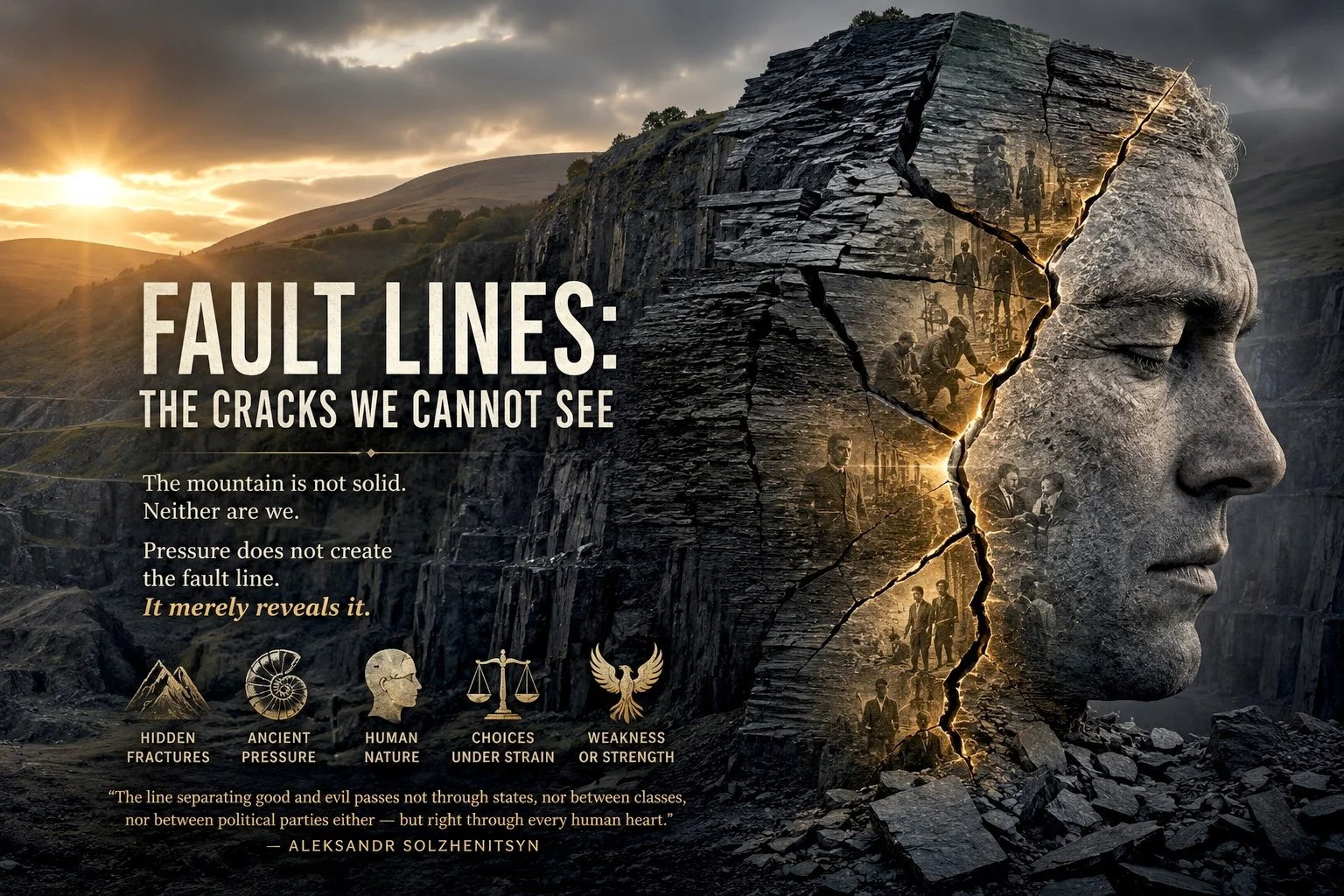
Fault Lines
The hidden pressures, fears, and ambitions that reveal the fault lines within human character.
The cracks we cannot see
I live in North Wales, once the global slate capital. It was said that this region roofed the world. Vast fortunes were built here. Communities flourished. Lives were lost. For generations, men carved mountains apart in pursuit of a material that helped shape the modern world.
Today, many of those quarries stand silent.
When I walk among the remains of these places, where nature is slowly reclaiming what industry left behind, it is easy to believe the mountain has always been as it is.
The rock face appears solid, immense, almost permanent. Layer upon layer of slate stretches away into the distance, shaped by forces so vast and ancient that they are difficult to comprehend. Yet every quarryman knows something that the casual observer does not.
The mountain is not solid.
Hidden within the rock are fractures. Most remain invisible. They may lie dormant for years, unnoticed by anyone passing by. Then pressure arrives. A blast is set, a section is cut away, or the weight above shifts ever so slightly. Suddenly the hidden weakness reveals itself.
The rock breaks.
Human beings are not so different.
We tend to think of character as something fixed. We describe people as honest, trustworthy, loyal, courageous, generous, or kind, as though these qualities were carved permanently into stone. Yet history, psychology, and everyday experience suggest something rather different.
Much of who we are remains untested.
A person may live for decades without ever encountering the circumstances that expose their deepest weaknesses. Another may spend a lifetime believing themselves incapable of a particular action, only to discover under pressure that they are not quite the person they imagined themselves to be.
This is not necessarily because people are deceitful. Often, they simply do not know themselves as well as they believe.
Pressure has a curious way of revealing what lies beneath the surface.
Fear can do it.
So can shame, greed, loss, humiliation, the threat of failure, fear of exposure, or the possibility of losing status, wealth, reputation, or belonging.
History offers countless examples. Respected politicians have ruined careers to conceal relatively minor mistakes. Successful business leaders have risked fortunes in desperate attempts to preserve the appearance of success. Religious leaders, academics, military officers, and public figures have all been known to compromise deeply held principles when faced with pressures they felt unable to endure.
When these stories emerge, we often ask a simple question.
‘What were they thinking?’
It is a natural response.
Yet it may be the wrong question.
A better one might be:
‘What pressure were they under?’
Throughout history, philosophers, psychologists, writers, and statesmen have wrestled with the question of why people act as they do under pressure.
Shakespeare filled his plays with characters undone by ambition, jealousy, pride, and fear. Macbeth does not begin as a murderer. He becomes one, step by step, under the pressure of temptation and self-deception.
The psychologist Carl Jung argued that much of our behaviour is driven by forces hidden beneath conscious awareness. Until we confront those hidden aspects of ourselves, he suggested, they continue to shape our actions from the shadows.
Writing after his experiences of the Soviet labour camps in The Gulag Archipelago, Aleksandr Solzhenitsyn offered perhaps the most sobering observation of all:
‘The line separating good and evil passes not through states, nor between classes, nor between political parties either — but right through every human heart.’
This is not to suggest that all people are equally virtuous, nor that serious wrongdoing can be explained away by circumstance. Rather, it is to recognise that human behaviour is seldom as simple as we would like it to be.
Different centuries. Different experiences. Yet all point towards a similar conclusion: human beings are rarely as simple as they appear.
This does not excuse wrongdoing. Nor does it remove personal responsibility. But it does acknowledge something important about human behaviour.
Most people do not wake up one morning and decide to become dishonest, cruel, or destructive.
The process is usually more gradual.
A compromise here.
A rationalisation there.
A decision justified as temporary.
An action taken to avoid embarrassment.
A truth left unspoken.
A warning ignored.
What begins as self-preservation can slowly become self-deception.
Psychologists have long understood that people possess a remarkable ability to explain their own behaviour in ways that preserve a positive self-image. We tell ourselves stories about who we are. Most of the time those stories serve us well. They provide coherence and meaning.
The problem arises when reality begins to challenge them.
Consider the person whose identity is built around success. What happens when failure becomes unavoidable?
Or the scholar whose reputation rests upon a particular theory. What happens when evidence emerges that threatens everything they have spent years defending?
Or the business owner facing financial ruin after decades of achievement?
In such moments, the threat is often deeper than it first appears.
It is not simply money, status, or reputation that is at stake.
It is identity itself.
The question becomes not merely, ‘What will happen to me?’
But rather:
‘Who will I be if this is taken away?’
Under sufficient pressure, people can behave in ways that would once have seemed impossible to them.
The fault line was always there.
The pressure simply revealed it.
Perhaps this is why history remains so endlessly fascinating. It is not merely a record of events. It is a record of human beings under pressure.
Wars, revolutions, industrial disputes, financial collapses, political crises, and social upheavals all place extraordinary strain upon individuals and communities. Some people rise to the occasion with remarkable courage.
Others fracture.
Most of us are capable of both.
The uncomfortable truth is that we rarely know which version of ourselves will emerge until the moment arrives.
This is not a pessimistic view of human nature. Quite the opposite.
For every story of corruption, there is another of resilience.
For every act of cowardice, there is an act of quiet courage.
Pressure does not merely expose weakness. it reveals strength as well.
The irony is that slate itself owes its existence to pressure.
What began as layers of mud on the floor of an ancient sea was transformed over millions of years by heat and compression into one of the most durable materials known to man.
Not all pressure destroys.
Some pressure creates strength.
The same forces that drive one person towards selfishness may inspire another towards sacrifice.
The same crisis that causes one individual to retreat into fear may compel another to step forward.
The fault lines run in different directions.
Perhaps that is why understanding human behaviour requires a degree of humility.
It is easy to judge from a distance.
It is more difficult to acknowledge that, under different circumstances, we might have acted similarly ourselves.
The quarry offers a useful reminder.
What appears solid on the surface may conceal hidden fractures beneath.
Yet those fractures are part of the rock itself. They do not define the whole mountain. They merely reveal something about its structure.
Human beings are much the same.
Most of us carry strengths we have yet to discover and weaknesses we have yet to confront.
The challenge is not to pretend those weaknesses do not exist.
It is to understand them before pressure arrives.
Because sooner or later, for individuals, communities, and societies alike, it always does.
Perhaps that is why these questions continue to fascinate me. Not only in history and psychology, but in fiction as well.
They sit at the heart of much of my writing.
The loss of academic credibility and reputation formed a central theme in my first Owain Morgan novel, The Silence of the White Shadow. Those same questions continue to shape the novel I am currently working on.
Fault Lines explores an unexplained death in a North Wales slate community.
What causes an ordinary person to cross a line they once believed they never would?
The pressure does not create the fault line.
It merely reveals it.
Field Notes and photographs are occasionally shared on Instagram @iamjohnrees
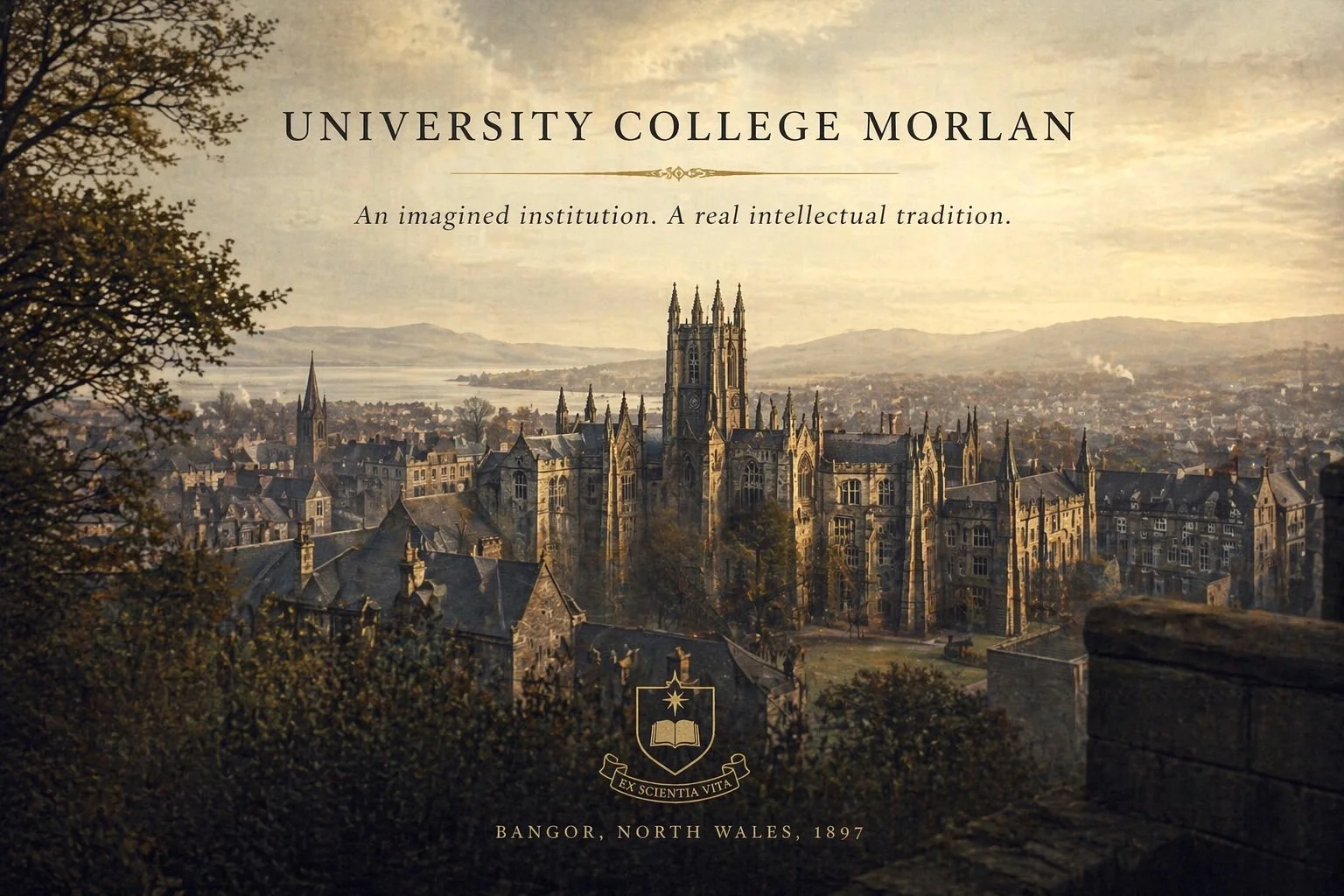
A Fictional University
The story of University College Morlan, and the real intellectual traditions of late Victorian Wales.
The intellectual home of Professor Owain Morgan
There is something slightly self-indulgent about writing the history of a place that never formally existed. It gives free rein to the imagination, and allows the creation of a world I might have wished to inhabit myself.
University College Morlan has no charter, no surviving records, no physical presence that can be visited or verified. And yet, in another sense, it feels entirely real.
That is not accidental.
I did not invent Morlan to escape history, but to work more closely within it. My aim was not to create something fantastical, but something plausible—something that might have stood alongside the institutions that did emerge in nineteenth-century Wales, shaped by the same intellectual, religious, and social currents.
In the later decades of the nineteenth century, higher education in Wales was beginning to take form in new ways. Colleges were being established, often with strong ties to religion, civic life, and the emerging idea of national identity. These institutions did not simply teach; they reflected the tensions of their time—between faith and reason, tradition and reform, authority and inquiry.
Morlan belongs to that moment.
It is not a reconstruction of any one institution, but a way of drawing together the influences of places I know into a single, coherent setting. The fact that I have sited it in Bangor, close to where I live, will no doubt invite comparison.
The late Victorian period was also a time in which ideas about the human mind were beginning to shift. Moral philosophy, theology, and the early study of psychology did not exist as separate disciplines in the way they do now. They overlapped, often uneasily, and it was within that overlap that questions of belief, habit, responsibility, and perception were explored.
It seemed to me that this intellectual world required a setting.
A real institution, bound by its own history and constraints, would always carry with it certain fixed meanings. By imagining Morlan, it became possible to bring these elements into focus without being confined by the exact record of any one place.
Fiction, in this sense, allows a different kind of truth to emerge.
It allows us to ask not only what happened, but what might have been thought, what tensions were felt, and how certain ways of seeing the world were formed.
Morlan exists in that space.
It is a place where ideas are not simply taught, but tested; where the structures of authority are present, but not always stable; where belief and habit shape conduct in ways that are not always visible, even to those who hold them.
From such a place, a mind like Owain Morgan’s becomes possible.
That, ultimately, is the purpose of Morlan:
not to describe an institution,
but to understand the conditions from which a way of thinking might emerge.
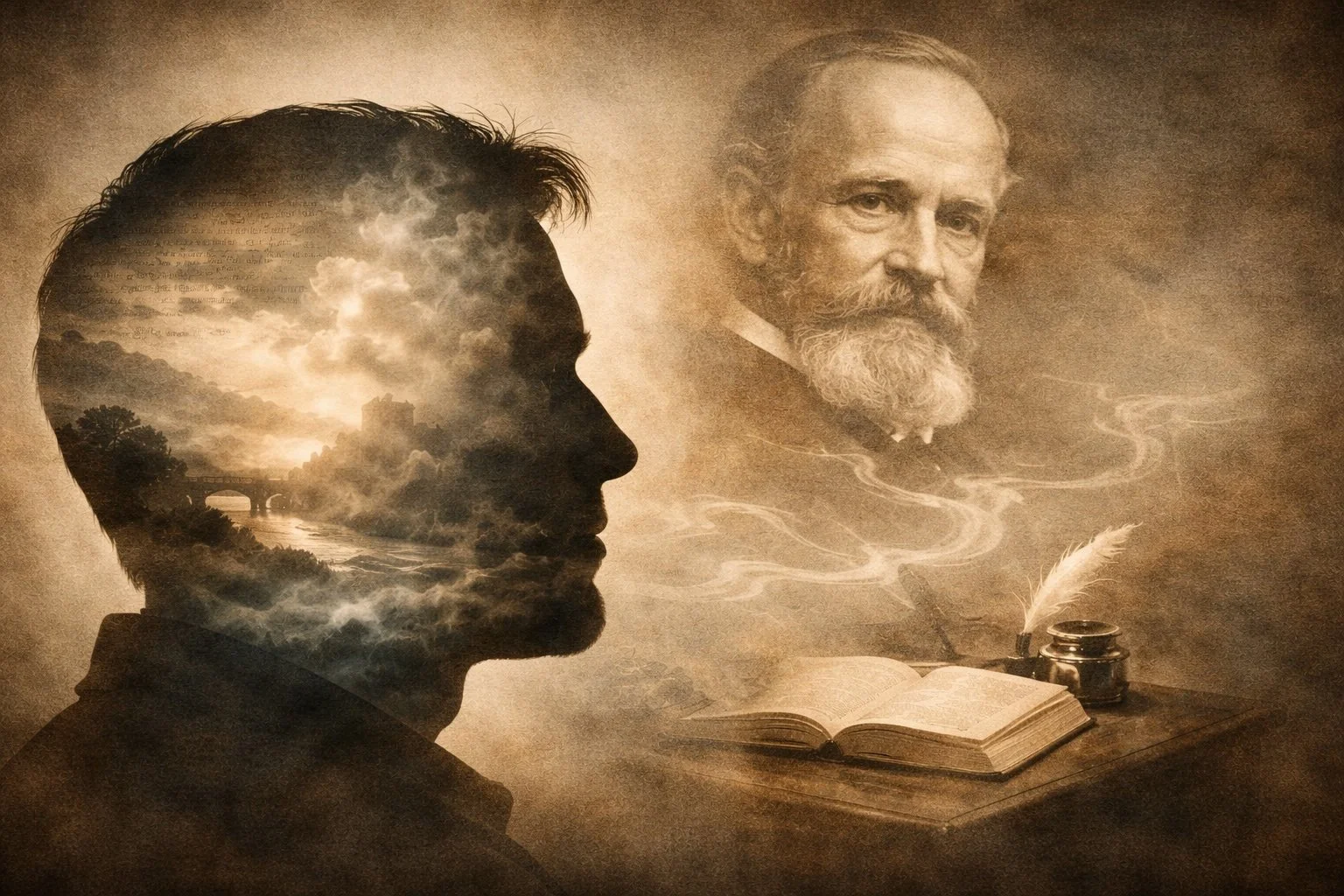
Thought, Silence, and Meaning
William James stream of thought, and how meaning emerges in what lies behind words.
William James and the inner world of Owain Morgan
When I began to develop the character of Owain Morgan, I found myself drawing on a number of longstanding interests. One of the most enduring of these has been psychology.
In the late nineteenth century, it was still an emerging field. It had not yet settled into the form we would recognise today, but it was already beginning to ask serious questions about how the mind works and why we behave as we do.
I wanted Owain to stand at that point of transition, at the edge of a discipline that was just beginning to take shape. It is within that moment that the work of William James becomes particularly important.
The Mind in Motion
In The Principles of Psychology, published in 1890, James challenged the idea that thought proceeds in clear, ordered steps. Instead, he described consciousness as something continuous and fluid. A stream rather than a sequence.
Thought does not arrive in neat sentences. It moves, hesitates, returns, and reshapes itself. What we say aloud is often only a fragment of what is present in the mind.
James also described what he called the “fringe” of consciousness. The half-formed edges of thought where meaning exists before it is fully expressed, and sometimes never is.
It is a simple idea, but a profound one.
What Is Not Said
We tend to think of meaning as something contained within words. We listen for what is spoken, and we assume that understanding lies there. But in practice, much of what matters lies elsewhere. It appears in hesitation. In the pause before a sentence is completed. In the slight alteration of phrasing, or the moment when a thought is abandoned and replaced with something safer.
These are not absences of meaning. They are often where meaning resides most clearly.
Owain Morgan’s Method
This idea sits at the heart of how Owain understands people.
He does not listen only to what is said. He pays equal attention to what is not said, to the small breaks in rhythm, the inconsistencies, and the shifts in tone that suggest something unresolved beneath the surface.
Where others hear a statement, he hears a process. In this sense, meaning does not reside solely in words, but in the spaces around them.
The Psychology of Motive
Owain’s thinking does not rest on a single system. It draws from a number of sources: Blake’s sensitivity to the symbolic, James’s sense of the fluidity of thought, and the observational discipline of writers such as Lewes and Bain.
What begins to take shape is something more personal. What he comes to think of as a psychology of motive. By this, he means the complex interaction of memory, emotion, conscience, and circumstance that precedes human action. The point at which thought becomes intention, and intention begins to move towards action.
It is here, rather than in the act itself, that he believes understanding lies.
Where It Becomes Visible
For Owain, the study of the mind is not an abstract exercise. It becomes most visible in moments of tension. When an individual is confronted with guilt, fear, or shame. When what is said begins to diverge from what is felt. In such moments, the movement of thought becomes more apparent. The hesitation, the shift in tone, the slight inconsistency in language. These are not incidental. They are the outward signs of an inner conflict.
It is this that draws him, at times, into investigation. Not the act alone, but the state of mind that made it possible.
The Shape of Thought
What James recognised was something we all experience, though we rarely name it. Our thoughts are seldom complete. Our intentions are often uncertain. What we express is only part of a larger and more complex movement of mind.
To understand another person, then, is not simply to hear their words, but to attend to the way those words emerge. It is in that movement, rather than in the statement itself, that something closer to the truth may be found.
From the research behind The Silence of the White Shadow
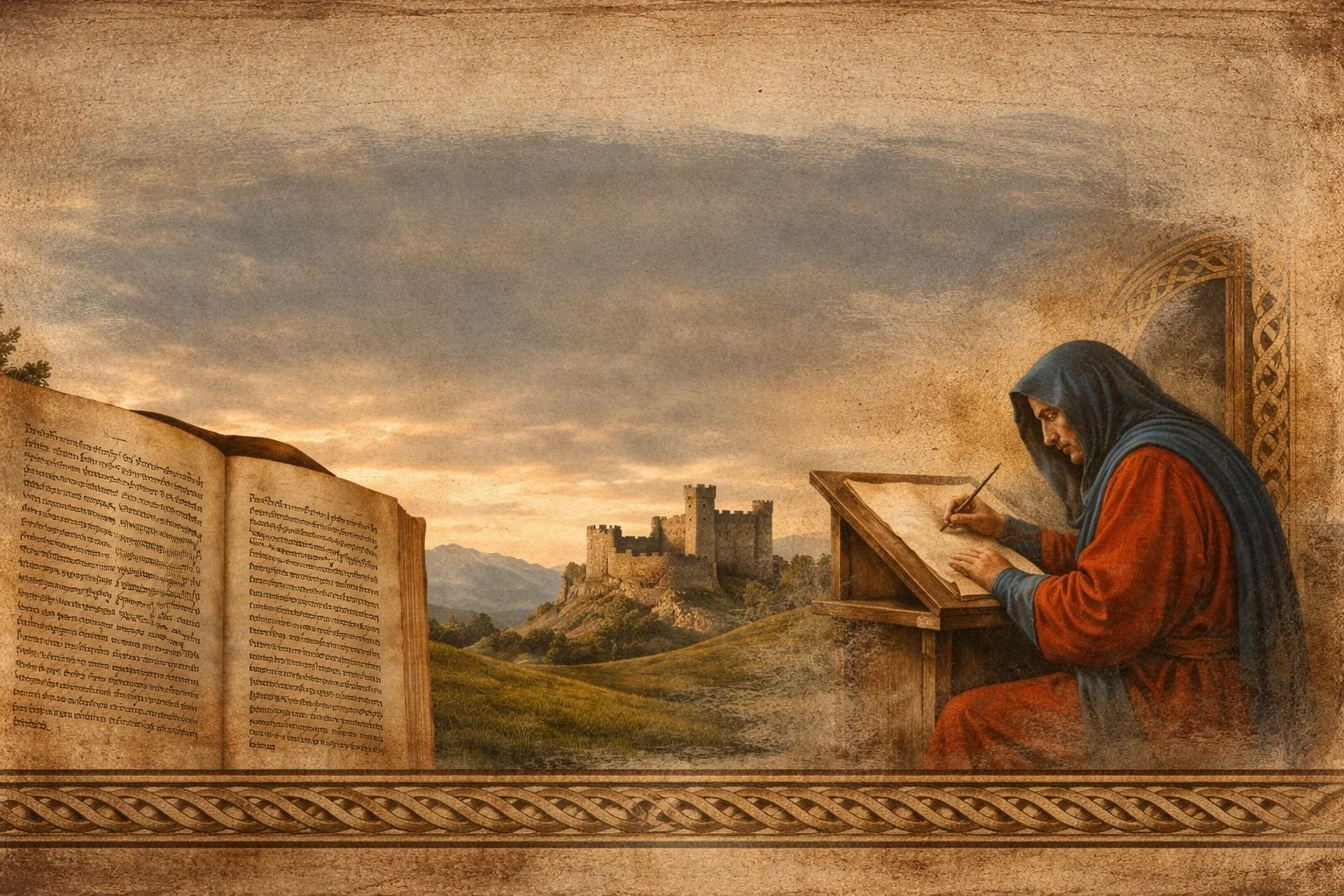
The Weight of a Word
How a phrase could alter history - the linguistic tensions behind The Silence of the White Shadow.
Middle Welsh, Latin, and the fragile art of translation in the world behind the story
Language is rarely as stable as we imagine it to be. That simple idea sits at the heart of my first Owain Morgan novel, The Silence of the White Shadow.
This piece draws on the real history that made that idea plausible.
In the medieval Welsh manuscripts that survive from the twelfth and thirteenth centuries, meaning is often uncertain. It shifts with the hand of the scribe, the habits of the writer, and the expectations of the reader. A single word can carry more than one sense. A single phrase can tilt a passage in one direction or another.
This is the world of Middle Welsh, Cymraeg Canol, the language of the law codes attributed to Hywel Dda and of the prose later gathered under the name of the Mabinogion, a collection of medieval Welsh tales drawn from much earlier oral tradition, preserved in manuscripts of the thirteenth and fourteenth centuries.
Hywel Dda, or Hywel ap Cadell, ruled much of Wales in the early tenth century, from around 920 until his death in 950. He is remembered not only as a king, but as a lawgiver. The legal traditions associated with his name, though compiled and written down in later centuries, reflect an attempt to order society through custom, judgement, and a shared understanding of justice.
These laws survive in Middle Welsh manuscripts, copied and recopied by generations of scribes. They do not present a single fixed text, but a living tradition, shaped by time, region, and interpretation. These texts don’t exist in a single original form. They were copied and changed over time, so what we read today reflects many different hands and moments, rather than just one.
It is within that shifting inheritance that the language must be understood.
Middle Welsh was the main form of the language used between the twelfth and fifteenth centuries. More survives from this period than from any earlier stage of Welsh, and it developed directly from Old Welsh.
It is recognisably Welsh, but not the Welsh spoken today. Its spelling is inconsistent, its grammar less settled, and its vocabulary often dependent on context in ways that resist easy translation. In some manuscripts, even the smallest variation, an added consonant or a shifted ending, can alter the force of a sentence.
It is, in other words, a language in which certainty is hard won.
And that uncertainty matters.
Because in the world of my novel, it is within one such ambiguity that everything begins to unravel.
Victorian Certainty
By the nineteenth century, scholars had begun the serious work of editing and translating medieval Welsh texts. Their efforts were often remarkable. They were painstaking, detailed, and in many ways foundational.
But they were also limited.
They worked with incomplete dictionaries and inconsistent grammars. More importantly, they often approached Welsh material through the intellectual frameworks they already knew, shaped by Latin, classical tradition, and a broader Anglocentric understanding of history.
Where Welsh and Latin appeared side by side, there was a tendency to assume that the Welsh reflected the Latin. It was expected to confirm rather than challenge it.
Middle Welsh does not always allow for that kind of certainty.
Its spelling varies from manuscript to manuscript. Words shift in meaning depending on context, date, or the habits of a particular scribe. Mutations, the subtle changes to the beginnings of words, can alter not just grammar but emphasis and legal force. Bilingual texts, far from offering clarity, often demand interpretation rather than simple translation.
It is a language that resists being forced into neat alignment.
Rutherford’s Discovery
In the novel, it is within this instability that Dr Meirion Rutherford finds his way through.
He notices a small grammatical construction in the Dolwyddelan Codex, something his mentor Professor Arthur Cavendish had passed over. Not because he lacked the ability to see it, but because he had learned, over time, not to look for it.
Cavendish assumed the primacy of Latin. When the two languages appeared together, he expected the Welsh to follow.
Rutherford did not.
Reading the Welsh on its own terms, and with a closer familiarity with medieval law texts, he recognised that a key passage did not mirror the Latin at all. It modified it, quietly but decisively.
The phrase was:
a gwnaethpwyt gyttyn
(roughly pronounced “ah gwneth-poo-it guth-in”)
Usually rendered simply as ‘and it was agreed’.
But in Middle Welsh legal contexts, it carries a more specific weight. It refers to a mutual compact, an agreement between parties standing in parity, rather than an act of submission or grant.
It is a small distinction.
But it changes everything.
Two Readings, Two Histories
From that single phrase, two entirely different interpretations emerge.
Rutherford reads:
‘And a compact was made between them, in equal standing, with neither service nor subordination.’
Cavendish reads:
‘And a grant was made unto him, binding him to service and rightful obedience.’
The difference is not merely linguistic.
In one version, the Welsh acknowledge English supremacy.
In the other, they enter into a negotiated relationship, one that implies parity rather than fealty.
A single verb unsettles an entire historical framework.
There are real precedents for this kind of divergence. The Treaty of Waitangi, signed in 1840, survives in both English and Māori versions. Yet the two do not say quite the same thing. Where the English text speaks of sovereignty, the Māori suggests something closer to governance. The difference is slight in wording, but profound in consequence, and it continues to shape interpretation to this day.
Even within older traditions, the same pattern appears. In the translation of biblical texts, a single Greek word, metanoia, originally meaning a change of mind or inner transformation, came to be rendered as repentance. The shift is subtle, but it alters the entire emphasis of the idea, from inward reflection to moral correction.
Meaning, once fixed in translation, begins to move.
What Could Not Be Seen
The error, then, is not simply linguistic. It is ideological.
For years, Cavendish’s scholarship has rested on a particular understanding of history, one in which hierarchy is assumed, and in which Welsh sources are expected to confirm English authority rather than complicate it.
He does not misread the text out of carelessness.
He misreads it because he cannot easily see beyond the structure of thought he has spent a lifetime building.
Rutherford approaches the text differently, with less certainty perhaps, but with greater openness to what it might contain.
That difference becomes the fault line between them.
Where Language and Life Meet
In the end, this is not only a question of translation.
It is a question of what we allow ourselves to see.
A small grammatical construction becomes the point at which:
a reputation begins to fracture
a body of work is quietly threatened
a man is forced to confront the possibility that he has misunderstood the very thing he set out to explain
Middle Welsh, in this sense, is more than a linguistic medium.
It is the place where meaning shifts, where certainty falters, and where the past resists being made too simple.
And in that moment, when a single word begins to carry more weight than it should, the tragedy of Dolwyddelan begins.
From the research behind The Silence of the White Shadow.

Dolwyddelan Castle
The castle and its real and imagined history in The Silence of the White Shadow.
Between history and imagination
Dolwyddelan Castle is close to my home. I pass it often, usually without thinking too much. Just that brief glance as the road bends and the tower comes into view.
I walked up to it properly last year. That was different. Being there, rather than passing by, stayed with me longer than I expected. It was that walk, I think, that led to the idea of setting a story there.
It later became the origin of Professor Owain Morgan, though that wasn’t clear at the time.
The castle has a history that is only partly visible, and I’ve found myself returning to it, trying to understand what it is that holds me there.
Dolwyddelan Castle stands in a narrow valley in Eryri, its surviving tower rising above the road that now runs through it. It is usually associated with Llywelyn ab Iorwerth, Llywelyn the Great, and is generally thought to have been built in the early thirteenth century, when control of the surrounding uplands carried both strategic and symbolic weight.
Its position is not accidental. The castle sits along a route that links the Conwy valley with the interior of Eryri, a landscape that, in the thirteenth century, was not remote in the modern sense, but politically central. Movement through these valleys seems to have mattered. Control wasn’t only a matter of holding ground, but of watching and shaping how people passed through it.
What remains today is fragmentary, but suggestive. The rectangular tower, with its thick stone walls and elevated entrance, reflects a style of fortification that is both practical and restrained. It lacks the scale of the later Edwardian castles, yet it carries a different kind of authority, one that feels closer to the ground it stands on.
Much of what we understand about the castle comes from later study rather than any continuous record. Archaeological work and architectural analysis, particularly in the twentieth century, have helped to clarify its phases of construction and use, though some uncertainty remains. Like many medieval sites in Wales, Dolwyddelan seems to exist partly in documentation, and partly in inference.
By the nineteenth century, the castle had fallen into significant disrepair. Travellers described it as a ruin, its walls broken and its interior exposed to the weather. At the same time, it began to attract a different kind of attention. Antiquarians and visitors, influenced by Romantic ideas of landscape and history, saw in such places not simply remnants of the past, but something closer to an expression of it.
The restoration that followed was undertaken by Lord Willoughby de Eresby, who carried out substantial repairs between the 1840s and 1860s. His work did not attempt a full reconstruction, but it did stabilise the structure and reshape parts of it according to the sensibilities of the period. As with many nineteenth-century interventions, the line between preservation and interpretation isn’t always easy to see.
It begins to matter, because what we see now isn’t a purely medieval object. It is the result of at least two moments of construction: the original building, and the later effort to recover and present it. Each reflects a different understanding of what the castle was, and what it might have been thought to be.
In the historical sources that remain, Dolwyddelan appears only intermittently. It is not a site that dominates the chronicles, nor one that features prominently in royal records. Yet its association with Llywelyn the Great has endured, supported by tradition and by its geographical logic within his sphere of influence. In this sense, it sits somewhere between certainty and belief, something known, but not entirely fixed.
That ambiguity seems to be part of what allows it to function within fiction.
In The Silence of the White Shadow, the castle is presented much as it stands, but with certain adjustments. Interior spaces are extended, domestic arrangements imagined, and connections between rooms clarified in ways that serve the movement of the narrative rather than the limits of the surviving structure. They aren’t there to mislead, only to make the space usable, somewhere events can unfold.
The figure of Baron de Haersbie, associated in the novel with the castle’s later history, is entirely fictional. In reality, there was no such ownership, nor any transfer to a private antiquarian of the kind described. The nineteenth-century restoration remains the most significant modern intervention, and its effects are still visible in the structure today.
What begins to emerge is a quieter distinction. The castle itself is real, its history partly recoverable, partly uncertain. The version that appears in the novel draws on that reality, but does not attempt to reproduce it exactly. It follows the same pattern that shapes our understanding of the site more broadly, a combination of material evidence, later interpretation, and the needs of the present.
Today, Dolwyddelan Castle is cared for by Cadw and remains open to visitors.
It hasn’t remained unchanged. What stands there now is a mixture of what was built, what was repaired, and what has been understood since.
From the research behind The Silence of the White Shadow.

William Blake’s Inner World
How William Blake influenced the thinking of Professor Owain Morgan.
In The Silence of the White Shadow, Blake’s work shapes the thinking of Owain Morgan. But the ideas behind it are rooted in something far older, and far less easily explained.
William Blake was not an incidental influence in The Silence of the White Shadow. His work helped shape the intellectual and emotional world of Owain Morgan.
That connection emerged during my research, particularly through reading Peter Ackroyd’s excellent biography of Blake. What I found there was not simply an artist or poet, but a way of thinking about the human mind that felt immediately relevant to the world I was creating.
Blake was, in many respects, ahead of his time; a visionary, engraver, painter, poet, and a thinker who resisted the limits of convention.
It was those qualities that first drew me to him and led me to see him as a powerful influence on my fictional Professor, Owain Morgan.
Blake was born in London in 1757, into a world that was beginning, quietly at first, to change.
The Industrial Revolution had not yet reached its full force, but its direction was already set. Systems were emerging, economic, social, and intellectual, that sought to organise, measure, and control. Reason was ascendant, order was prized, and progress increasingly defined in material terms.
Blake stood apart from all of this.
Not in the manner of a reformer or a political agitator, but as something more elusive, a man who seemed to inhabit a different layer of reality altogether.
He was, by trade, an engraver. This mattered more than is often acknowledged. Engraving is slow, exacting work. It requires patience, precision, and an eye for detail. Blake possessed all of these qualities.
But alongside them, he claimed something else.
He saw visions.
Not metaphorically, but literally: angels in trees, figures moving through space, a world alive with meaning that others could not perceive. Whether one takes these as spiritual experiences, imaginative expressions, or something in between is almost beside the point.
What matters is that Blake treated them as real.
Against ‘Single Vision’
Blake’s objection was not to reason itself, but to its dominance.
He believed that when reason becomes the only lens through which the world is viewed, something essential is lost. He described this narrowing as ‘single vision’, a flattening of experience into something manageable, but incomplete.
In its place, he proposed something far more difficult to grasp:
that truth is not singular, but layered
that contradiction is not a flaw, but a condition of being human
that imagination is not an escape from reality, but a means of perceiving it more fully
This is the foundation of The Marriage of Heaven and Hell.
The title itself is a provocation. Heaven and Hell are not reconciled in the sense of being made harmonious. They remain in tension, and that tension is necessary. Energy and restraint, impulse and structure, desire and control all exist because of one another.
Remove one, and the whole system collapses.
The Human Mind as a Landscape
What makes Blake feel so modern is his instinctive understanding that human behaviour cannot be reduced to simple categories.
Long before psychology gave us its language, Blake was exploring:
the fragmentation of identity
the conflict between opposing impulses
the way belief shapes perception
the danger of mistaking one’s own worldview for objective truth
His figures, whether in Songs of Innocence and of Experience or in his later, more mythological works, are rarely stable. They shift, fracture, expand, and collapse. They inhabit states of mind rather than fixed identities.
Nebuchadnezzar, the image that first drew my attention, is perhaps the clearest example of this.
Nebuchadnezzar was a king of ancient Babylon, whose story is told in the Book of Daniel. In that account, pride gives way to collapse. He loses not only his kingdom, but his sense of himself, and lives like an animal until his reason returns.
It is not simply a king brought low.
It is a mind unravelling.
There is something deeply unsettling about the image.
The body is still recognisably human, but the posture is not. The limbs are held in tension, the fingers splayed against the ground as though searching for a stability that is no longer there. The eyes are wide and alert, but not with clarity. They suggest a mind that remains active, but no longer anchored.
This is not sleep, nor rest, nor even madness in the theatrical sense.
It is something quieter, and perhaps more troubling.
A loss of orientation.
Blake does not show us the moment of downfall. He shows us what comes after, when the structures that once held a person in place have already given way.
There is no crown, no symbol of former power, no trace of the world that once defined this figure. Only the man remains, and even that is uncertain.
What we are looking at is not simply punishment.
It is exposure.
The stripping away of identity, until what remains is something more elemental, more instinctive, and far less easily understood.
In this sense, Nebuchadnezzar is not just a biblical image.
It is a psychological one.
It asks a question that Blake returns to again and again:
What becomes of a person when the framework through which they understand themselves begins to collapse?
Why Blake Endures
Like many thinkers and artists who break the mould, Blake was not widely celebrated in his lifetime.
He was, if anything, regarded as eccentric, even obscure. His methods were unusual, his ideas difficult, and his work often self-published in forms that resisted easy distribution.
And yet, over time, his influence has grown rather than diminished.
Why?
Because Blake speaks to something that remains unresolved.
We continue to live in a world that values clarity, measurement, and control. These things have brought undeniable progress. But they have not resolved the deeper question of what it means to be human.
We are still, as Blake understood, divided.
Capable of reason, yet driven by forces we do not fully comprehend. Seeking order, yet drawn towards chaos. Constructing identities that feel stable, even as they shift beneath us.
Blake does not offer solutions.
He offers recognition.
Blake and Owain Morgan
It becomes clear why William Blake held such significance for Owain Morgan.
A man trained in logic, philosophy, and emerging psychological thought, Owain operates in a world that increasingly seeks explanation through reason. Evidence, structure, and method are his tools.
And yet, his work repeatedly brings him into contact with something less easily contained.
Human behaviour resists neat explanation. Motives are rarely singular. People act from inner worlds that are coherent to them, even when they appear contradictory from the outside.
Blake understood this instinctively.
In The Silence of the White Shadow, Blake’s The Marriage of Heaven and Hell travelled with Owain to Edinburgh, where it became a quiet source of strength during his bereavement. In Blake’s union of vision and critique, he found something that spoke directly to his own tension, between reason and imagination, order and insight.
A Final Reflection
There is a temptation, when encountering a figure like William Blake, to try to resolve him, to decide whether he was visionary or irrational, prophetic or eccentric.
But perhaps that misses the point.
Blake’s enduring power lies precisely in his refusal to be reduced.
He reminds us that the human mind is not a tidy place, and that any attempt to make it so will always come at a cost.
It is this recognition that places him so firmly at the heart of Owain Morgan’s world.
For all his training in logic and method, Owain understands that reason alone is never enough. Beneath every action lies a more complex landscape of belief, contradiction, memory, and imagination.
Blake did not solve that complexity.
He saw it clearly.
And in doing so, he gave it form.
From the research behind The Silence of the White Shadow.

The Dolwyddelan Codex
A fictional manuscript that raises questions about history, truth, and interpretation.
A fictional manuscript grounded in historical possibility
In my novel The Silence of the White Shadow, a codex is discovered at Dolwyddelan Castle in North Wales in 1896. It proposes a formal agreement between Welsh princes and the English Crown, suggesting a relationship that sits uneasily with accepted history and directly contradicts the scholarship of one of the novel’s central figures, Emeritus Professor Arthur Cavendish. Its implications are profound, and for him, deeply unsettling.
The codex is, of course, a figment of my imagination.
Yet the anxieties it provokes are not. They are rooted in the realities of medieval politics and in the uncertainties of nineteenth-century scholarship.
Within the logic of the novel, the Dolwyddelan Codex is imagined to have originated during the principality of Llywelyn ab Iorwerth (Llywelyn the Great), who died in 1240. His authority rested not only on strength of arms, but on diplomacy, legal awareness, and a careful negotiation of power with the English Crown. In this period, power was rarely absolute. It was expressed through obligation, agreement, and language that allowed room for interpretation.
In that context, the document functions as a record of conditional arrangements. Its phrasing is deliberately measured, shaped by a political culture in which parity might still be asserted in form, even where it did not fully exist in practice. Agreements were typically recorded in Latin, the language of law, yet their meaning was never entirely fixed. It depended on how they were translated, understood, and remembered within Welsh legal and cultural traditions.
The danger emerges later, during the reign of Llywelyn ab Gruffudd.
In 1267, under the Treaty of Montgomery, Henry III recognised Llywelyn as Prince of Wales. The agreement appeared to formalise a delicate equilibrium. Llywelyn exercised authority within Wales while acknowledging the overlordship of the English Crown. Such arrangements were not unusual. Medieval sovereignty was layered, negotiated, and often deliberately imprecise.
When Edward I came to the throne in 1272, he initially confirmed this settlement. Relations soon deteriorated. Disputes over homage, tribute, and territorial authority intensified, and Llywelyn’s refusal to attend Edward’s court provided the pretext for intervention.
Following this breakdown, Edward initiated a campaign in 1277 that brought immediate pressure to bear on Welsh authority without yet extinguishing it. Advancing into North Wales with a combination of military force and logistical control, he compelled Llywelyn to submit. The resulting settlement, formalised in the Treaty of Aberconwy, reduced Llywelyn’s territorial power significantly, confining him largely to Gwynedd west of the Conwy, while allowing him to retain his title in a diminished and carefully defined sense.
At this stage, the underlying structure of negotiation remained intact, though increasingly constrained. Authority was no longer balanced, but it had not yet been entirely replaced. The language of agreement still held, even as its terms narrowed.
The events of 1282 marked a decisive change. What began as a regional uprising, led initially by Llywelyn’s brother Dafydd, developed into a broader conflict that drew Llywelyn himself into open resistance. Edward’s response was no longer one of pressure, but of conquest. English forces advanced systematically, and in December of that year Llywelyn was killed at the Battle of Orewin Bridge, near Builth Wells.
With his death, the political framework that had sustained Welsh autonomy collapsed. By 1283, resistance had been extinguished, and the remaining leadership eliminated. In the years that followed, Edward consolidated his control through both administration and architecture, embedding authority in stone as well as in law. The Statute of Rhuddlan in 1284 formalised this transformation, converting a negotiated frontier into a governed territory.
This was most visibly expressed in the great programme of castle-building across North Wales, a network later described as a ‘ring of steel’, including strongholds such as Caernarfon, Conwy, Harlech, and Beaumaris. These were not merely defensive structures, but instruments of domination, asserting control over landscape, movement, and population.
It is within this transition that the significance of ambiguity becomes clear. Before these campaigns, language could sustain a degree of flexibility, allowing competing interpretations to coexist. After them, interpretation itself came increasingly under the control of a single authority. What had once been negotiated could now be defined. In such a world, the survival of an older wording was not merely inconvenient. It was potentially subversive.
The idea of a supplementary manuscript preserving more favourable terms for the Welsh is therefore fictional, but not implausible. Medieval documentation was rarely singular or fixed. Charters were copied, glossed, and reinterpreted. Legal traditions evolved through use as much as through decree. In such a world, the survival of a document capable of sustaining an alternative reading of authority is entirely credible.
It is the nineteenth century that gives this idea its sharper edge.
During the Welsh antiquarian revival, manuscripts became objects of intense scrutiny and, at times, controversy. Collections such as The Myvyrian Archaiology of Wales (1801–1807) sought to gather and preserve the literary and historical record of Wales, while chronicles such as Brut y Tywysogion preserved narratives of medieval Welsh rule. Yet the boundary between preservation and invention was not always clear. Figures such as Iolo Morganwg produced materials later exposed as forgeries, but which nonetheless shaped perceptions of Welsh history and identity.
In such an environment, the meaning of a manuscript extended far beyond its text. Questions of authenticity, translation, and interpretation became entangled with questions of nationhood and legitimacy. As E. H. Carr later observed, historical facts do not speak for themselves. They are selected, arranged, and given meaning by those who interpret them. The past is not simply recovered. It is understood through the concerns of the present.
The Dolwyddelan Codex is invented. But the conditions that make it dangerous are not.
A document whose ambiguity once allowed coexistence could, under a different political order, become evidence of a lost claim. A record intended to stabilise relations could, centuries later, unsettle them.
That is the principle at the heart of this fiction.
The past does not change — but its meaning never stands still.
From the research behind The Silence of the White Shadow.
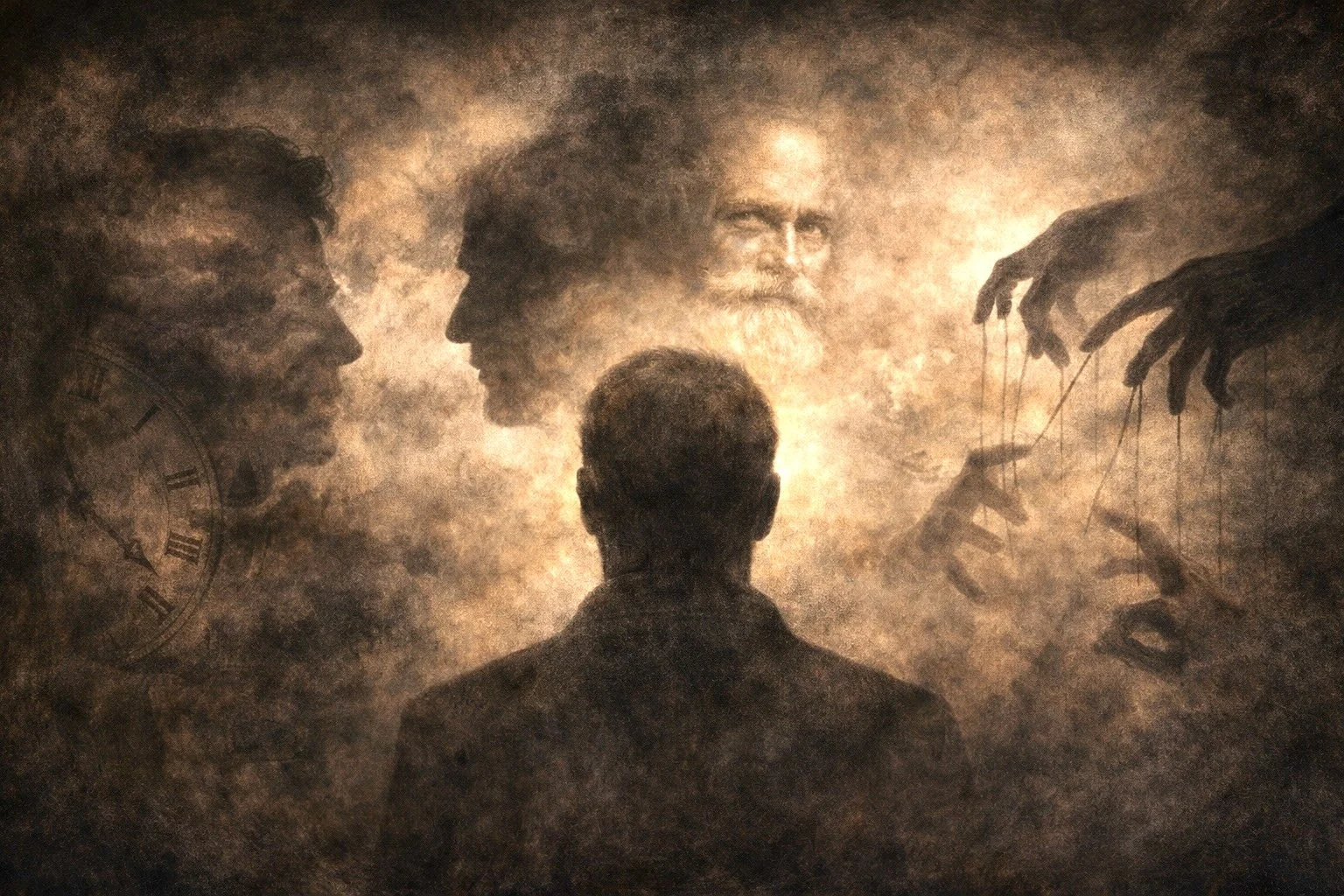
Motive and Self-Deception
How ideas from great thinkers shape Owain Morgan’s understanding of human behaviour.
The lesser-known influences behind Owain Morgan
In developing the character of Owain Morgan, I wanted his intellect to emerge from the intellectual world of his time, rather than to feel imposed upon it.
He is not an invention placed into history, but a figure shaped by it.
An academic educated at Oxford and later in Edinburgh, he would naturally have encountered many of the ideas that were beginning to reshape the study of the human mind in the late nineteenth century. He would have read widely, not as a specialist confined to a single discipline, but as a thinker moving across philosophy, psychology, and moral inquiry.
What interested me was not simply what he might have read, but what he would have done with it.
Ideas, after all, are rarely absorbed unchanged. They are tested, adapted, and, over time, made personal. In that sense, Owain’s method is not borrowed. It is formed.
He draws on well-known figures such as William James, but also on thinkers who are less frequently read today, yet whose influence runs quietly beneath much of modern thought.
It is at that point, where historical ideas are internalised and reshaped, that the fictional and the factual begin to meet.
What connects these influences is a shared concern with what lies beneath outward behaviour. Not simply what is said, but the motive from which it arises.
Beneath the Surface
One of the most important of these influences is Henry Sidgwick (1838–1900).
Writing in the late nineteenth century, Sidgwick was concerned with the problem of moral reasoning. How we justify our actions to ourselves, and how easily that process can become distorted.
He was particularly interested in self-deception. Not the deliberate lie, but the quieter process by which we come to believe our own explanations. We shape our account of events in a way that allows us to feel justified in what we have already, often unconsciously, decided to do.
This insight sits close to Owain’s way of thinking. For him, the explanation offered is rarely the starting point. It is something that follows.
The Evidence of Behaviour
George Henry Lewes (1817–1878) approached the mind from a different direction.
Rather than focusing on abstract reasoning, he argued that mental life could be understood through observation. Not by asking what a person claims to think, but by attending to what they do.
In this sense, hesitation, omission, and pause are not empty moments. They are actions. Small, often unnoticed, but revealing. Traces of a thought process that has not fully resolved itself, or that is being quietly redirected.
Owain’s attention to silence owes much to this way of seeing.
Habit and the Shape of Action
Alexander Bain (1818–1903) extended this line of thought further.
He was interested in habit and repetition. The idea that patterns of behaviour reveal more about a person than any single statement.
What we do repeatedly acquires a kind of consistency that is difficult to disguise. Not because it is consciously chosen each time, but because it reflects something more deeply established. A tendency, a disposition, a way of responding to the world.
For Owain, this becomes an important principle. A single statement may be constructed. A pattern, sustained over time, is harder to control.
Contradiction and Truth
F. H. Bradley (1846–1924) approached the problem from yet another angle.
His concern was with contradiction. The points at which a system of thought begins to break down under its own weight.
For Bradley, contradiction revealed the limits of what we take to be reality.
Owain does not follow him into his broader metaphysical conclusions. But he recognises something important in the observation itself. When an account contains contradiction, it is rarely accidental. It marks a point of strain. A place where what is being said can no longer fully accommodate what is known, felt, or remembered. In that moment, something closer to the truth begins to surface.
The Psychology of Motive
Taken together, these ideas begin to form a coherent approach.
For Owain, understanding a person is not a matter of collecting statements. It is a matter of tracing the movement by which thought becomes action.
Memory, emotion, conscience, habit, and circumstance all play a part. What results is rarely simple, and rarely fully conscious. But it is not arbitrary because people act for reasons. They are simply not always aware of what those reasons are.
What This Means
In the world of the novels, this way of thinking shapes how Owain approaches both his academic work and his occasional involvement in investigation.
He is less interested in what can be demonstrated immediately, and more in what can be understood over time. Not the surface of an action, but the structure beneath it. Because it is there, in the tension between what is said and what is meant, that the deeper truth most often lies.
From the research behind The Silence of the White Shadow.