
Machiavelli: The Original Spin Doctor
After the serene logic of Aquinas, we now tumble headfirst into the smoky backrooms of Renaissance politics, where halos are optional, daggers are decorative, and truth is whatever gets you through the day.
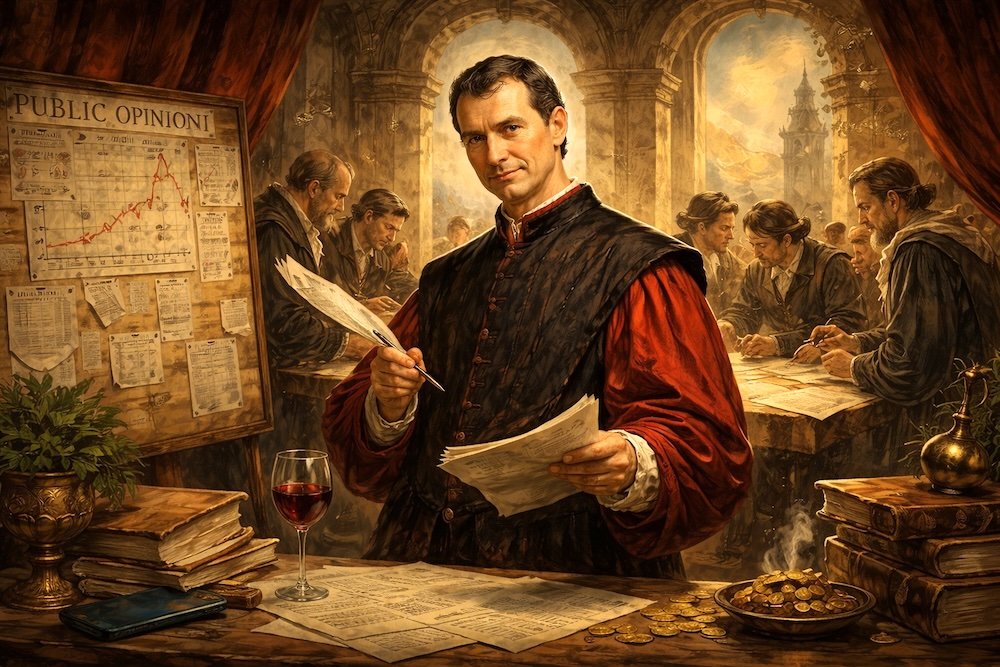
Niccolò Machiavelli was the man who taught politics to stop pretending it had morals. The original spin doctor, he replaced divine right with human cunning and turned survival into an art form.
The Big Idea
Forget virtue. Power works better.
Machiavelli believed that politics wasn’t about being good. It was about being effective. The ruler’s first duty was to survive. And if that meant lying, bribing, flattering, or occasionally having your enemies ‘disappear’, so be it.
The shocking part isn’t that he said it. It’s that he said it out loud. And that feels uncomfortably familiar in the politics of the twenty-first century.
For centuries, moralists had treated politics as an offshoot of philosophy. Government was ethics in action. Machiavelli cheerfully threw that idea out of the nearest palace window.
To him, politics was a human game. Messy, pragmatic, and indifferent to virtue. The only real sin was losing. Winning was everything.
The Man and the Moment
Machiavelli was born in 1469 in Florence, a city that made Westminster look like a Quaker meeting. Florence was the beating heart of the Renaissance. Beautiful, brilliant, and utterly corrupt.
Power changed hands with the seasons. Anyone with ambition needed good friends, better timing, and a sturdy hiding place.
He came of age under the Medici, Florence’s ruling dynasty of bankers, patrons, and part-time despots. When they were overthrown, Machiavelli found himself serving the new republican government as a diplomat and civil servant. He was good at it. Quick, shrewd, and sharply observant, he wrote dispatches from across Europe that still read like first-rate political journalism.
Then, inevitably, the Medici returned to power.
Machiavelli, loyal to the wrong regime, was arrested, tortured, and exiled. It was the Renaissance equivalent of being cancelled, only with actual thumbscrews and a rack to help you achieve that extra height you’d always wished for.
He retreated to a small farm outside Florence, where he wrote letters, drank far too much wine, and composed The Prince, the short book that would make his name synonymous with political cynicism.
Why It Mattered
The Prince is not so much a manual for tyranny as a brutally honest description of how power actually works. It’s about perception, manipulation, and control. About doing what’s necessary rather than what’s admirable.
Machiavelli argued that a ruler must learn how not to be good. That cruelty, used swiftly and decisively, could be kinder than prolonged weakness.
‘It is better to be feared than loved,’ he wrote, though ideally, a ruler would manage both.
The key word is realism. Machiavelli looked at human nature and found it mostly self-interested, occasionally noble, and often absurd. He believed politics should be built on what people are, not what they ought to be.
That made him sound cynical. In truth, he was simply honest. He didn’t invent political manipulation. He just described it without flinching.
Every generation that reads him feels the same mixture of outrage and recognition.
He also wrote comedies, poems, and plays, which is probably how he stayed sane. You can almost imagine him chuckling as he drafted passages on loyalty and betrayal, fully aware that both were temporary arrangements. In that sense, he may have been the first political realist with a sense of humour.
The Legacy
Few thinkers have had their names turned into adjectives, and none less gratefully. ‘Machiavellian’ now means cunning, deceitful, and unscrupulous. Not quite what he intended, though he’d probably have appreciated the irony.
His reputation was sealed when the Church banned The Prince. Popes, it turns out, don’t enjoy being reminded that they’re politicians. Publicly, they claim to serve a higher authority. The historical record suggests a more complicated arrangement.
Over time, his ideas seeped everywhere. Into diplomacy, military strategy, management theory, and modern politics. From the Borgias to the boardroom, Machiavelli’s ghost has been whispering for five hundred years.
Shakespeare read him. Elizabeth I practised him. Most modern politicians quote him, usually while pretending not to.
Even the idea of political ‘spin’ owes him a quiet debt.
He showed that politics isn’t about morality. It’s about stability, persuasion, and survival. You can almost see him now, watching rolling news and murmuring, ‘I did warn you.’
In Our Time
If Machiavelli were alive today, he’d be in public relations, running a think tank, or advising governments ‘off the record’. He’d be that suspiciously well-informed guest on Question Time who says what everyone else is thinking but isn’t meant to say out loud.
He’d be fascinated by social media, a tool of power so efficient it practically governs itself. ‘Control the narrative,’ he’d say, ‘and you control the people.’ The algorithms would delight him.
He wouldn’t despair at modern politics. He’d admire the performance. The way openness is proclaimed while secrecy deepens. The confidence with which contradictions are delivered.
He’d prefer subtlety. A quiet alliance here. A strategic silence there. Real manipulation, he’d insist, is an art form.
In an age of blunt populism, he’d be the master of nuance. The one smiling politely while a policy slipped through unnoticed.
And when accused of cynicism, he’d simply shrug and say, ‘I’m not cynical. I’m Italian.’
Key Works
The Prince (1513, published 1532). The book that launched a thousand political careers, and ended a few. Short, sharp, and still disturbingly relevant.
Discourses on Livy (c. 1517). Machiavelli’s more republican side. A thoughtful exploration of how to build a state that lasts.
The Art of War (1521). A treatise on military strategy, proving that in Renaissance Italy, you could never have too many contingency plans.
The Mandrake (1524). A wickedly funny play about lust, deceit, and human folly. Think Yes, Minister with tunics.
The Essence
‘It is better to be feared than loved, if you cannot be both.’ — The Prince
Honesty may be the best policy. Just not, apparently, in politics.
Next up is Thomas Hobbes, who took Machiavelli’s realism and gave it a philosophical upgrade. Like The Prince, but with thunder, Leviathans, and a much darker view of human nature.