
Thomas Hobbes: The Philosopher of Fear
If Machiavelli gave politics its grin, Hobbes gave it a frown and then locked the door for everyone’s safety.
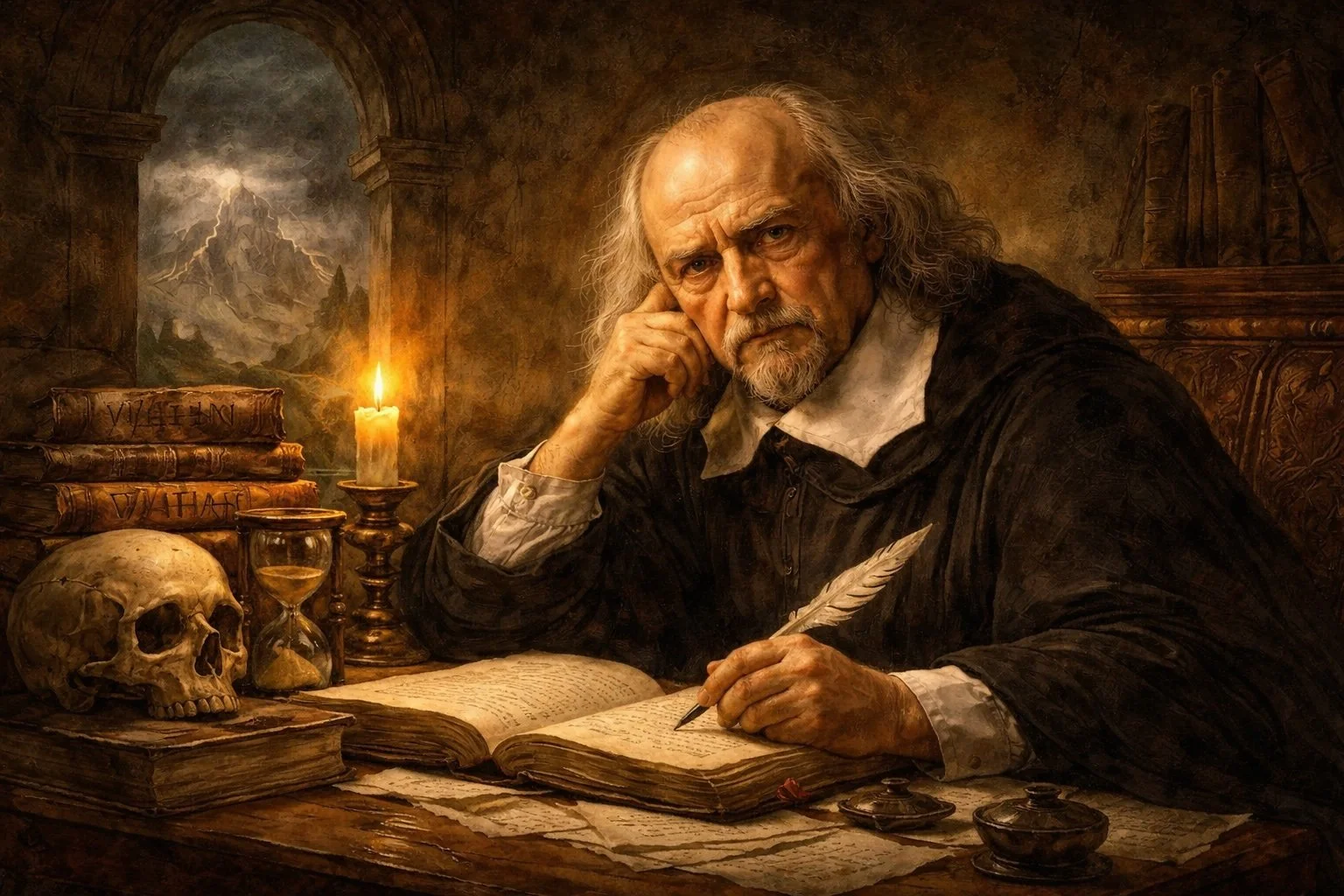
The Big Idea
Humans are a danger to themselves.
Left unchecked, we fight, cheat, we fight, cheat, panic, and compete. Society only works when someone strong enough to scare us into behaving is in charge.
That, in essence, was Hobbes’s argument. He didn’t think people were evil, just hopelessly self-interested. Without laws and authority, he said, life would collapse into chaos, ‘solitary, poor, nasty, brutish, and short.’
Civilisation, he believed, depended on a simple bargain. We surrender some freedom in exchange for safety. The state, his famous Leviathan, was our big, collective bodyguard.
It was less a moral vision than a survival plan for mankind — or, as we’d say today, humankind.
The Man and the Moment
Thomas Hobbes was born in 1588, the year of the Spanish Armada. His mother supposedly went into labour early after hearing England might be invaded. ‘Fear and I were born twins,’ he later wrote.
That line sums him up perfectly. Fear was both his subject and his shadow.
He grew up during one of the most turbulent centuries in English history. Civil war, religious conflict, and public executions were regular entertainment.
Kings were beheaded, prophets sprang up like weeds, and everyone thought God was on their side.
Hobbes, who preferred facts to faith, thought the whole country had gone slightly mad. He wasn’t wrong.
He studied at Oxford between 1603 and 1608, at Magdalen Hall, now part of Hertford College. The curriculum was dominated by Scholastic philosophy and classical languages. Aristotle, logic, Latin, theology, with a dash of geometry for good measure.
Hobbes hated it.
He later described his education as dry and useless, too focused on debating angels on pinheads and not nearly enough on the real world. In classic Hobbesian fashion, he ignored much of the syllabus and taught himself mathematics, physics, and political theory, all considered faintly dangerous subjects at the time.
He travelled widely across Europe and met some of the sharpest minds of his age, including Galileo. Science thrilled him. Its laws of motion made sense. To Hobbes, people were much the same. Bodies in motion, colliding desires, held together only by fear and necessity.
Then came the English Civil War.
Hobbes watched neighbours turn on one another and decided that liberty was overrated. He fled to France, convinced that whichever side won would kill him for the wrong reasons. Out of that fear came his greatest work.
Why It Mattered
When Hobbes published Leviathan in 1651, it shocked almost everyone. The title came from a monstrous sea creature in the Bible, but for Hobbes it symbolised the state. Vast, powerful, and slightly terrifying, but preferable to anarchy.
His argument was simple enough to unsettle both royalists and republicans. Without government, life descends into a war of all against all. Therefore, society requires a sovereign strong enough to keep order, not because he is holy, but because he is useful.
That was revolutionary.
Hobbes stripped politics of theology. Power, he said, doesn’t come from God. It comes from a social contract among frightened people. The ruler isn’t divinely appointed. He’s hired.
The Church hated him. Republicans thought he sounded like a tyrant. Even his friends found him alarming.
But Hobbes wasn’t celebrating cruelty. He was describing the world as he saw it. Peace, even under an absolute ruler, was better than chaos in the name of freedom.
He was the philosopher of damage control.
And for all his bleakness, his view of humanity was oddly compassionate. If people are selfish, fearful, and quick to fight, then systems, not sermons, are what keep us civil.
The Legacy
Hobbes laid the foundations of modern political philosophy. Almost everyone who followed him argued against him. Locke, Rousseau, even Marx all defined their ideas by first wrestling with Hobbes.
He showed that government wasn’t divine theatre but a human invention designed to stop us eating each other. In doing so, he made philosophy brutally practical.
His influence runs deep. The idea of the social contract became the backbone of Western political thought. Even when we reject his conclusions, we’re still playing on the field he marked out.
He also anticipated psychology, game theory, and economics, all built on the assumption that humans act from self-interest and respond to incentives. Hobbes just expressed it with more thunder.
He lived to the age of ninety-one, remarkable in a century when average life expectancy was around forty, and all the more so given that he spent much of his life expecting disaster. In old age, he translated Homer, wrote an autobiography in Latin verse, and complained that philosophers were misreading him.
He died in 1679, reportedly telling his doctor, ‘I am about to take my last voyage, a great leap in the dark.’ Even then, he refused consolation.
In Our Time
Hobbes would feel uncomfortably at home today. The world he described runs on fear, and we’ve only upgraded the technology.
He’d see social media as a digital state of nature. Millions of people shouting, accusing, and competing for dominance. A war of all against all, but with better Wi-Fi.
He’d look at the rise of ‘strong leaders’ and nod knowingly. The trade-off between freedom and security was his entire thesis. People, he’d remind us, surrender liberty the moment they feel threatened.
He might even admire the efficiency of modern surveillance states. In Hobbesian terms, the camera and the algorithm are the new Leviathans. Watchful, powerful, and tolerated because they promise protection.
But he’d also see the danger. When rulers begin to act as if they are the state, the contract collapses. The Leviathan grows bloated, and the people forget they created it.
And he’d laugh at our contradictions. We demand free speech and panic when it’s used. We insist on liberty but recoil when no one’s in charge. Hobbes would sip his coffee, mutter something about human inconsistency, and scroll on.
His realism feels disturbingly modern. Anxious, divided, hyperconnected, and permanently on edge. He might even have thrived on TikTok, explaining in sixty seconds why democracy only works when everyone is slightly afraid.
Key Works
Leviathan (1651). Hobbes’s masterpiece. A vast, unsettling exploration of human nature, power, and authority.
De Cive (1642). A rehearsal for Leviathan, focusing on citizenship and obedience.
Behemoth (written 1668, published posthumously). Hobbes’s account of the English Civil War. Essentially: ‘I warned you.’
The Essence
‘During the time men live without a common power to keep them all in awe, they are in that condition which is called war.’ — Leviathan
Freedom, Hobbes reminds us, is precious. But without order, it doesn’t last long.
Next up is Rene Descartes, the man who gave us the biggest headache of all time.